INDIA ARRESTS MAN WHO THREATENED HUNGER STRIKE

Anna-Hazare arrested
This blog provides a meditation on the Episcopal daily readings along with a headline from world news
2 Samuel 18:9-18
9 Absalom happened to meet the servants of David. Absalom was riding on his mule, and the mule went under the thick branches of a great oak. His head caught fast in the oak, and he was left hanging between heaven and earth, while the mule that was under him went on. 10A man saw it, and told Joab, ‘I saw Absalom hanging in an oak.’ 11Joab said to the man who told him, ‘What, you saw him! Why then did you not strike him there to the ground? I would have been glad to give you ten pieces of silver and a belt.’ 12But the man said to Joab, ‘Even if I felt in my hand the weight of a thousand pieces of silver, I would not raise my hand against the king’s son; for in our hearing the king commanded you and Abishai and Ittai, saying: For my sake protect the young man Absalom! 13On the other hand, if I had dealt treacherously against his life (and there is nothing hidden from the king), then you yourself would have stood aloof.’ 14Joab said, ‘I will not waste time like this with you.’ He took three spears in his hand, and thrust them into the heart of Absalom, while he was still alive in the oak. 15And ten young men, Joab’s armour-bearers, surrounded Absalom and struck him, and killed him.
16 Then Joab sounded the trumpet, and the troops came back from pursuing Israel, for Joab restrained the troops. 17They took Absalom, threw him into a great pit in the forest, and raised over him a very great heap of stones. Meanwhile all the Israelites fled to their homes. 18Now Absalom in his lifetime had taken and set up for himself a pillar that is in the King’s Valley, for he said, ‘I have no son to keep my name in remembrance’; he called the pillar by his own name. It is called Absalom’s Monument to this day.
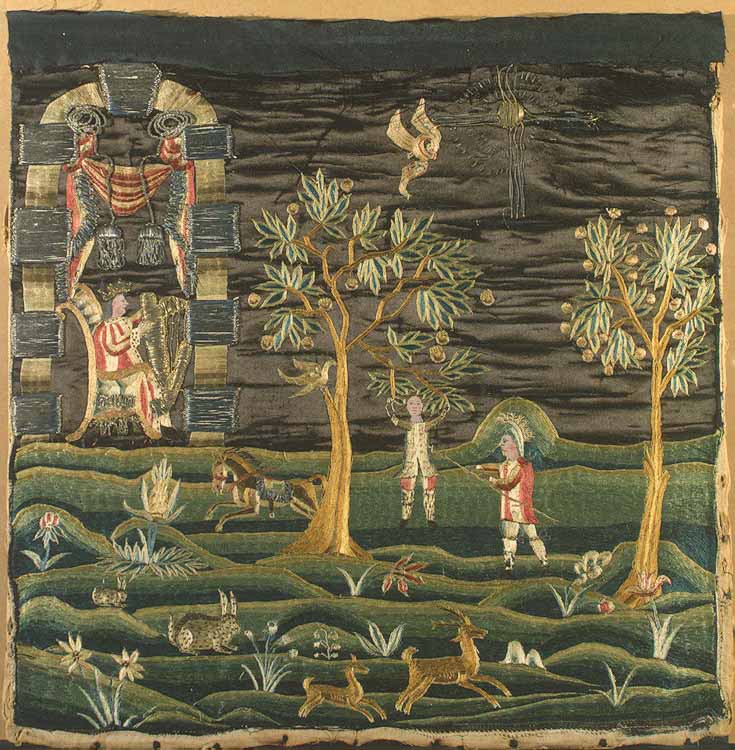
Christian art has little sympathy for Absalom
The dilemma of an ordinary trooper is spelled out vividly: if he’d been prepared to disobey the king, Joab would have blamed Absalom’s death on him. Joab on the other hand knows that kingdoms are not saved by talk or by fathers’ indulgence of their rebellious sons, but by getting rid of the rebel. Men on both sides have risked too much to allow the instigator of war to survive. Joab is clear that this is the only way. The narrator, while offering no criticism of Joab at this point, has already demonstrated that the sons of Zeruiah are thugs whose quick solutions leave problems in their wake. Over the course of the whole narrative the author suggests that there is always a better justice than either personal wilfulness or brutal statecraft. His steady gaze is a model for how we should examine politics today.
Mark 11:27-12:12
27 Again they came to Jerusalem. As he was walking in the temple, the chief priests, the scribes, and the elders came to him 28and said, ‘By what authority are you doing these things? Who gave you this authority to do them?’ 29Jesus said to them, ‘I will ask you one question; answer me, and I will tell you by what authority I do these things. 30Did the baptism of John come from heaven, or was it of human origin? Answer me.’ 31They argued with one another, ‘If we say, “From heaven”, he will say, “Why then did you not believe him?” 32But shall we say, “Of human origin”?’—they were afraid of the crowd, for all regarded John as truly a prophet. 33So they answered Jesus, ‘We do not know.’ And Jesus said to them, ‘Neither will I tell you by what authority I am doing these things.’
12Then he began to speak to them in parables. ‘A man planted a vineyard, put a fence around it, dug a pit for the wine press, and built a watch-tower; then he leased it to tenants and went to another country. 2When the season came, he sent a slave to the tenants to collect from them his share of the produce of the vineyard. 3But they seized him, and beat him, and sent him away empty-handed. 4And again he sent another slave to them; this one they beat over the head and insulted. 5Then he sent another, and that one they killed. And so it was with many others; some they beat, and others they killed. 6He had still one other, a beloved son. Finally he sent him to them, saying, “They will respect my son.” 7But those tenants said to one another, “This is the heir; come, let us kill him, and the inheritance will be ours.” 8So they seized him, killed him, and threw him out of the vineyard. 9What then will the owner of the vineyard do? He will come and destroy the tenants and give the vineyard to others. 10Have you not read this scripture:
“The stone that the builders rejected
has become the cornerstone;
11 this was the Lord’s doing,
and it is amazing in our eyes”?’
12 When they realized that he had told this parable against them, they wanted to arrest him, but they feared the crowd. So they left him and went away.
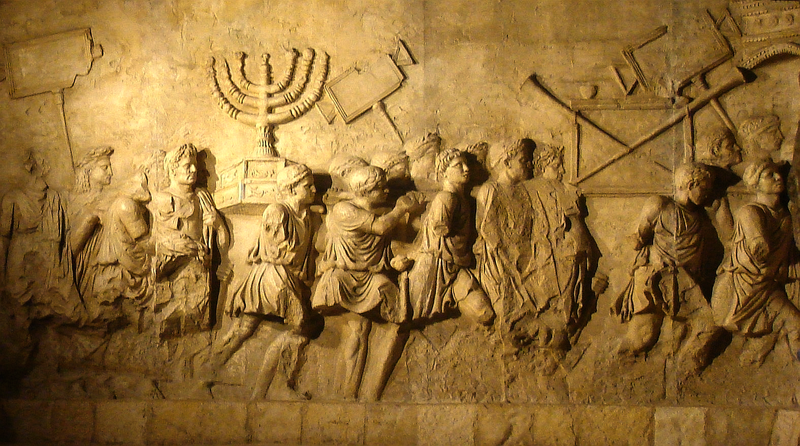
Arch of Titus: Jewish refugees 70CE
Mark depicts Jesus masterfully teaching the people in the temple. This is his father’s house in which he is very much at home, untroubled by the opposition of the religious leaders. His barbed question about John the Baptist turns the tables on his critics and he then takes the offensive wit the parable about the tenants. Jesus is not providing an allegory in which the figure of the landowner stands for God. Absentee landowners were well-known and little loved. Their demands for payment were often threatening. Jesus asks in effect: if an absentee landlord is unlikely to put up with tenants who won’t pay and who abuse his messengers, how much less will God put up with the refusal of his people to give the fruits of obedience?
The rejected stone is Jesus-and-his-people, which in the author’s knowledge includes the gentiles, whom he may also see as the “others” to whom the vineyard will be given. The readiness of the gospel writers to see the destruction of Jerusalem by the Romans in 70CE as God’s punishment for the rejection of Jesus by the Jewish leadership is evident in many passages, including this one, where it has probably led to the addition of the “sending of the son” and his fate. We should ask questions about this kind of theology which has also interpreted AIDS as God’s punishment for homosexuality.
 Emmock's Blog