
 ISRAELI STRIKES BRING NO GOOD NEWS
This blog provides a meditation on the Episcopal daily readings along with aheadline from world news
2 Samuel 18:19-23
19 Then Ahimaaz son of Zadok said, ‘Let me run, and carry tidings to the king that the Lord has delivered him from the power of his enemies.’ 20Joab said to him, ‘You are not to carry tidings today; you may carry tidings another day, but today you shall not do so, because the king’s son is dead.’ 21Then Joab said to a Cushite, ‘Go, tell the king what you have seen.’ The Cushite bowed before Joab, and ran. 22Then Ahimaaz son of Zadok said again to Joab, ‘Come what may, let me also run after the Cushite.’ And Joab said, ‘Why will you run, my son, seeing that you have no reward for the tidings?’ 23‘Come what may,’ he said, ‘I will run.’ So he said to him, ‘Run.’ Then Ahimaaz ran by the way of the Plain, and outran the Cushite.
The young man shows no grasp of the complex nature of the relationship between the king and his rebellious and now dead son. Joab,  wiser and more experienced, hints that he’ll be the bearer of bad news rather than good and that this may be bad for his health. With a sure hand the author increases the reader’s interest in David’s reaction. With a few words, he creates the eager and naïve Ahimaaz.
Mark 12:13-27
13 Then they sent to him some Pharisees and some Herodians to trap him in what he said. 14And they came and said to him, ‘Teacher, we know that you are sincere, and show deference to no one; for you do not regard people with partiality, but teach the way of God in accordance with truth. Is it lawful to pay taxes to the emperor, or not? 15Should we pay them, or should we not?’ But knowing their hypocrisy, he said to them, ‘Why are you putting me to the test? Bring me a denarius and let me see it.’ 16And they brought one. Then he said to them, ‘Whose head is this, and whose title?’ They answered, ‘The emperor’s.’ 17Jesus said to them, ‘Give to the emperor the things that are the emperor’s, and to God the things that are God’s.’ And they were utterly amazed at him.
18 Some Sadducees, who say there is no resurrection, came to him and asked him a question, saying, 19‘Teacher, Moses wrote for us that if a man’s brother dies, leaving a wife but no child, the man shall marry the widow and raise up children for his brother. 20There were seven brothers; the first married and, when he died, left no children; 21and the second married her and died, leaving no children; and the third likewise; 22none of the seven left children. Last of all the woman herself died. 23In the resurrection whose wife will she be? For the seven had married her.’
24 Jesus said to them, ‘Is not this the reason you are wrong, that you know neither the scriptures nor the power of God? 25For when they rise from the dead, they neither marry nor are given in marriage, but are like angels in heaven. 26And as for the dead being raised, have you not read in the book of Moses, in the story about the bush, how God said to him, “I am the God of Abraham, the God of Isaac, and the God of Jacob”? 27He is God not of the dead, but of the living; you are quite wrong.’
Mark recounts Jesus’ mastery of his opponents as they contest with him in the temple area. He demolishes their tax trap by showing that they, like others, actually use the hated coinage; and secondly by contrasting Caesar’s image on the coin, with God’s image on humanity. Human beings belong to God. This is far more than a smart reply, and is certainly not a support for the doctrine of the separation of powers. It clearly puts God before Caesar, but doesn’t thereby deprive Caesar of all authority.
In the second of these discussions, the Sadducees bring Jesus quite a nifty demolition of sentimental beliefs about resurrection, that we will all be reunited with our dear ones as the after-life will reproduce the relationships of this life. They probably thought their parodic story was good ammunition for public debate. Again Jesus copes with ease. The resurrection is not a reproduction of this life but its transformation. Then he delivers his thunderbolt: the very self-designation of God, the I AM, is linked to “I AM the God of Abraham , Isaac and Jacob.” If the livingness of God embraces these patriarchs, how can they be dead? This reply defeats the traditionalists out of their own tradition, indeed from the heart of it. God is overwhelmingly the God of life, in Jesus’ reaching and practice.
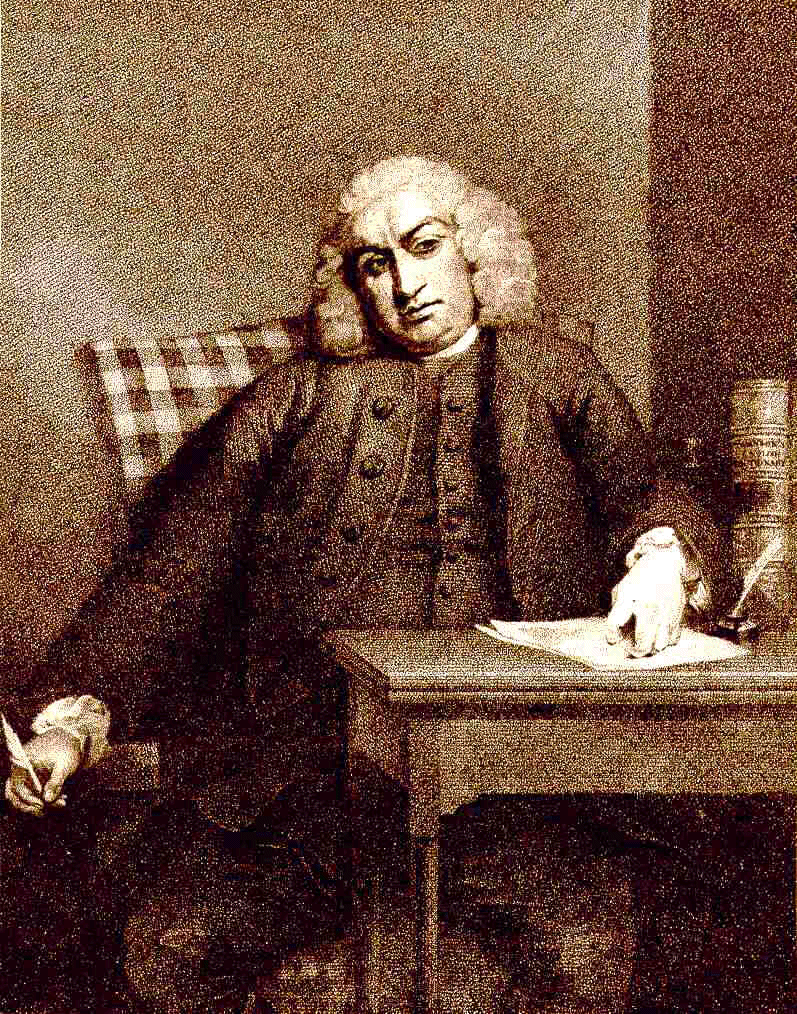
Dr. Samuel Johnson
Mark gives the reader these and other examples of Jesus’ spontaneous profundity and wit-characteristics which would have delighted Samuel Johnson whom the church remembers today, although of course Johnson’s piety would have prevented him seeing these qualities in Jesus. His work and character are dear to me as combining considerable pessimism with great faith:
“Surely there is no man who, thus afflicted, does not seek succour in the gospel, which has brought life and immortality to light. The precepts of Epicurus, who teaches us to endure what the laws of the universe make necessary, may silence but not content us. The dictates of Zeno, who commands us to look with indifference on external things, may dispose us to conceal our sorrow, but cannot assuage it. Real alleviation of the loss of friends, and rational tranquillity in the prospect of our own dissolution, can be received only by the promises of Him in whose hands are life and death, and from the assurance of another and better state, in which all tears will be wiped from the eyes, and the whole soul shall be filled with joy. Philosophy may infuse stubbornness, but Religion only can give patience.”
Johnson: Idler #41 (January 27, 1759)
 Emmock's Blog