GORBACHOV REMEMBERS THE COUP OF 1991
This blog provides a meditation on the Episcopal daily readings along with a headline from world news
2 Samuel 19: 1-23
1. It was told Joab, ‘The king is weeping and mourning for Absalom.’ 2So the victory that day was turned into mourning for all the troops; for the troops heard that day, ‘The king is grieving for his son.’ 3The troops stole into the city that day as soldiers steal in who are ashamed when they flee in battle. 4The king covered his face, and the king cried with a loud voice, ‘O my son Absalom, O Absalom, my son, my son!’ 5Then Joab came into the house to the king, and said, ‘Today you have covered with shame the faces of all your officers who have saved your life today, and the lives of your sons and your daughters, and the lives of your wives and your concubines, 6for love of those who hate you and for hatred of those who love you. You have made it clear today that commanders and officers are nothing to you; for I perceive that if Absalom were alive and all of us were dead today, then you would be pleased. 7So go out at once and speak kindly to your servants; for I swear by the Lord, if you do not go, not a man will stay with you this night; and this will be worse for you than any disaster that has come upon you from your youth until now.’ 8Then the king got up and took his seat in the gate. The troops were all told, ‘See, the king is sitting in the gate’; and all the troops came before the king.
Meanwhile, all the Israelites had fled to their homes. 9All the people were disputing throughout all the tribes of Israel, saying, ‘The king delivered us from the hand of our enemies, and saved us from the hand of the Philistines; and now he has fled out of the land because of Absalom. 10But Absalom, whom we anointed over us, is dead in battle. Now therefore why do you say nothing about bringing the king back?’
11 King David sent this message to the priests Zadok and Abiathar, ‘Say to the elders of Judah, “Why should you be the last to bring the king back to his house? The talk of all Israel has come to the king. 12You are my kin, you are my bone and my flesh; why then should you be the last to bring back the king?” 13And say to Amasa, “Are you not my bone and my flesh? So may God do to me, and more, if you are not the commander of my army from now on, in place of Joab.” ’ 14Amasa swayed the hearts of all the people of Judah as one, and they sent word to the king, ‘Return, both you and all your servants.’ 15So the king came back to the Jordan; and Judah came to Gilgal to meet the king and to bring him over the Jordan.
16 Shimei son of Gera, the Benjaminite, from Bahurim, hurried to come down with the people of Judah to meet King David; 17with him were a thousand people from Benjamin. And Ziba, the servant of the house of Saul, with his fifteen sons and his twenty servants, rushed down to the Jordan ahead of the king, 18while the crossing was taking place, to bring over the king’s household, and to do his pleasure.
Shimei son of Gera fell down before the king, as he was about to cross the Jordan, 19and said to the king, ‘May my lord not hold me guilty or remember how your servant did wrong on the day my lord the king left Jerusalem; may the king not bear it in mind. 20For your servant knows that I have sinned; therefore, see, I have come this day, the first of all the house of Joseph to come down to meet my lord the king.’ 21Abishai son of Zeruiah answered, ‘Shall not Shimei be put to death for this, because he cursed the Lord’s anointed?’ 22But David said, ‘What have I to do with you, you sons of Zeruiah, that you should today become an adversary to me? Shall anyone be put to death in Israel this day? For do I not know that I am this day king over Israel?’ 23The king said to Shimei, ‘You shall not die.’ And the king gave him his oath.
This is another extraordinary understanding of relationship between character and politics. The brutal shrewdness of Joab saves David from making too great a spectacle of his private grief for the son who has led a coup against him. Loyalty demands that the King thanks his loyal troops.
David’s customary grace and good sense is evident in his approach to the rebels of Israel, whom he flatters and encourages to trust him, even to the extent of making promises which may be impossible to keep. His feeling for the nature of a political moment and its possibilities is shown in his treatment of the man who cursed him in his misfortune. The picture is of a man terribly grieved yet trying to do the right thing in his dealings with people who have their own aims.
God is not mentioned here but the author has built up a sense of David as God’s person, in and through whose flawed character God’s justice is partly achieved. There is no sentimentality and no religiosity in this account; but it remains a marvellous portrait of the nature of God.
Mark 12:28-34
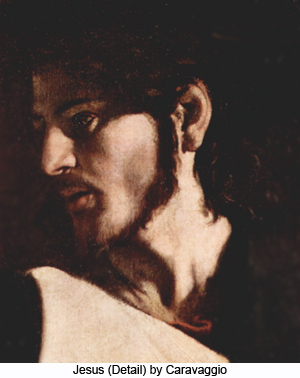
28 One of the scribes came near and heard them disputing with one another, and seeing that he answered them well, he asked him, ‘Which commandment is the first of all?’ 29Jesus answered, ‘The first is, “Hear, O Israel: the Lord our God, the Lord is one; 30you shall love the Lord your God with all your heart, and with all your soul, and with all your mind, and with all your strength.” 31The second is this, “You shall love your neighbour as yourself.” There is no other commandment greater than these.’ 32Then the scribe said to him, ‘You are right, Teacher; you have truly said that “he is one, and besides him there is no other”; 33and “to love him with all the heart, and with all the understanding, and with all the strength”, and “to love one’s neighbour as oneself”,—this is much more important than all whole burnt-offerings and sacrifices.’ 34When Jesus saw that he answered wisely, he said to him, ‘You are not far from the kingdom of God.’ After that no one dared to ask him any question.
The question to Jesus really means, “Are you a Jew and what sort of Jew are you?” It invites Jesus to declare himself publicly as an orthodox Jew and to indicate where he stands in the perpetual Jewish argument between ritual and moral law. Jesus accepts the invitation, indicating that love of God and neighbour are more important than ritual. In our time it’s helpful to emphasise that love of God takes pride of place. The love of the goodness which comes from beyond us is fundamental to our own characters and to our grasp of what constitutes neighbourly love. Reserve, inwardness, fierceness and joy should characterise the expression of our love for God. Worship which is chummy, sentimental, ostentatious and self-regarding is degenerate and does not obey the first commandment.
 Emmock's Blog