
MI5 COOPERATED WITH GADAFI 
This blog provides a meditation on the Episcopal daily readings along with a headline from world news
Philippians 1:1-11
1Paul and Timothy, servants of Christ Jesus,
To all the saints in Christ Jesus who are in Philippi, with the bishops and deacons:
2 Grace to you and peace from God our Father and the Lord Jesus Christ.
3 I thank my God every time I remember you, 4constantly praying with joy in every one of my prayers for all of you, 5because of your sharing in the gospel from the first day until now. 6I am confident of this, that the one who began a good work among you will bring it to completion by the day of Jesus Christ. 7It is right for me to think this way about all of you, because you hold me in your heart, for all of you share in God’s grace with me, both in my imprisonment and in the defence and confirmation of the gospel. 8For God is my witness, how I long for all of you with the compassion of Christ Jesus. 9And this is my prayer, that your love may overflow more and more with knowledge and full insight 10to help you to determine what is best, so that on the day of Christ you may be pure and blameless, 11having produced the harvest of righteousness that comes through Jesus Christ for the glory and praise of God.
-I thank my God….joy…you hold me in your heart….I long for you….that your love may overflow….
Of course this language speaks of personal emotion but it is for Paul rooted in something deeper expressed here by the verb to share-sharing in the gospel….share in God’s grace. Paul sees the Christian life as a shared life. It is fundamentally the life of the ascended Messiah Jesus, shared by his followers as the life of one body. This sharing is very near the heart of Paul’s gospel, so that for him the Philippians “sharing his imprisonment” is not an exaggeration for effect but sober reality in Christ.
The reformation interpretation of Paul as the apostle of individual salvation by faith obscured this central message of Paul’s writing and impoverished the community life of protestant churches, relegating the experience of shared life to smaller denominations, labelled Spiritualist, Anabaptist, Quaker, and the like. I can’t emphasise too much that I’m not talking about any sort of emotionalism: Paul’s words express his and his convert’s emotions, but these are rooted in a sober commitment to the shared life of Christ expressed in the Philippians financial support of Paul and in the “collection” for the poor in Jerusalem. Just as Evil has a shared life (MI5 and Gadafi) so also does Goodness.
By means of this shared life Paul sees the church crossing boundaries of nation and race to establish its koinonia across the oikumene, the inhabited world.
Mark 15:40-47
40 There were also women looking on from a distance; among them were Mary Magdalene, and Mary the mother of James the younger and of Joses, and Salome. 41These used to follow him and provided for him when he was in Galilee; and there were many other women who had come up with him to Jerusalem.
a full stop
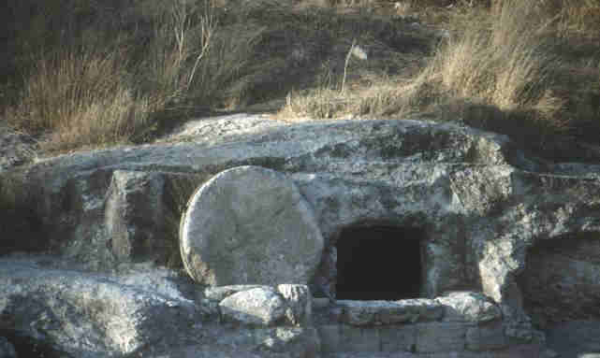
42 When evening had come, and since it was the day of Preparation, that is, the day before the sabbath, 43Joseph of Arimathea, a respected member of the council, who was also himself waiting expectantly for the kingdom of God, went boldly to Pilate and asked for the body of Jesus. 44Then Pilate wondered if he were already dead; and summoning the centurion, he asked him whether he had been dead for some time. 45When he learned from the centurion that he was dead, he granted the body to Joseph. 46Then Joseph bought a linen cloth, and taking down the body, wrapped it in the linen cloth, and laid it in a tomb that had been hewn out of the rock. He then rolled a stone against the door of the tomb. 47Mary Magdalene and Mary the mother of Joses saw where the body was laid.
The gospel records the presence of Jesus female disciples in the absence of the males. This is so far from what might have been expected in such a narrative that it would have scandalised every new generation of Christian believers. The desertion of the men said something shocking about the beginnings of faith: that the expected handing on of the flame from persecuted leader to faithful and sorrowing disciples did not happen. They ran away leaving the women as witnesses and were only rescued by the grace of God in the risen Jesus.
It becomes clear that this faith will not rest on human achievement but on the power of God who raises the dead.
The Gospel therefore takes pains to emphasise that the death of Jesus is a real death involving a real burial. The stone rolled against the mouth of the tomb is a full-stop to the life of Jesus of Nazareth.
 Emmock's Blog