
This blog provides a meditation on the Episcopal daily readings along with a headline from world news:
FEAR OF ISLAM DRIVES SYRIAN CHRISTIANS TOWARDS ASSAD 
1 Corinthians 8:1-13
8Now concerning food sacrificed to idols: we know that ‘all of us possess knowledge.’ Knowledge puffs up, but love builds up. 2Anyone who claims to know something does not yet have the necessary knowledge; 3but anyone who loves God is known by him.
4 Hence, as to the eating of food offered to idols, we know that ‘no idol in the world really exists’, and that ‘there is no God but one.’ 5Indeed, even though there may be so-called gods in heaven or on earth—as in fact there are many gods and many lords— 6yet for us there is one God, the Father, from whom are all things and for whom we exist, and one Lord, Jesus Christ, through whom are all things and through whom we exist.
7 It is not everyone, however, who has this knowledge. Since some have become so accustomed to idols until now, they still think of the food they eat as food offered to an idol; and their conscience, being weak, is defiled. 8‘Food will not bring us close to God.’ We are no worse off if we do not eat, and no better off if we do. 9But take care that this liberty of yours does not somehow become a stumbling-block to the weak. 10For if others see you, who possess knowledge, eating in the temple of an idol, might they not, since their conscience is weak, be encouraged to the point of eating food sacrificed to idols? 11So by your knowledge those weak believers for whom Christ died are destroyed. 12But when you thus sin against members of your family, and wound their conscience when it is weak, you sin against Christ. 13Therefore, if food is a cause of their falling, I will never eat meat, so that I may not cause one of them to fall
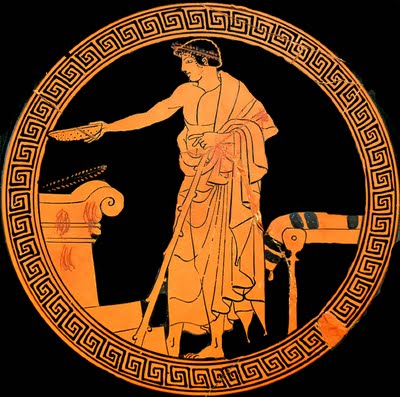
Greek offering to Gods
Paul is dealing with a group of “knowledgeable” Christians who know that food offered to idols can’t be sinful because idols have no substantial reality. Yes, Paul says, quoting them “we all have knowledge” and knowledge puffs up while love builds up. Perhaps there are brothers and sisters who shun such food because although they have faith in God idols are still real for them. Nobody should eat such food, Paul says, if it constitutes a temptation for them; and nobody should “show off” in front of those who are tempted.
Paul’s profound common sense is active in the passage. He has the ability to go the heart of the matter which is to encourage love more than theological smartness.
Recently this passage has been used to argue that those for whom gay clergy are acceptable should hold back from pressing this view out of concern for “weaker brothers and sisters” who think such relationships abominable. The cases are not comparable. Paul is dealing with something which is of no importance in itself (as he says, we are no worse if we eat, nor if we don’t) but becomes important because of the tender consciences of some believers; whereas the church’s attitude to gay clergy profoundly affects those clergy and homosexual people in general. It is a matter of substance. If the church’s condemnation of faithful homesexual relationships has been mistaken (and all the evidence suggests that it has) its first concern should be for those it has slandered and abused rather than those who understandably enough find change difficult.
Matthew 7:13-21
13 ‘Enter through the narrow gate; for the gate is wide and the road is easy that leads to destruction, and there are many who take it. 14For the gate is narrow and the road is hard that leads to life, and there are few who find it.
15 ‘Beware of false prophets, who come to you in sheep’s clothing but inwardly are ravenous wolves. 16You will know them by their fruits. Are grapes gathered from thorns, or figs from thistles? 17In the same way, every good tree bears good fruit, but the bad tree bears bad fruit. 18A good tree cannot bear bad fruit, nor can a bad tree bear good fruit. 19Every tree that does not bear good fruit is cut down and thrown into the fire. 20Thus you will know them by their fruits.
21 ‘Not everyone who says to me, “Lord, Lord”, will enter the kingdom of heaven, but only one who does the will of my Father in heaven. 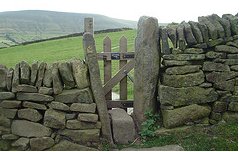
- The gate is narrow but we should remember that Jesus is quoted in John’s gospel as saying “I am the gate”. The entry to God’s rule is “narrow” because it requires self-denial, trust, courage, and love for God and one’s neighbour, that is, it has the character of Jesus and is therefore also broad in its humanity and openness to all. But Jesus is at pains to emphasise that not many will choose it.
- Character is revealed by deeds; and deeds cannot be separated from character. The image of the fruit tree points to the organic relationship between what we are and what we do: good trees don’t produce bad fruit.
- Jesus wants his hearers to know that he is not inaugurating a religion. Emotional gestures have a place in religion but the “Rule of God” is exactly that or nothing: it requires obedience.
 Emmock's Blog