This blog provides a meditation on the Episcopal daily readings along ith aheadline from world news
HAJJ BEGINS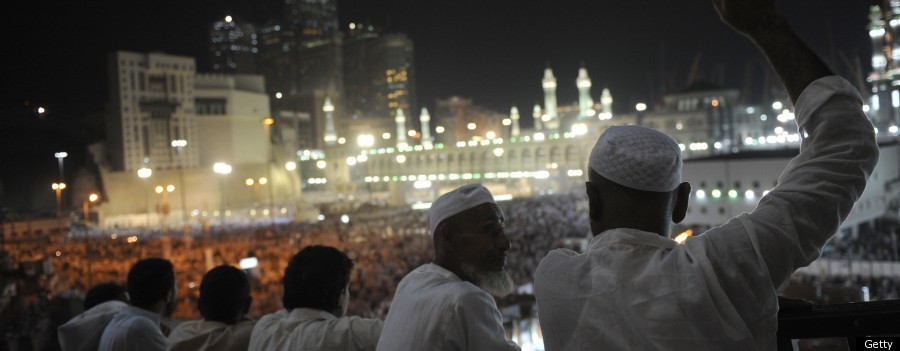
REVELATION 15: 1-8
15Then I saw another portent in heaven, great and amazing: seven angels with seven plagues, which are the last, for with them the wrath of God is ended.
2 And I saw what appeared to be a sea of glass mixed with fire, and those who had conquered the beast and its image and the number of its name standing beside the sea of glass with harps of God in their hands. 3And they sing the song of Moses, the servant of God, and the song of the Lamb:
‘Great and amazing are your deeds,
Lord God the Almighty!
Just and true are your ways,
King of the nations!
4 Lord, who will not fear
and glorify your name?
For you alone are holy.
All nations will come
and worship before you,
for your judgements have been revealed.’
5 After this I looked, and the temple of the tent of witness in heaven was opened, 6and out of the temple came the seven angels with the seven plagues, robed in pure bright linen, with golden sashes across their chests. 7Then one of the four living creatures gave the seven angels seven golden bowls full of the wrath of God, who lives for ever and ever; 8and the temple was filled with smoke from the glory of God and from his power, and no one could enter the temple until the seven plagues of the seven angels were ended.
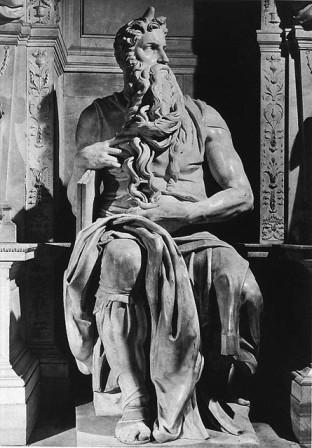
Michelangelo's Moses
I’ll have to tackle the issue of what this author means by the “wrath of God” but I’ll postpone that until the material about the seven plagues. Today I just want to pick up the splendid detail that the saints sing the song of Moses as well as the song of the Lamb (Jesus).
This detail shows that the author is generous towards his ancestors in faith. For hijm the Christian revelation succeeds the Jewish one, but the story of Jewish faith is not abandoned. Moses remains one of the inspirations.
There is a particular point and a general point to be made here. The Christian story issues from the Jewish story and indeed only makes sense if the Jewish scriptures are recognised as part of its revelation. There were people in the early churches who wanted to cut Christianity adrift from its Jewish origins but this was wisely resisted. The more general point is more contentious. I think that the generosity offered to the Jewish revelation can in principle be extended to other religious and philosophical traditions. I don’t mean that we should accept these as “preparation” for the fuller revelation of Christianity, but rather that we should extend to them the goodwill of examining them positively in the light of Christ, noting what is unacceptable from our standpoint and celebrating what is consonant with Christian faith. All of us need conversion, to be turned to the One God, but we do not need to consign all previous convictions to the dustbin. This approach to interfaith relationship, which is both critical and welcoming, seems to me to do justice to the convergences as well as the divergences of different religions and philosophies; and to serve peace.
Matthew 14:13-21
13 Now when Jesus heard this, he withdrew from there in a boat to a deserted place by himself. But when the crowds heard it, they followed him on foot from the towns. 14When he went ashore, he saw a great crowd; and he had compassion for them and cured their sick. 15When it was evening, the disciples came to him and said, ‘This is a deserted place, and the hour is now late; send the crowds away so that they may go into the villages and buy food for themselves.’ 16Jesus said to them, ‘They need not go away; you give them something to eat.’ 17They replied, ‘We have nothing here but five loaves and two fish.’ 18And he said, ‘Bring them here to me.’ 19Then he ordered the crowds to sit down on the grass. Taking the five loaves and the two fish, he looked up to heaven, and blessed and broke the loaves, and gave them to the disciples, and the disciples gave them to the crowds. 20And all ate and were filled; and they took up what was left over of the broken pieces, twelve baskets full. 21And those who ate were about five thousand men, besides women and children.
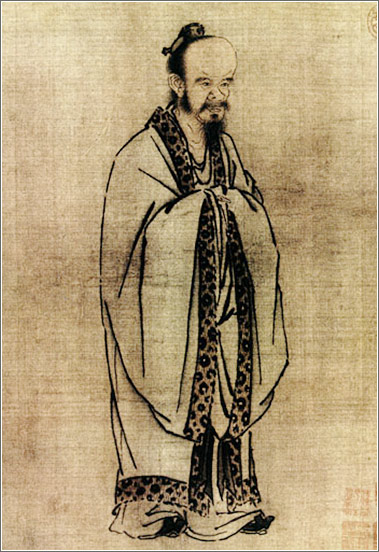
The compassionate Confucius
Matthew places this story after the story of John the Baptist’s murder by Herod. The picture of the ruler who consumes his people is replaced by that of the ruler who shares all he and his servants have so that his people should be fed. Mark in his version of this, emphasises Jesus’ teaching; while Matthew emphasises compassion. Like Moses he enables his people in the desert to be fed by God. As with Moses the number twelve indicates the whole people of God. The goodness of God, which is meant for his people is “blessed and broken”, as Jesus himself will be, and as the bread of his Holy Supper will be. Perhaps we might say that the difference between Jesus and Moses is precisely in the brokenness of the giver, but when we look back at Moses in the light of Christ, we can discern in him also the marks of sacrifice, as we can in the lives of the Buddha and Confucius.
 Emmock's Blog