This blog provides a meditation on the Episcopal daily readings along with a headline from world news:
G20: WORLD ECONOMY ON VERGE OF COLLAPSE 
Revelation 17:1-14
17Then one of the seven angels who had the seven bowls came and said to me, ‘Come, I will show you the judgement of the great whore who is seated on many waters, 2with whom the kings of the earth have committed fornication, and with the wine of whose fornication the inhabitants of the earth have become drunk.’ 3So he carried me away in the spirit into a wilderness, and I saw a woman sitting on a scarlet beast that was full of blasphemous names, and it had seven heads and ten horns. 4The woman was clothed in purple and scarlet, and adorned with gold and jewels and pearls, holding in her hand a golden cup full of abominations and the impurities of her fornication; 5and on her forehead was written a name, a mystery: ‘Babylon the great, mother of whores and of earth’s abominations.’ 6And I saw that the woman was drunk with the blood of the saints and the blood of the witnesses to Jesus.
When I saw her, I was greatly amazed. 7But the angel said to me, ‘Why are you so amazed? I will tell you the mystery of the woman, and of the beast with seven heads and ten horns that carries her. 8The beast that you saw was, and is not, and is about to ascend from the bottomless pit and go to destruction. And the inhabitants of the earth, whose names have not been written in the book of life from the foundation of the world, will be amazed when they see the beast, because it was and is not and is to come.
9 ‘This calls for a mind that has wisdom: the seven heads are seven mountains on which the woman is seated; also, they are seven kings, 10of whom five have fallen, one is living, and the other has not yet come; and when he comes, he must remain for only a little while. 11As for the beast that was and is not, it is an eighth but it belongs to the seven, and it goes to destruction. 12And the ten horns that you saw are ten kings who have not yet received a kingdom, but they are to receive authority as kings for one hour, together with the beast. 13These are united in yielding their power and authority to the beast; 14they will make war on the Lamb, and the Lamb will conquer them, for he is Lord of lords and King of kings, and those with him are called and chosen and faithful.’

Nero and burning Rome
The interpretation of some details is disputed but there is no doubt that the woman called Babylon the Great is what we would call the “culture” of the Roman Empire The Beast is the Satanic power of the Empire which resources its rulers and manifests itself as living parody of the One God, who was and is and is to come. The sexual imagery associated with the woman must be interpreted as referring to gross religious and economic “affairs”, the many religious cults of the Empire and the unjust wealth enjoyed by its servants.
The seven kings are the emperors of Rome ending with Nero who was, (he ruled) and is not (he’s dead) and is to come (legend said he would return to destroy Rome) In that sense he’s like an eighth emperor. This detail shows that the vision is about the politics of the Empire, and not about a never-never land of otherworldly events.
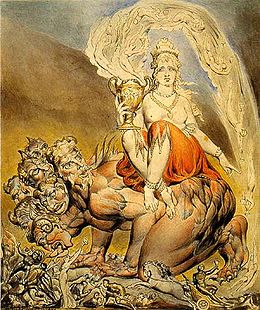
The great Whore: William Blake
A man who has been exiled for his faith “sees” the world empire which has power over him as a brutal and alluring entity (a beast and a woman) which makes war on all who belong to the Lamb but will suffer defeat. There’s no doubt that the imagery of such passages has appealed to violent religious crazies of all centuries. It must therefore be rigorously interpreted as an exposition of the power of the crucified-and-risen Jesus and his powerless people. All the violent images, the bowls of wrath, the plagues, the lake of fire, are pictures of what evil does to itself in its hatred of the crucified Jesus. The turbulent images portray the destructive effects of evil and the dynamism of suffering love.
Matthew 14:22-36
22 Immediately he made the disciples get into the boat and go on ahead to the other side, while he dismissed the crowds. 23And after he had dismissed the crowds, he went up the mountain by himself to pray. When evening came, he was there alone, 24but by this time the boat, battered by the waves, was far from the land, for the wind was against them. 25And early in the morning he came walking towards them on the lake. 26But when the disciples saw him walking on the lake, they were terrified, saying, ‘It is a ghost!’ And they cried out in fear. 27But immediately Jesus spoke to them and said, ‘Take heart, it is I; do not be afraid.’
28 Peter answered him, ‘Lord, if it is you, command me to come to you on the water.’ 29He said, ‘Come.’ So Peter got out of the boat, started walking on the water, and came towards Jesus. 30But when he noticed the strong wind, he became frightened, and beginning to sink, he cried out, ‘Lord, save me!’ 31Jesus immediately reached out his hand and caught him, saying to him, ‘You of little faith, why did you doubt?’ 32When they got into the boat, the wind ceased. 33And those in the boat worshipped him, saying, ‘Truly you are the Son of God.’ 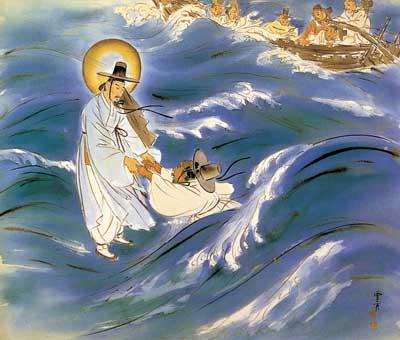
34 When they had crossed over, they came to land at Gennesaret. 35After the people of that place recognized him, they sent word throughout the region and brought all who were sick to him, 36and begged him that they might touch even the fringe of his cloak; and all who touched it were healed.
In this narrative an actual crossing of the lake has become a symbolic account of the death and resurrection of Jesus, Peter’s weakness and the Mission to Gentiles. Jesus and the disciples are going to the other side (into Gentile territory). Jesus is not in the boat, he is praying(Gethsemane?), He is absent (He’s dead). Early in the morning (Mark 16) he comes to them walking on the water (treading on the element of death) terrifying them. Peter is bold enough to ask to walk on water also (to share the danger of Jesus’ way) but he lacks the trust to do so, and has to be rescued by Jesus. When Jesus gets into the boat (when the risen Lord is with his people) the storm ceases. He is worshipped as the Son of God. After this dream sequence, Matthew tells us soberly that Jesus’ compassion attracts the sick and needy Gentiles, who recognise him. The living Lord who suffers and dies, knows and can heal the suffering of Gentiles as well as Jews. Mathew’s mastery of this sort of narrative can be appreciated when you realise how much better the original is, compared with my paraphrase.
 Emmock's Blog