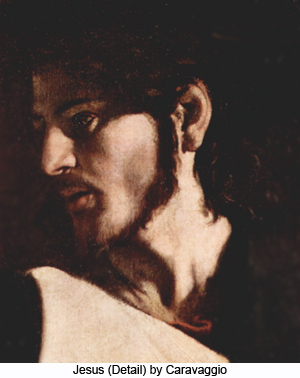
This blog provides a meditation on the Episcopal daily readings along with a headline from world news:
VANUNU STILL SUFFERS FOR TRUTH ABOUT ISRAELI NUKES
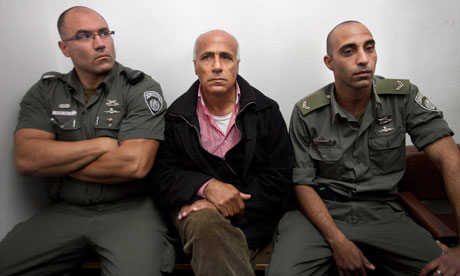
Vanunu and guards
Revelation 19:11-16
11 Then I saw heaven opened, and there was a white horse! Its rider is called Faithful and True, and in righteousness he judges and makes war. 12His eyes are like a flame of fire, and on his head are many diadems; and he has a name inscribed that no one knows but himself. 13He is clothed in a robe dipped in blood, and his name is called The Word of God. 14And the armies of heaven, wearing fine linen, white and pure, were following him on white horses. 15From his mouth comes a sharp sword with which to strike down the nations, and he will rule them with a rod of iron; he will tread the wine press of the fury of the wrath of God the Almighty. 16On his robe and on his thigh he has a name inscribed, ‘King of kings and Lord of lords’.
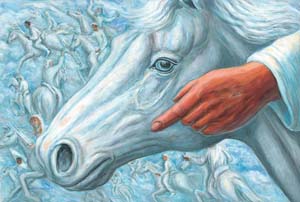
wounded hand guides the white horse
The clues to the meaning of this passage are in the “sharp sword” and the “wine press”. The sword represents the sharpness of God’s word and the wine press is used in the New Testament as a symbol of Christ’s crucifixion (“I have trodden the winepress alone”) The rider is Christ and he conquers by his truth and suffering love, as he always has done. The method of battle does not change, but in the end-time his victory-and that of his followers- will no longer be hidden. They will rule the earth by truth and love. The warlike trappings of the vision are there to represent the devastating power of truth and love which expose evil, and before which even death is abolished.
The great virtue of the Revelation is that its symbolic narrative preserves the reality of the Lamb (the crucified and risen Jesus) at every stage. The Lamb is God’s utter refusal to use the weapons of evil. In the end, as we shall see, evil is destroyed by its own corrosive hatred, the lake of fire.
The reality of Christ as both Lamb and Rider-on-the-white-horse allows those who suffer now for truth and love to believe that they are victorious even as worldly people celebrate their defeat, and may even encourage those who like me, are very reluctant to suffer, to “straighten our feeble knees.”
Matthew 16:13-20
13 Now when Jesus came into the district of Caesarea Philippi, he asked his disciples, ‘Who do people say that the Son of Man is?’ 14And they said, ‘Some say John the Baptist, but others Elijah, and still others Jeremiah or one of the prophets.’ 15He said to them, ‘But who do you say that I am?’ 16Simon Peter answered, ‘You are the Messiah, the Son of the living God.’ 17And Jesus answered him, ‘Blessed are you, Simon son of Jonah! For flesh and blood has not revealed this to you, but my Father in heaven. 18And I tell you, you are Peter, and on this rock I will build my church, and the gates of Hades will not prevail against it. 19I will give you the keys of the kingdom of heaven, and whatever you bind on earth will be bound in heaven, and whatever you loose on earth will be loosed in heaven.’ 20Then he sternly ordered the disciples not to tell anyone that he was the Messiah. 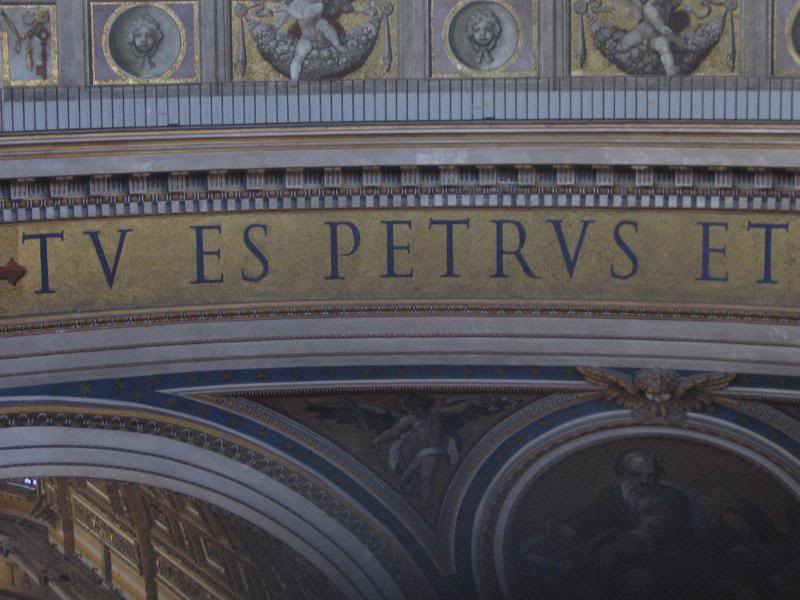
The idiots, who placed the triumphalist caption “Tu es Petrus etc” round the base of the cupola of St. Peter’s in Rome, completely failed to understand the profound irony of Jesus’ words, a twofold irony:
- Jesus knows Peter is more rocky than a rock: he is also the boastful betrayer
- What is revealed is that the “Son of Man” (Obscure Galilean rabbi and followers) is God’s Messiah. Only through utter failure can this figure carry out the Messianic task of bringing God’s justice to the world. Peter doesn’t yet understand this.
Binding and losing refers to the authority to guide the practice of a religious community. God, says Jesus, is happy to put this (Messianic) authority in the hands of the one who will learn humility and courage from his own failure. The keys of the kingdom should be safe in the hands of one who knows he would have been locked out but for the forgiveness of his crucified leader.
As soon as Peter becomes triumphalist he loses his authority.
The truth announced in this story is the same as that of the book of Revelation: the keys of the kingdom belong to the Lamb and the followers of the Lamb.
 Emmock's Blog