
This blog provides a meditation o the Episcopal daily readings along with a headline from world news:
FOREIGN MINISTER: SYRIA UNITED IN KILLING ITS OWN CITIZENS 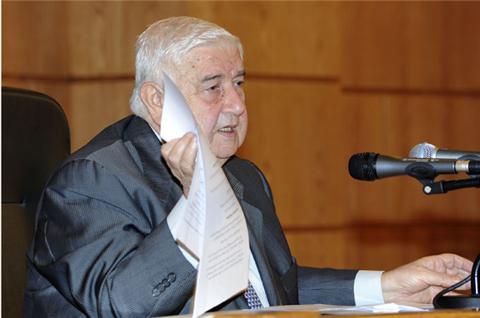
Revelation 20:7-15
7 When the thousand years are ended, Satan will be released from his prison 8and will come out to deceive the nations at the four corners of the earth, Gog and Magog, in order to gather them for battle; they are as numerous as the sands of the sea. 9They marched up over the breadth of the earth and surrounded the camp of the saints and the beloved city. And fire came down from heaven and consumed them. 10And the devil who had deceived them was thrown into the lake of fire and sulphur, where the beast and the false prophet were, and they will be tormented day and night for ever and ever.
11 Then I saw a great white throne and the one who sat on it; the earth and the heaven fled from his presence, and no place was found for them. 12And I saw the dead, great and small, standing before the throne, and books were opened. Also another book was opened, the book of life. And the dead were judged according to their works, as recorded in the books. 13And the sea gave up the dead that were in it, Death and Hades gave up the dead that were in them, and all were judged according to what they had done. 14Then Death and Hades were thrown into the lake of fire. This is the second death, the lake of fire; 15and anyone whose name was not found written in the book of life was thrown into the lake of fire.
Look at how many passive and impersonal verbs are in this passage: “will be released….fire came down…. Devil was thrown etc.” The writer means the reader to understand that although these are the will of God, evil creates its own punishment. For evil, God’s love is like a consuming fire, and its own anger becomes an everlasting torment.
 The book of life contains the names of those who will live in God’s love. How does your name get there? By your “works” is the answer given here. For the writer of Revelation there is no distinction between work and faith. Those who do evil demonstrate their allegiance to idols; those who do good, their trust in the one God. This writer is not noted for subtle ethical distinctions: either you follow the Lamb or the Beast; there’s not much ground in between. I am happy to accept this provided we imagine the dividing line running through individual character rather than simply between people; through me, for example, rather than between me and others.
I like the idea that although I may hold to the true God and do some good, I don’t write my own name in the book of life. It is written by another. For this reason I can pray, “Write my name in the book of life.”
Matthew 17:1-13
17Six days later, Jesus took with him Peter and James and his brother John and led them up a high mountain, by themselves. 2And he was transfigured before them, and his face shone like the sun, and his clothes became dazzling white. 3Suddenly there appeared to them Moses and Elijah, talking with him. 4Then Peter said to Jesus, ‘Lord, it is good for us to be here; if you wish, I will make three dwellings here, one for you, one for Moses, and one for Elijah.’ 5While he was still speaking, suddenly a bright cloud overshadowed them, and from the cloud a voice said, ‘This is my Son, the Beloved; with him I am well pleased; listen to him!’ 6When the disciples heard this, they fell to the ground and were overcome by fear. 7But Jesus came and touched them, saying, ‘Get up and do not be afraid.’ 8And when they looked up, they saw no one except Jesus himself alone.
9 As they were coming down the mountain, Jesus ordered them, ‘Tell no one about the vision until after the Son of Man has been raised from the dead.’ 10And the disciples asked him, ‘Why, then, do the scribes say that Elijah must come first?’ 11He replied, ‘Elijah is indeed coming and will restore all things; 12but I tell you that Elijah has already come, and they did not recognize him, but they did to him whatever they pleased. So also the Son of Man is about to suffer at their hands.’ 13Then the disciples understood that he was speaking to them about John the Baptist. 
The story reads like a fantasia on the Festival of Booths in which Jewish people took to temporary dwellings to remind the of them forty years sojourn in the desert, during which they learned to be, as Hosea says, “the son that God called out of Egypt.” Here Jesus appears in the presence or glory of God with the lawgiver and prophet of Israel.
The booths are rejected as unnecessary because Jesus is revealed as the beloved son of God, who through suffering and death will lead his people into the land of promise. Listening to him is the new way for Jews and Gentiles to become “children of God.”
How does such a story come into being? It seems to me to contain elements of the experience of Jesus’ disciples, from the time of his ministry through the terror of his death and resurrection, into the time of the first Christian communities. It also derives from storytellers telling the story of Jesus’ life and ministry, who used it, as Matthew does, to punctuate the narrative by giving a glimpse of Jesus’ glory prior to their account of his crucifixion. The story of the transfiguration tells the inner truth about Jesus’ fate in a way that factual information is unable to do. It encourages me to be open to the inner truth of other people and even of myself, that as we make our apparently insignificant and sometimes painful ways through life, we shine with the glory of God.
 Emmock's Blog