This blog provides a meditation on the Episcopal daily readings along with a headline from world news:
AI WEIWEI SINGS A SONG AGAINST TYRANNY

ai weiwei mocks Chinese censorship in "hymn"
Revelation 21:1-8
21Then I saw a new heaven and a new earth; for the first heaven and the first earth had passed away, and the sea was no more. 2And I saw the holy city, the new Jerusalem, coming down out of heaven from God, prepared as a bride adorned for her husband. 3And I heard a loud voice from the throne saying,
‘See, the home of God is among mortals.
He will dwell with them;
they will be his people,
and God himself will be with them;
4 he will wipe every tear from their eyes.
Death will be no more;
mourning and crying and pain will be no more,
for the first things have passed away.’
5 And the one who was seated on the throne said, ‘See, I am making all things new.’ Also he said, ‘Write this, for these words are trustworthy and true.’ 6Then he said to me, ‘It is done! I am the Alpha and the Omega, the beginning and the end. To the thirsty I will give water as a gift from the spring of the water of life. 7Those who conquer will inherit these things, and I will be their God and they will be my children. 8But as for the cowardly, the faithless, the polluted, the murderers, the fornicators, the sorcerers, the idolaters, and all liars, their place will be in the lake that burns with fire and sulphur, which is the second death.’ 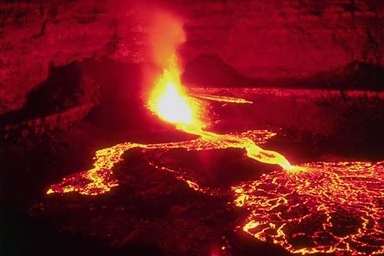
- The vision is of a renewed heaven and earth in which the city of God comes down to earth to be the place where God dwells with his people. Although the first earth is no more, “earth” is not superfluous to God’s kingdom but is the place where God rules.
- Mortal people will share the life of God, becoming immortal.
- The life which God shares with his people is perfect happiness, for all evil is ended and death is no more.
- All the pain and grief that mortal people have suffered is recognised by God and comforted. The image of God as mother wiping tears from the eyes of his children is the most profound in this book and perhaps in the whole Bible.
- This transformation is still happening-“I am making” but it is also already accomplished “It is done. (The words of Jesus on the cross), and will happen in the future, “I will give water from the spring.” The God who was, and is, and is to come encloses all dimensions of his peoples’ lives with love.
- Love means that those who choose evil will not be forced to do otherwise. They will receive the death they’ve chosen. This is the wrath of the Lamb. The Bible respects the God-given ability of human beings to choose evil if they wish. They are punished in mortal life by the consequences of their evil, and if this does not drive them to change, they die because their names are not written in the book of life. Like Julian of Norwich we may believe in this punishment without believing that any have actually been thus punished, but the writer of Revelation thinks he knows who’ll get it.
Of course all this discourse is “mythological”: it speaks of human life in terms of the story of God and humanity told by the Christian Bible. Only a foolish person however would think that it is for that reason unable to tell the truth about human life. The myth enables unspeakable truths to be spoken.
 Matthew 17:14-21
14 When they came to the crowd, a man came to him, knelt before him, 15and said, ‘Lord, have mercy on my son, for he is an epileptic and he suffers terribly; he often falls into the fire and often into the water. 16And I brought him to your disciples, but they could not cure him.’ 17Jesus answered, ‘You faithless and perverse generation, how much longer must I be with you? How much longer must I put up with you? Bring him here to me.’ 18And Jesus rebuked the demon, and it came out of him, and the boy was cured instantly. 19Then the disciples came to Jesus privately and said, ‘Why could we not cast it out?’ 20He said to them, ‘Because of your little faith. For truly I tell you, if you have faith the size of a mustard seed, you will say to this mountain, “Move from here to there”, and it will move; and nothing will be impossible for you.’
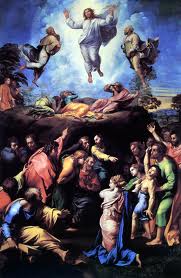
The disciples have been asked to see that the transfiguration of Jesus is not a theophany to be compartmentalised-“the wonderful revelation of Jesus the Son of God-“, but the brute fact of what is taking place in Jesus’ ministry, and especially in his suffering and death. The drama of being the Son of God is his compassionate descent into the disease and evil that afflict human beings, in order to rescue them-“He himself bore our diseases.” This of course also happens in the healing of the epileptic boy. Because the disciples still believe that God puts things right by superman tactics, they don’t know how to heal. In Jesus, the glory of the divine love shines in the midst of suffering which is shared by the Son of God. Rafael in his great painting makes the light spill from the transfigured Jesus on to the face of the epileptic boy in the lower part of his canvas.
When the early church fathers talked about the salvation of Christ in relation to his humanity, they formed the principle, “What is not assumed (taken on) by Christ cannot be healed.” This principle could also stand as a truth about all efforts to care for people: the suffering we do not “share”, we cannot heal.
 Emmock's Blog