This blog provides a meditation on the Episcopal daily readings along with aheadline from world news:
POOR CAMBODIAN COUNTRYPEOPLE PROTEST EXPULSION FOR CHINESE BUSINESS DEVELOPMENT

She offers no violence; she's not even pushing. She opposes the power of Caesar.
Amos 5: 18-24
Alas for those who long for the day of the Lord!
Why long for such a day?
The day of the Lord will be a day of darkness, not a day of light.
It will be like a man running from a lion,
Only to find himself clutched by a bear.
Like a man who runs into his own home,
And as he leans his hand against the wall
Is bitten by a snake.
Is it not true that the day of the Lord
Will be darkness and not light,
Pitch-darkness with no brightening gleam?
God requires inner integrity.
I loathe and despise your festivals;
Your meetings for sacrifice give me no pleasure.
You may bring me your burnt-offerings, your meal- offerings,
Or your thank-offerings of fat cattle,
And I shall not so much as look at them.
Let me have no more of your noisy hymns;
My ears are closed to the music of your harps.
Instead, let justice roll on like a mighty river,
And integrity like a never-failing stream!

a mighy river
Amos is death on those whose religion allows them to long for the “day of the Lord” when God will exercise his judgement (or Christ offer his rapture). For those who think themselves elect of God without obedience to God’s justice, the day will be a nasty surprise. The same is true, Amos indicates, of those who imagine that ritual sacrifice or noisy hymn singing guarantees God’s favour. God hates all that stuff if it’s not accompanied by justice and integrity.
Religious people are easily deceived by snake oil salesmen peddling some saving prescription that costs nothing except their donations. The sad history of vicious, exploitative or simply silly guarantees of salvation should open the ears of believers to Amos, who almost 3000 years ago got it right
“Let justice roll on like a mighty river
And integrity like a never-failing stream!”
Matthew 22:15-22
15 Then the Pharisees went and plotted to entrap him in what he said. 16So they sent their disciples to him, along with the Herodians, saying, ‘Teacher, we know that you are sincere, and teach the way of God in accordance with truth, and show deference to no one; for you do not regard people with partiality. 17Tell us, then, what you think. Is it lawful to pay taxes to the emperor, or not?’ 18But Jesus, aware of their malice, said, ‘Why are you putting me to the test, you hypocrites? 19Show me the coin used for the tax.’ And they brought him a denarius. 20Then he said to them, ‘Whose head is this, and whose title?’ 21They answered, ‘The emperor’s.’ Then he said to them, ‘Give therefore to the emperor the things that are the emperor’s, and to God the things that are God’s.’ 22When they heard this, they were amazed; and they left him and went away. 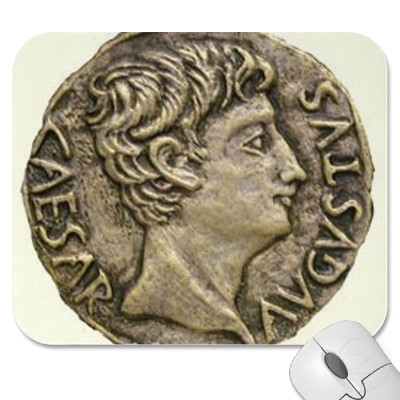
The political implication of the Pharisees’ are clear: in the crowd there would be jihadists who practiced an armed struggle against Roman rule; patriots who disapproved of killing but detested the conqueror; religious leaders who thought that foreigners might contaminate their ritual cleanliness; priests who had come to a “live and let live” accommodation with Rome; collaborators who worked for Romans; and spies of all parties who reported to their paymasters. Most of these justified their position by reference to Torah, God’s Law.
Jesus’ reply is therefore a masterpiece: it says what he thinks without giving anyone an advantage over him. He innocently asks for a coin and is given a Roman denarius which shows that his questioners use the foreign coinage. The Emperor’s image on the coin might well seem blasphemous to many Jews including Jesus, as breaking the first commandment. But still, it’s in circulation, even amongst Pharisees. Jesus advises that this tarnished object bearing the Emperor’s image can be used to pay the taxes he levies. But God, he goes on to say, demands what belongs to him and bears his image, that is, human beings. He reminds his listeners of the divine image they share, and how their very selves belong to God.
There may well be occasions, Jesus implies, when we choose or are forced to obey a political power we have not chosen; but we should always obey God. He doesn’t need to tell us what to do when the one conflicts with the other. Clearly the government of a democratic state is very different from the Roman Emperor. This should make us reluctant to apply Jesus’ maxim to elected governments. Nevertheless, his reminder about our primary allegiance in any political matter, is clear and unambiguous: Give to God the things that are God’s, namely, yourselves.
 Emmock's Blog