This blog provides a meditation on the Episcopal daily readings along with a headline from world news:
MILLIONS OF COLOMBIANS DEMONSTRATE AGAINST VIOLENCE 
Haggai 1:1-15
1In the second year of King Darius, in the sixth month, on the first day of the month, the word of the Lord came by the prophet Haggai to Zerubbabel son of Shealtiel, governor of Judah, and to Joshua son of Jehozadak, the high priest: 2Thus says the Lord of hosts: These people say the time has not yet come to rebuild the Lord’s house. 3Then the word of the Lord came by the prophet Haggai, saying: 4Is it a time for you yourselves to live in your panelled houses, while this house lies in ruins? 5Now therefore, thus says the Lord of hosts: Consider how you have fared. 6You have sown much, and harvested little; you eat, but you never have enough; you drink, but you never have your fill; you clothe yourselves, but no one is warm; and you that earn wages earn wages to put them into a bag with holes.
7 Thus says the Lord of hosts: Consider how you have fared. 8Go up to the hills and bring wood and build the house, so that I may take pleasure in it and be honoured, says the Lord. 9You have looked for much, and, lo, it came to little; and when you brought it home, I blew it away. Why? says the Lord of hosts. Because my house lies in ruins, while all of you hurry off to your own houses. 10Therefore the heavens above you have withheld the dew, and the earth has withheld its produce. 11And I have called for a drought on the land and the hills, on the grain, the new wine, the oil, on what the soil produces, on human beings and animals, and on all their labours.
12 Then Zerubbabel son of Shealtiel, and Joshua son of Jehozadak, the high priest, with all the remnant of the people, obeyed the voice of the Lord their God, and the words of the prophet Haggai, as the Lord their God had sent him; and the people feared the Lord. 13Then Haggai, the messenger of the Lord, spoke to the people with the Lord’s message, saying, I am with you, says the Lord. 14And the Lord stirred up the spirit of Zerubbabel son of Shealtiel, governor of Judah, and the spirit of Joshua son of Jehozadak, the high priest, and the spirit of all the remnant of the people; and they came and worked on the house of the Lord of hosts, their God, 15on the twenty-fourth day of the month, in the sixth month.
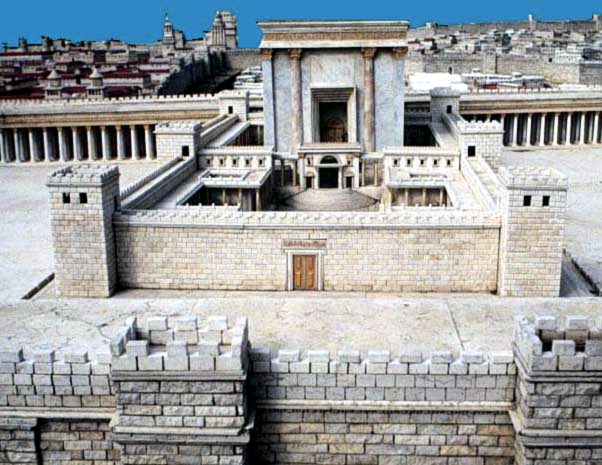
the rebuilt temple
The message is plain: the people of Israel have returned from exile (well, some of them have and others were never away) and have re-established a community of sorts round Jerusalem. They have done well enough, but remain relatively poor. The prophet points to the fact that the Lord’s temple is in ruins. If the people honour their God with a new temple, God will bring them greater prosperity.
I disagree with this message and view at as a way of favouring the symbols of religion more than its substance. For me, the heart of the Jewish faith is its trust in the one invisible God who needs no temple but dwells in the hearts of his people and in the justice with which they maintain their community.
I have to admit, nevertheless, that the visible temple and its worship of God is an important element in the history of Jewish faith. Indeed some would say that the ordered worship of God is the most important element. Haggai’s plea that beauty and richness should be evident in “God’s house” as well as the houses of the people, can be seen as making the worth of God the supreme value in national life. The temple would be a symbol contradicting mere materialism. “The chief end of Man is to glorify God and enjoy Him forever” (Westminster Catechism).
But how does God want to be glorified? The answer of most of the Jewish prophets is summed up by Micah in his famous words, “To do justly, to love mercy, and to walk humbly with your God.” The answer of the New Testament is to trust in Jesus as God’s “dwelling place”, and to follow him.
People of faith will make up their own minds on this one. I remain an unrepentant follower of George Fox the Quaker who annoyed pious folk by calling churches “Steeple –Houses” and deriding their claims to be “Houses of God.”
Matthew 23:27-39
27 ‘Woe to you, scribes and Pharisees, hypocrites! For you are like whitewashed tombs, which on the outside look beautiful, but inside they are full of the bones of the dead and of all kinds of filth. 28So you also on the outside look righteous to others, but inside you are full of hypocrisy and lawlessness.
29 ‘Woe to you, scribes and Pharisees, hypocrites! For you build the tombs of the prophets and decorate the graves of the righteous, 30and you say, “If we had lived in the days of our ancestors, we would not have taken part with them in shedding the blood of the prophets.” 31Thus you testify against yourselves that you are descendants of those who murdered the prophets. 32Fill up, then, the measure of your ancestors. 33You snakes, you brood of vipers! How can you escape being sentenced to hell? 34Therefore I send you prophets, sages, and scribes, some of whom you will kill and crucify, and some you will flog in your synagogues and pursue from town to town, 35so that upon you may come all the righteous blood shed on earth, from the blood of righteous Abel to the blood of Zechariah son of Barachiah, whom you murdered between the sanctuary and the altar. 36Truly I tell you, all this will come upon this generation.
37 ‘Jerusalem, Jerusalem, the city that kills the prophets and stones those who are sent to it! How often have I desired to gather your children together as a hen gathers her brood under her wings, and you were not willing! 38See, your house is left to you, desolate. 39For I tell you, you will not see me again until you say, “Blessed is the one who comes in the name of the Lord.”

how often I have longed to gather you...
It’s hard not to see in this a mingling of the sorrow and anger of Jesus at the hard-heartedness of some Pharisees of his day, with Matthew’s rage at the Pharisees of AD 80-90 who expelled Christian Jews from the synagogues and denounced them as apostates. The “prophets, sages etc” of verse 34 are surely the agents of the Christian mission and belong to Matthew’s time rather than Jesus’s.
Embedded in these later elements is the devastating criticism by Jesus of pharisaical religion as concerned only with outward appearances. His phrase as translated in the KJV has passed into our language: “whited sepulchre” remains a vivid description of respectable hypocrisy. Verses 37-39 may preserve Jesus’ tenderness towards the Holy City of his people, memorably expressed in his image of himself as a mother hen and in his sorrow at its violent traditionalism. He prophesies that the temple will be left desolate: God will be resident elsewhere. Here the two readings for today focus on a common theme, which might be expressed in the words of Solomon’s prayer in the book of Kings, “But will God indeed dwell on earth? Behold, heaven and the heaven of heavens cannot hold you. How much less this House which I have built!”
 Emmock's Blog