This blog provides a meditation on the Episcopal daily readings along with a headline from world news:
PUTIN SHAKEN BY PROTEST NUMBERS 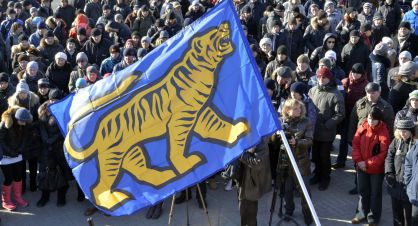
Haggai 2:1-9
2In the second year of King Darius,1in the seventh month, on the twenty-first day of the month, the word of the Lord came by the prophet Haggai, saying: 2Speak now to Zerubbabel son of Shealtiel, governor of Judah, and to Joshua son of Jehozadak, the high priest, and to the remnant of the people, and say, 3Who is left among you that saw this house in its former glory? How does it look to you now? Is it not in your sight as nothing? 4Yet now take courage, O Zerubbabel, says the Lord; take courage, O Joshua, son of Jehozadak, the high priest; take courage, all you people of the land, says the Lord; work, for I am with you, says the Lord of hosts, 5according to the promise that I made you when you came out of Egypt. My spirit abides among you; do not fear. 6For thus says the Lord of hosts: Once again, in a little while, I will shake the heavens and the earth and the sea and the dry land; 7and I will shake all the nations, so that the treasure of all nations shall come, and I will fill this house with splendour, says the Lord of hosts. 8The silver is mine, and the gold is mine, says the Lord of hosts. 9The latter splendour of this house shall be greater than the former, says the Lord of hosts; and in this place I will give prosperity, says the Lord of hosts.

necessary symbol of holy people or distraction?
The prophet “sees” that the place of God’s presence is worth all the treasures of the nations, but perhaps he means God’s dwelling in the lives of those who have welcomed his presence. We may say that the Temple he wants to build is a symbol of the holy people who welcome God. The assurance that God’s spirit is with the people supports this interpretation. Indeed the temple is also a symbol of what is yet to come into existence-a whole earth which recognises its creator. That future will come, according to the prophet, for God will shake all the nations until they acknowledge him. How did Haggai imagine this shaking would take place? He gives no image of it because it is the action of a transcendent God which cannot be measured or depicted. So how does Haggai know about it at all? He knows about through the word which is given him to speak, a word which comes from God through the faith of the prophet and is announced in human language. For this reason we can say that God shakes the world by his word.
This is a conclusion which would have delighted the heart of Karl Barth, the great theologian of the 20th century, who insisted, against all the idolatries of that time, on the primacy of God’s Word Jesus Christ. He guided the Confessing Church in Germany in the 1930’s in opposition to Nazism, and personally sent a copy of the Barmen declaration of his Church, to Adolf Hitler. It emphasised that Christian people should listen only to the Word of God and should obey only Jesus Christ. I believe that God dwells in such people. Whether they need a temple, as Haggai recommends, I don’t know.
Matthew 24:1-14
24As Jesus came out of the temple and was going away, his disciples came to point out to him the buildings of the temple. 2Then he asked them, ‘You see all these, do you not? Truly I tell you, not one stone will be left here upon another; all will be thrown down.’
3 When he was sitting on the Mount of Olives, the disciples came to him privately, saying, ‘Tell us, when will this be, and what will be the sign of your coming and of the end of the age?’ 4Jesus answered them, ‘Beware that no one leads you astray. 5For many will come in my name, saying, “I am the Messiah!” and they will lead many astray. 6And you will hear of wars and rumours of wars; see that you are not alarmed; for this must take place, but the end is not yet. 7For nation will rise against nation, and kingdom against kingdom, and there will be famines and earthquakes in various places: 8all this is but the beginning of the birth pangs.
9 ‘Then they will hand you over to be tortured and will put you to death, and you will be hated by all nations because of my name. 10Then many will fall away, and they will betray one another and hate one another. 11And many false prophets will arise and lead many astray. 12And because of the increase of lawlessness, the love of many will grow cold. 13But anyone who endures to the end will be saved. 14And this good news of the kingdom will be proclaimed throughout the world, as a testimony to all the nations; and then the end will come.
God will not save her if people don't...
Matthew reports Jesus prophesying the destruction of the temple in Jerusalem. It’s difficult to know exactly what Jesus said, because Matthew was writing after the Temple had been destroyed by the Romans in 70 CE and any prophecy could be reworded to fit this event. It seems likely that Jesus caused outrage by stating that the temple was not part of God’s plan for the future. Christian believers were not slow to proclaim Jesus as the foundation of a new temple “not built with hands” or indeed as himself the one in whom “the presence of God dwells fully.”
The “end” of which Jesus speaks is the end of “this present evil age” and the dawning of the “age to come,” in which God’s justice will be revealed. The mixture of idolatry, violence and persecution of the faithful which precedes the new age is characterised by Jesus as its “birth pains”-an image also used by St. Paul in Roman’s chapter 8, “For we know that until now the whole of humanity groans as in the pains of childbirth as we wait for God to make us his children.” The phrase, “anyone who endures to the end will be saved” has always stood out for me, as having the authentic pitilessness of Jesus. Those who trust in Jesus will not be saved from suffering; but through suffering they shall be saved. It’s not an easy word to receive. I would like to be reassured of God’s special care of me and mine amidst the dangers of the world but nothing in the Christian revelation provides this reassurance. Thomas Merton, another 20th century theologian who is remembered along with Barth on this day, struggled as a monk with this contradiction throughout his life, in particular against what he came to see as the unnecessary suffering of monastic discipline. Rosemary Reuther, the feminist theologian, told him in correspondence that disciples of Jesus should not seek artificial sufferings in the safety of monasteries but take the risks of real suffering in the unsafe world. His writings remain an encouragement to honest religion..
 Emmock's Blog