This blog provides a meditation on the Episcopal daily readings along with a headline from world news:
TRIUMPH OF HUMAN INGENUITY:MEXICO CONTRUCTS ROAD BRIDGE OVER 1200 foot CHASM 
GENESIS 2 from v.4
4 These are the generations of the heavens and the earth when they were created.
In the day that the Lord God made the earth and the heavens, 5when no plant of the field was yet in the earth and no herb of the field had yet sprung up—for the Lord God had not caused it to rain upon the earth, and there was no one to till the ground; 6but a stream would rise from the earth, and water the whole face of the ground— 7then the Lord God formed man from the dust of the ground, and breathed into his nostrils the breath of life; and the man became a living being. 8And the Lord God planted a garden inEden, in the east; and there he put the man whom he had formed. 9Out of the ground the Lord God made to grow every tree that is pleasant to the sight and good for food, the tree of life also in the midst of the garden, and the tree of the knowledge of good and evil.
10 A river flows out ofEdento water the garden, and from there it divides and becomes four branches. 11The name of the first is Pishon; it is the one that flows around the wholelandofHavilah, where there is gold; 12and the gold of that land is good; bdellium and onyx stone are there. 13The name of the second river is Gihon; it is the one that flows around the wholelandofCush. 14The name of the third river is Tigris, which flows east ofAssyria. And the fourth river is theEuphrates.
15 The Lord God took the man and put him in the garden of Eden to till it and keep it. 16And the Lord God commanded the man, ‘You may freely eat of every tree of the garden; 17but of the tree of the knowledge of good and evil you shall not eat, for in the day that you eat of it you shall die.’
18 Then the Lord God said, ‘It is not good that the man should be alone; I will make him a helper as his partner.’ 19So out of the ground the Lord God formed every animal of the field and every bird of the air, and brought them to the man to see what he would call them; and whatever the man called each living creature, that was its name. 20The man gave names to all cattle, and to the birds of the air, and to every animal of the field; but for the man there was not found a helper as his partner. 21So the Lord God caused a deep sleep to fall upon the man, and he slept; then he took one of his ribs and closed up its place with flesh. 22And the rib that the Lord God had taken from the man he made into a woman and brought her to the man. 23Then the man said,
‘This at last is bone of my bones
and flesh of my flesh;
this one shall be called Woman,
for out of Man this one was taken.’
24Therefore a man leaves his father and his mother and clings to his wife, and they become one flesh. 25And the man and his wife were both naked, and were not ashamed.
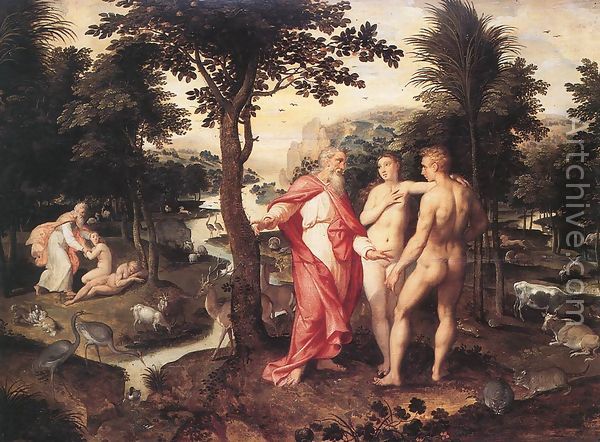
Garden of Eden by De Backer
This is both the earth and not the earth; it is life but not as we know it, Jim. It is the earth and its life imagined by an author who knows that the earth he inhabits and the life human beings live is not as his God had intended. He takes the great risk of describing the earth as it once was/ would have been/ may one day be. To be sure he puts Eden in the past and shows how it became the earth he knew, but that is all part of his theological story which takes place in “the day God created the heavens and the earth”, that is, in a time which runs aslant historical time.
Scholars disagree about the date of this narrative, suggesting that if a version of it was extant as early as the 8th century BCE, its final revisions may have been completed in the 2nd century BCE. This means it’s a profound construct which contains Israel’s best insights into the universe, humanity and their creator.
The universe consists of the heavens and the earth, but the author concentrates on the latter. It is a garden world, with its flora and system of irrigation. This ecosystem is not described in full but the reader is to note its ordered fruitfulness given by God. To this system God adds a human being, who is therefore part of it but not limited by it, and constitutes a danger to it. This danger is symbolised in the divine command that he should not eat the fruit of the tree of the “knowledge of everything” (“Good and evil” means A to Z in this context).
The human being is made of dust and his name means “dust-creature”. His physical nature is composed of the same molecules of which everything else is made but his soul is breathed into him by the creator. This creation story differs from the measured account in Genesis 1 in which human beings are God’s last creative work. Here the animals are made for humanity and named by humanity. This naming is a sign of human authority over the animals. The narrator tells us that although these animals have been made for companionship with the dust-creature, they do not lessen his loneliness. In effect God splits the dust-creature in two, thus making man and woman, who forever after will want to unite in one flesh. Thus the narrator explains gender, sexual desire and marriage by linking these to God’s creation of human beings. 
The Creator God who accomplishes all this is not described other than in his actions and his reflection on it; he goes about his tasks in a orderly way but without any of the grandeur implicit in “And God said, Let there be light and there was light”, or visible in the Sistine Chapel ceiling, but rather with the kind of methodical attention to plan which we might expect of a good landscape gardener, not excluding the ability to re-assess the plan in the light of experience-“It’s not good for the man to be alone…” The Creator gives humanity his own breath of life but tells them that grasping the “knowledge of everything” will mean the breath of life being taken away. Humanity will become mortal so that the seized knowledge cannot put the whole creation at risk. We are forced to ask, if the Creator knew of this danger why did he/she make such a creature and place the knowledge within its reach? (The snake fed the woman/ and the woman fed the man/ and there wouldn’t be an apple/ if it wasn’t in the plan) The reader who knows how the story continues will recognise that the sad history of humanity’s use of knowledge is here made implicit in its origins.
These observations only touch the surface of this astonishing story. Only an idiot could either set it against scientific discovery (both fundamentalists and Richard Dawkins are guilty of this) or fail to appreciate its wisdom.
 Emmock's Blog