This blog provides a meditation on the Episcopal daily readings along with a headline from world news:
IRAN’S FIRST NUCLEAR FUEL ROD 
Genesis 3:1-24
3Now the serpent was more crafty than any other wild animal that the Lord God had made. He said to the woman, ‘Did God say, “You shall not eat from any tree in the garden”?’2The woman said to the serpent, ‘We may eat of the fruit of the trees in the garden;3but God said, “You shall not eat of the fruit of the tree that is in the middle of the garden, nor shall you touch it, or you shall die.” ’4But the serpent said to the woman, ‘You will not die;5for God knows that when you eat of it your eyes will be opened, and you will be like God,* knowing good and evil.’6So when the woman saw that the tree was good for food, and that it was a delight to the eyes, and that the tree was to be desired to make one wise, she took of its fruit and ate; and she also gave some to her husband, who was with her, and he ate.7Then the eyes of both were opened, and they knew that they were naked; and they sewed fig leaves together and made loincloths for themselves.
8 They heard the sound of the Lord God walking in the garden at the time of the evening breeze, and the man and his wife hid themselves from the presence of the Lord God among the trees of the garden.9But the Lord God called to the man, and said to him, ‘Where are you?’10He said, ‘I heard the sound of you in the garden, and I was afraid, because I was naked; and I hid myself.’11He said, ‘Who told you that you were naked? Have you eaten from the tree of which I commanded you not to eat?’12The man said, ‘The woman whom you gave to be with me, she gave me fruit from the tree, and I ate.’13Then the Lord God said to the woman, ‘What is this that you have done?’ The woman said, ‘The serpent tricked me, and I ate.’14The Lord God said to the serpent,
‘Because you have done this, cursed are you among all animals and among all wild creatures;
upon your belly you shall go, and dust you shall eat all the days of your life.
15 I will put enmity between you and the woman, and between your offspring and hers;
he will strike your head, and you will strike his heel.’
16To the woman he said,
‘I will greatly increase your pangs in childbearing; in pain you shall bring forth children,
yet your desire shall be for your husband, and he shall rule over you.’
17And to the man* he said,
‘Because you have listened to the voice of your wife, and have eaten of the tree
about which I commanded you, “You shall not eat of it”,
cursed is the ground because of you; in toil you shall eat of it all the days of your life;
18 thorns and thistles it shall bring forth for you; and you shall eat the plants of the field.
19 By the sweat of your face you shall eat bread
until you return to the ground, for out of it you were taken;
you are dust, and to dust you shall return.’
20 The man named his wife Eve,* because she was the mother of all who live.21And the Lord God made garments of skins for the man* and for his wife, and clothed them.
22 Then the Lord God said, ‘See, the man has become like one of us, knowing good and evil; and now, he might reach out his hand and take also from the tree of life, and eat, and live for ever’—23therefore the Lord God sent him forth from the garden of Eden, to till the ground from which he was taken.24He drove out the man; and at the east of the garden of Eden he placed the cherubim, and a sword flaming and turning to guard the way to the tree of life.
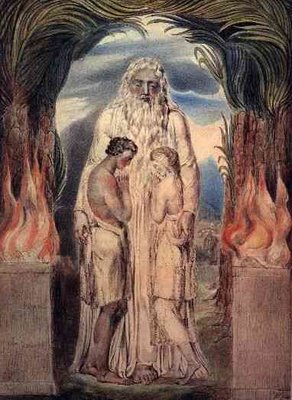
God clothing Adam and Eve
The impulse which drives this story is conviction that the way the world is, is not the way it was meant to be. Something is profoundly wrong with a world where humanity is at enemity with wild animals, where livelihood must be earned by sweated toil, where birth is painful, where men have power over women, where human beings with all their gifts return to dust. The author’s answer is that the creator’s intention was altogether different but that he was outmanoevred by his creatures and forced to adopt plan B as a method of restraint. Before we ask what that says about human beings, let’s look at what it apparently says about God.
The first thing to note is that this “God” is a creation of the author’s imagination; and that he may not even represent the fulness of the author’s own image of God. This “God” is a character in a drama, in this case a tragi-comic drama, which depicts God having to catch up with the initiatives of his human creatures, to whom he had given the ability to make decsions and within whose world he had placed the tree of knowledge. The measures he takes are taken patiently and without anger, with the intention of limiting the scope of evil in the world. The indignity of a God who is pushed into changing his plans is one of the profound insights f this author. (Later, St. Paul, responding to the indignity of the cross, calls this the “foolishness of God”)
If God seems a little foolish, humanity is revealed as wilfully stupid. In the garden where they enjoy life like Gods, they seek forbidden knowledge in order to be like Gods. The cunning serpent is just the voice of human arrogance. Something they already enjoy as God’s gift they want to possess on their own terms. The author exposes the root of evil as the desire to control rather than enjoy the world, to possess rather than to receive, to be God rather than to trust in God. The forbidden tree represents the “knowledge of everything” (“Good and evil” means A to Z), a persistent human dream that complete knowledge will provide complete control of life. Instead it brings the world the author inhabits, with its miserable toil, pain and death.
Still, the author recognises the human desire for knowledge- as -power to be the engine of human history. He does not moralise but presses on with his story of the grandeur and squalor of human progress in the book of Genesis. It’s a model of how to do theology: attention to the relevant human facts; faith in One who is beyond all facts; subtlety in depicting their interaction. If you are inclined to ask, “But did it really happen?” the proper answer is, “Yes, in the story it really happened.” If you want to go further and ask, “Is the story a true image of God?” the proper answer is, “All images of “God” are invented by human beings.” If then you ask, “Does the One who is beyond all facts reveal himself/herself to humanity” the proper answer (I believe) is, “Yes, and this story is part of that revelation.”
 Emmock's Blog