This blog provides a meditation on the Episcopal daily readings along with a headline from world news:
EVIL BEGETS EVIL: 10 YEARS OF GUANTANAMO 
Genesis 4:1-16
4Now the man knew his wife Eve, and she conceived and bore Cain, saying, ‘I have produced* a man with the help of the Lord.’2Next she bore his brother Abel. Now Abel was a keeper of sheep, and Cain a tiller of the ground.3In the course of time Cain brought to the Lord an offering of the fruit of the ground,4and Abel for his part brought of the firstlings of his flock, their fat portions. And the Lord had regard for Abel and his offering,5but for Cain and his offering he had no regard. So Cain was very angry, and his countenance fell.6The Lord said to Cain, ‘Why are you angry, and why has your countenance fallen?7If you do well, will you not be accepted? And if you do not do well, sin is lurking at the door; its desire is for you, but you must master it.’

Aam and Eve with the body of Abel
8 Cain said to his brother Abel, ‘Let us go out to the field.’* And when they were in the field, Cain rose up against his brother Abel and killed him.9Then the Lord said to Cain, ‘Where is your brother Abel?’ He said, ‘I do not know; am I my brother’s keeper?’10And the Lord said, ‘What have you done? Listen; your brother’s blood is crying out to me from the ground!11And now you are cursed from the ground, which has opened its mouth to receive your brother’s blood from your hand.12When you till the ground, it will no longer yield to you its strength; you will be a fugitive and a wanderer on the earth.’13Cain said to the Lord, ‘My punishment is greater than I can bear!14Today you have driven me away from the soil, and I shall be hidden from your face; I shall be a fugitive and a wanderer on the earth, and anyone who meets me may kill me.’15Then the Lord said to him, ‘Not so!* Whoever kills Cain will suffer a sevenfold vengeance.’ And the Lord put a mark on Cain, so that no one who came upon him would kill him.16Then Cain went away from the presence of the Lord, and settled in the land of Nod,*east of Eden.
JOHN 1: 1-18
35 The next day John again was standing with two of his disciples,36and as he watched Jesus walk by, he exclaimed, ‘Look, here is the Lamb of God!’37The two disciples heard him say this, and they followed Jesus.38When Jesus turned and saw them following, he said to them, ‘What are you looking for?’ They said to him, ‘Rabbi’ (which translated means Teacher), ‘where are you staying?’39He said to them, ‘Come and see.’ They came and saw where he was staying, and they remained with him that day. It was about four o’clock in the afternoon.40One of the two who heard John speak and followed him was Andrew, Simon Peter’s brother.41He first found his brother Simon and said to him, ‘We have found the Messiah’ (which is translated Anointed*).42He brought Simon* to Jesus, who looked at him and said, ‘You are Simon son of John. You are to be called Cephas’ (which is translated Peter*).
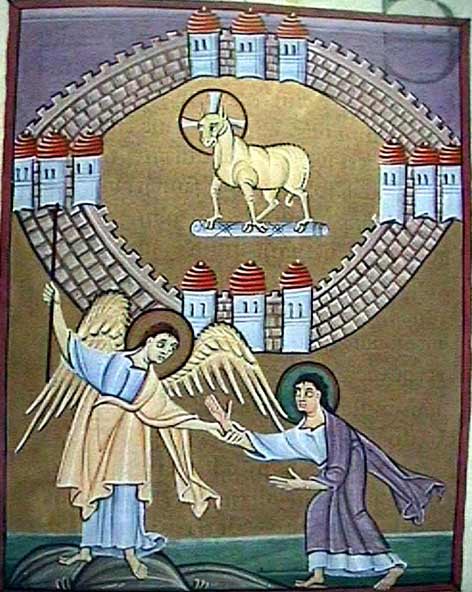
The lamb at the centre of the Holy City
The purpose of the Lectionary is to contrast the worlds of these two stories. The world of Genenis is one of mutual suspicion and misunderstanding. Does God prefer Abel’s offering because He’s a carnivore, or because livestock is a greater sacrifice or because it is offered in a more genuine spirit? We have no way of telling and neither has Cain. No wonder he feels rejected. Doubtless God could have sorted things out, but he only tells Cain that his anger is dangerous and sinful. I’ve tried to tell this story to chilren in a way that lets God off the hook, but they in their honesty won’t have it. They know where the trouble starts: favouritism. Abel suffers because of God’s favouritism. Again, as in the whole of Genesis, this should lead us to ask questions about “God”. We should always remember he’s a character in a story. In this case his role is to represent he fundamental unfairness of the life into which we are thrown. Cain’s murderous rage is all too familiar, as is his question, “Am I my brother’s keeper?”. God’s justice is the curse that alienates Cain from the soil he tills, with only a mark upon him to warn others against killing him. The reader may sense that God’s patience with Cain flows from a recognition of His own partial responsibility for another fine mess. If the author is using his “God” character to explore the issue of divine resposibility for the human predicament we should read him without pious evasion: the world he depicts is not an easy world.
The world of John’s story is very different. Here brothers are each other’s keepers, sharing their discovery of the messiah whom they have come to know because of his complete openness to them: “come and see (where I live)”. Life opens up to life and character arises from encounter with Jesus: you’ll be called Cephas, the Rock. The world’ s being transformed by the presence of Jesus who is called the Lamb of God, a name which goes all the way back to Abel’s acceptable sacrifice; but in this case is offered by God to humanity rather than the other way round. No longer does a man have to make himself acceptable to God. God, by coming in his Son and offering his lifeblood, makes Himself acceptable to human beings.
DON’T FORGET. THIS FRIDAY. HERE. THE JESUS PROBLEM PAGE. PROBLEMS TO: mvamair@gmail.com. PLEASE
 Emmock's Blog