
This blog provides a meditation on the Episcopal daily readings along with a headline from world news:
Injured Purser of Costa Concordia a shining example of concern for others 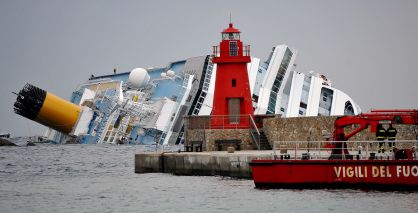
Genesis 8:13-22
13 In the six hundred and first year, in the first month, on the first day of the month, the waters were dried up from the earth; and Noah removed the covering of the ark, and looked, and saw that the face of the ground was drying. 14In the second month, on the twenty-seventh day of the month, the earth was dry. 15Then God said to Noah, 16‘Go out of the ark, you and your wife, and your sons and your sons’ wives with you. 17Bring out with you every living thing that is with you of all flesh—birds and animals and every creeping thing that creeps on the earth—so that they may abound on the earth, and be fruitful and multiply on the earth.’ 18So Noah went out with his sons and his wife and his sons’ wives. 19And every animal, every creeping thing, and every bird, everything that moves on the earth, went out of the ark by families.
20 Then Noah built an altar to the Lord, and took of every clean animal and of every clean bird, and offered burnt-offerings on the altar. 21And when the Lord smelt the pleasing odour, the Lord said in his heart, ‘I will never again curse the ground because of humankind, for the inclination of the human heart is evil from youth; nor will I ever again destroy every living creature as I have done.
22 As long as the earth endures,
seedtime and harvest, cold and heat,
summer and winter, day and night,
shall not cease.’
 The theology of the Genesis’ author tells us that he and we live in the time of God’s second thoughts, or the time of God’s promise that He will not destroy but preserve life. Still, the memory of God’s wrath remains as a warning to humanity. The author does not give God a rosy view of humanity-“the inclination of the human heart is evil from youth,” but his patience will include all created life. There is no threat but the story qualifies the present time as precisely the time of God’s patience. God wrath against evil is held in check but his patience is not to be taken for granted: as the great spiritual says, “God gave Noah the rainbow sign/ no more water but the fire next time.”
Genesis’ history of “God” provokes the question as to how this God will tackle the evil of the world if He promises not to intervene in his wrath. As we shall see the book gives an astonishing answer: “God” recruits human beings to work on his side against human evil. There was a habit when I was young to patronise Genesis ,as if, because it narrated primitive stories, it was itself primitive. Nothing could be further from the truth. It confronts profound issues of the human condition with subtlety, precision and humour and even offers some answers.
John 2:23-3:15
3Now there was a Pharisee named Nicodemus, a leader of the Jews. 2He came to Jesus by night and said to him, ‘Rabbi, we know that you are a teacher who has come from God; for no one can do these signs that you do apart from the presence of God.’ 3Jesus answered him, ‘Very truly, I tell you, no one can see thekingdomofGodwithout being born from above.’ 4Nicodemus said to him, ‘How can anyone be born after having grown old? Can one enter a second time into the mother’s womb and be born?’ 5Jesus answered, ‘Very truly, I tell you, no one can enter thekingdomofGodwithout being born of water and Spirit. 6What is born of the flesh is flesh, and what is born of the Spirit is spirit. 7Do not be astonished that I said to you, “You must be born from above.” 8The wind blows where it chooses, and you hear the sound of it, but you do not know where it comes from or where it goes. So it is with everyone who is born of the Spirit.’ 9Nicodemus said to him, ‘How can these things be?’ 10Jesus answered him, ‘Are you a teacher ofIsrael, and yet you do not understand these things?
11 ‘Very truly, I tell you, we speak of what we know and testify to what we have seen; yet you do not receive our testimony. 12If I have told you about earthly things and you do not believe, how can you believe if I tell you about heavenly things? 13No one has ascended into heaven except the one who descended from heaven, the Son of Man. 14And just as Moses lifted up the serpent in the wilderness, so must the Son of Man be lifted up, 15that whoever believes in him may have eternal life.

- from above

To be born from above is to attend to the source of goodness which is “beyond” all universes but allows that goodness to flow into human lives. Jesus’ first disciples have come to him in the day and ask to see “where Jesus lives”-as we might say, where he’s coming from. They have seen and believed. Now Nicodemus comes at night, out of his reluctance to acknowledge that any human being has access to that source. Jesus tells him that it is not only possible to draw from this source, it is necessary. Water and Spirit represent the two elements in baptism, the water representing the death of the old life and the Spirit which constitutes the new. (In fact the first Christians interpreted the Noah story as an image of baptism.) The lifting up of the Son of Man is also twofold: Jesus is lifted up on the cross in death; then he is lifted up to the Father in resurrection.
Jesus’ first encounters with disciples (see previous blogs) have shown the openness of Jesus to people and their open response to him. Here it is emphasised that opening oneself to God is costly as it involves something analogous to a new birth. Simone Weil the French philosopher wrote that the only way eternal goodness comes into the world is through those who agree to embody it. This agreement, she says, may be given in explicit faith or through conscientious decisions. I think only a persistent and customary agreement can be described as “being born from above.”
 Emmock's Blog