
This blog provides a meditation on the Episcopal daily readings along with a headline from world news:
Political Amnesty signals new start in Syria? Mmnn…. 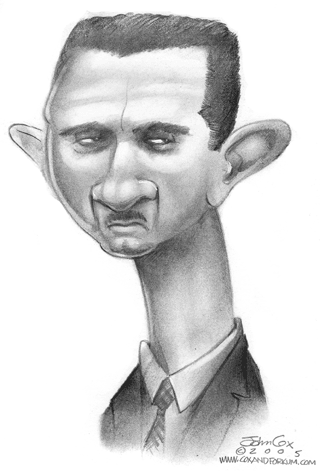
Genesis 9:1-7
9God blessed Noah and his sons, and said to them, ‘Be fruitful and multiply, and fill the earth. 2The fear and dread of you shall rest on every animal of the earth, and on every bird of the air, on everything that creeps on the ground, and on all the fish of the sea; into your hand they are delivered. 3Every moving thing that lives shall be food for you; and just as I gave you the green plants, I give you everything. 4Only, you shall not eat flesh with its life, that is, its blood. 5For your own lifeblood I will surely require a reckoning: from every animal I will require it and from human beings, each one for the blood of another, I will require a reckoning for human life.
6 Whoever sheds the blood of a human,
by a human shall that person’s blood be shed;
for in his own image
God made humankind.
7And you, be fruitful and multiply, abound on the earth and multiply in it.’

not God's first thought...
The eating of animals by human beings is part of “God’s second thoughts” after the flood. The author recognises the hunting of animals by humans as a concession by “God” to the dominance of humans over animals, In biblical terms, vegetarians revert to the law of Eden. Blood is understood as the life or soul of a living creature which must be treated with respect. This is also true of human blood which like Abel’s will cry out for vengeance if it is spilt. “God” abandons his careful treatment of Cain for a formula that will permit the very blood feud that treatment was devised to avoid. A different perspective is evident in the reminder that human beings are made in the image of God. Killing is an insult to the Creator. This perspective can obviously be used to forbid killing in vengeance or even in legal process.
All in all, this narrative shows “God” still struggling to contain the powers of his human creature. The new beginning lacks the freshness of Eden. The book of Genesis permits no idealisation of humanity.
Such a perspective helped launch St. Antony, whose feast day this is, on his invention of Christian monasticism, in 4th century Egypt. He encouraged the kind of monastic community in which hermits lived within easy range of each other, remote from cities, to concentrate on prayer, meditation, scripture, manual labour and charity. He did however maintain contact with society and visited Alexandria o a number of occasions. His image is stern, but St Athanasius said of him, “Who ever met him grieving that did not go away rejoicing?”
John 3:16-21
16 ‘For God so loved the world that he gave his only Son, so that everyone who believes in him may not perish but may have eternal life.
17 ‘Indeed, God did not send the Son into the world to condemn the world, but in order that the world might be saved through him. 18Those who believe in him are not condemned; but those who do not believe are condemned already, because they have not believed in the name of the only Son of God. 19And this is the judgement, that the light has come into the world, and people loved darkness rather than light because their deeds were evil. 20For all who do evil hate the light and do not come to the light, so that their deeds may not be exposed. 21But those who do what is true come to the light, so that it may be clearly seen that their deeds have been done in God.’

...so loved the world...
Verses 19-21 express a truth which all good people will recognise. The light of goodness comes into the world. Some people welcome it, others prefer the darkness, because the light exposes their evil. Those who welcome the light are happy when it reveals that their goodness, like all goodness, comes from God. A follower of this author added in the 1st Letter of John that good people also come to the light so that they may see their sins and confess them. These are profound truths that Christianity shares with all good people. Verses 17-18 on the other hand express a truth that belongs only to Christianity. God, the eternal truth and goodness has sent his only son into the world to express his love for it and to make real his desire that all should be rescued from evil and enter eternal life. The son’s “name”, that is his character, becomes a crisis point for human decision: those who love the light, however sinful they are will receive him; those who hate the light, however righteous they are, will reject him.
The darkness that is so evident in the book of Genesis is still present in the gospel but here God’s love for his world is unequivocally declared through the sending of his son into it. The light shines in the darkness and the darkness has never quenched it. For those of Christian faith the “name” or character of Jesus Christ is not only the way to that eternal goodness who is called the Father but also the unveiling of eternal truth and life in the world. The particularity of verses 16-18 and universality of verses 19-21 are connected by the character of Jesus Christ. Christianity is open to the world because Jesus is the embodiment of God’s love for it.
 Emmock's Blog