
This blog provides a meditation on the episcopal daily readings along with a headline from world news:
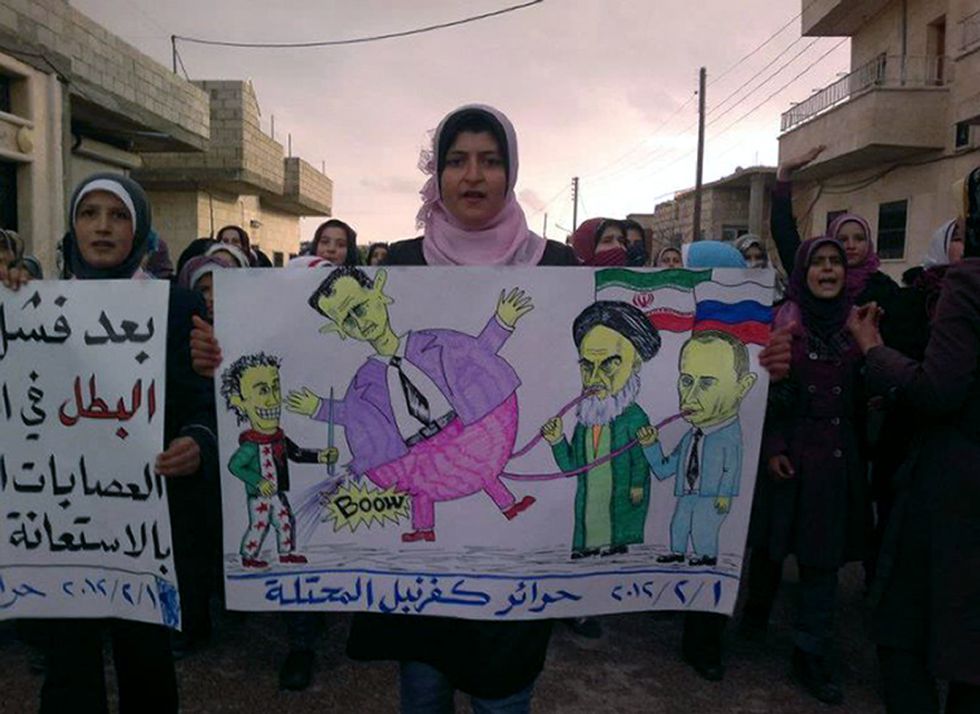
WIT PUNCTURES THE BALLOON OF ASSAD’S POWER 
Genesis 24:28-38,49-51
28 Then the girl ran and told her mother’s household about these things.29Rebekah had a brother whose name was Laban; and Laban ran out to the man, to the spring.30As soon as he had seen the nose-ring, and the bracelets on his sister’s arms, and when he heard the words of his sister Rebekah, ‘Thus the man spoke to me’, he went to the man; and there he was, standing by the camels at the spring.31He said, ‘Come in, O blessed of the Lord. Why do you stand outside when I have prepared the house and a place for the camels?’32So the man came into the house; and Laban unloaded the camels, and gave him straw and fodder for the camels, and water to wash his feet and the feet of the men who were with him.33Then food was set before him to eat; but he said, ‘I will not eat until I have told my errand.’ He said, ‘Speak on.’
34 So he said, ‘I am Abraham’s servant.35The Lord has greatly blessed my master, and he has become wealthy; he has given him flocks and herds, silver and gold, male and female slaves, camels and donkeys.36And Sarah my master’s wife bore a son to my master when she was old; and he has given him all that he has.37My master made me swear, saying, “You shall not take a wife for my son from the daughters of the Canaanites, in whose land I live;38but you shall go to my father’s house, to my kindred, and get a wife for my son.”49Now then, if you will deal loyally and truly with my master, tell me; and if not, tell me, so that I may turn either to the right hand or to the left.’
50 Then Laban and Bethuel answered, ‘The thing comes from the Lord; we cannot speak to you anything bad or good.51Look, Rebekah is before you; take her and go, and let her be the wife of your master’s son, as the Lord has spoken.’
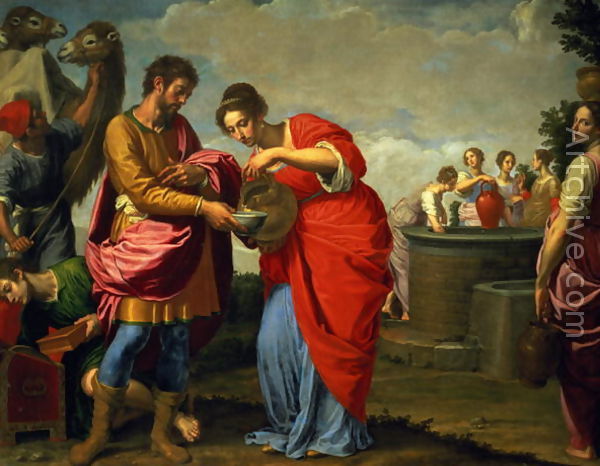 There’s a lovely balance of family, faith and fortune in the decision to let Rebecca marry Isaac.
1. Family ties are very important but they can be used to the advantage of one side or the other, as we see in the later story of Jacob and Laban. Here the courtesies are observed while Rebecca’s people try to make a clear estimate of the soundnesss of this proposal. The courtesies allow this process to happen without offence to either side’s honour. Our brusque contemporary habits often forget these courtesies.
2. There seems to be a shared faith in the “Lord”. Local Gods in that region were often called “Baal” or “Lord” so we should not assume that Rebecca’s people have the same faith as Abraham but there is a common recognition that the blessings of life come from the Lord. This gives a deeper dimension to the estimation of Abraham’s worth.
3. Fortune. If a family has prospered, that makes them a sound bet for a marriage alliance, since all will assume that their prosperity comes from the Lord’s blessing. The sight of the nose-ring and the bracelets goes a long way to convincing Laban about Abraham’s credibility.
All of these factors work in favour of the decision to allow Rebecca to marry Isaac. Something momentous, the future of the “family of blessing” is decided in strict conformity to prevailing wisdom. There is common sense, grace and patience Abraham’s proceedure which we would do well to imitate.
John 7:25-36

mystery of the word made flesh
25 Now some of the people of Jerusalem were saying, ‘Is not this the man whom they are trying to kill?26And here he is, speaking openly, but they say nothing to him! Can it be that the authorities really know that this is the Messiah?*27Yet we know where this man is from; but when the Messiah* comes, no one will know where he is from.’28Then Jesus cried out as he was teaching in the temple, ‘You know me, and you know where I am from. I have not come on my own. But the one who sent me is true, and you do not know him.29I know him, because I am from him, and he sent me.’30Then they tried to arrest him, but no one laid hands on him, because his hour had not yet come.31Yet many in the crowd believed in him and were saying, ‘When the Messiah* comes, will he do more signs than this man has done?’* <!– 32 –>
Officers Are Sent to Arrest Jesus
32 The Pharisees heard the crowd muttering such things about him, and the chief priests and Pharisees sent temple police to arrest him.33Jesus then said, ‘I will be with you a little while longer, and then I am going to him who sent me.34You will search for me, but you will not find me; and where I am, you cannot come.’35The Jews said to one another, ‘Where does this man intend to go that we will not find him? Does he intend to go to the Dispersion among the Greeks and teach the Greeks?36What does he mean by saying, “You will search for me and you will not find me” and, “Where I am, you cannot come”?’
Jesus’ words about others not being able to come to “where he is”, must be taken along with his promise to his disciples, “I will come back and take you with me so that where I am, there you may be also.” The words are mysterious to the crowd, because they are part of a persistent play in John’s Gospel with language about “where Jesus lives”, where he “comes from”, and “where he is going”. Jesus, a man of flesh and blood abides with God, from whom he comes and to whom he will go by way of his cross. That he should forever abide with God yet leave and return to God is the mystery of the Word made flesh. In plain language, Jesus’ whole being is of God, and that divine being involves a journey into time and suffering, because it is love for the world. In Jesus God’s love abides with us, so that we may abide with it forever. God has sent his son to woo humanity. We estimate the worth of his proposal not by nose-ring and bracelets but by the grace and truth of his messenger.
 Emmock's Blog