This blog provides a meditation on the Episcopal daily readings along with a headline from world news:
WORLD FRESH WATER RESOURCES SHRINKING
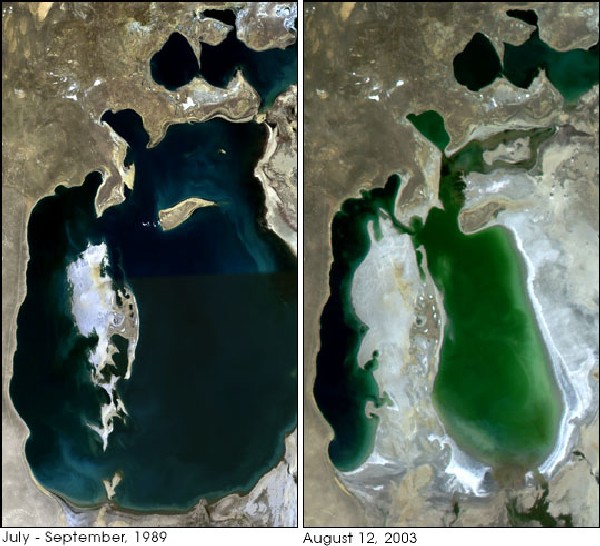
Aral Sea comparison
Genesis 26:12-33
Isaac and Abimelech
12 Isaac sowed seed in that land, and in the same year reaped a hundredfold. The Lord blessed him,13and the man became rich; he prospered more and more until he became very wealthy.14He had possessions of flocks and herds, and a great household, so that the Philistines envied him.15(Now the Philistines had stopped up and filled with earth all the wells that his father’s servants had dug in the days of his father Abraham.)16And Abimelech said to Isaac, ‘Go away from us; you have become too powerful for us.’
17 So Isaac departed from there and camped in the valley of Gerar and settled there.18Isaac dug again the wells of water that had been dug in the days of his father Abraham; for the Philistines had stopped them up after the death of Abraham; and he gave them the names that his father had given them.19But when Isaac’s servants dug in the valley and found there a well of spring water,20the herders of Gerar quarrelled with Isaac’s herders, saying, ‘The water is ours.’ So he called the well Esek,* because they contended with him.21Then they dug another well, and they quarrelled over that one also; so he called it Sitnah.*22He moved from there and dug another well, and they did not quarrel over it; so he called it Rehoboth,* saying, ‘Now the Lord has made room for us, and we shall be fruitful in the land.’
23 From there he went up to Beer-sheba.24And that very night the Lord appeared to him and said, ‘I am the God of your father Abraham; do not be afraid, for I am with you and will bless you and make your offspring numerous for my servant Abraham’s sake.’25So he built an altar there, called on the name of the Lord, and pitched his tent there. And there Isaac’s servants dug a well.
26 Then Abimelech went to him from Gerar, with Ahuzzath his adviser and Phicol the commander of his army.27Isaac said to them, ‘Why have you come to me, seeing that you hate me and have sent me away from you?’28They said, ‘We see plainly that the Lord has been with you; so we say, let there be an oath between you and us, and let us make a covenant with you29so that you will do us no harm, just as we have not touched you and have done to you nothing but good and have sent you away in peace. You are now the blessed of the Lord.’30So he made them a feast, and they ate and drank.31In the morning they rose early and exchanged oaths; and Isaac set them on their way, and they departed from him in peace.32That same day Isaac’s servants came and told him about the well that they had dug, and said to him, ‘We have found water!’33He called it Shibah;* therefore the name of the city is Beer-sheba* to this day.
- moving to find water
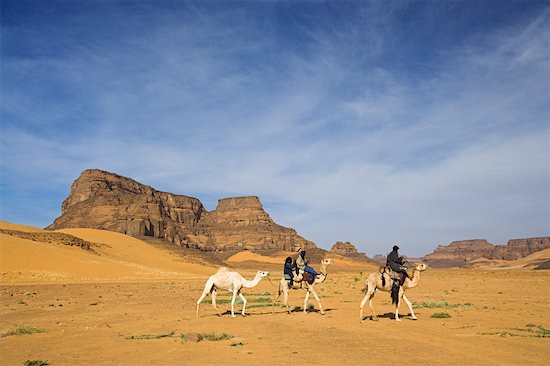
This story illustrates the trials of a nomadic people moving amongst a settled community. Isaac’s people believe that God wants them to live in this land which has been promised to Abraham, but they prosper too well and are told to move on. They do so, peacefully; and even when they re-activate wells dug by Abraham, they don’t fight for possession but move on again. Eventually their peaceful persistence and their skill at finding water so impresses the host people that they are recognised as “blessed” and invited to remain. More important than that, however is the response of God who “appears” and confirms his blessing upon them.
The whole story is a kind of counterblast to the narrative of the later conquest under Joshua of the same territory, as if the author were saying, “No, this is God’s way for a people to settle the land.” It might also be used as a story to set against the bloody history of modern Israel, or indeed as an interrogation of the way in which the U.K treats the nomadic peoples who try to find a fruiful life in the its crowded territory.
Or, on a different level, it could stand as a parable of faithful living under God: as strangers and sojourners on this earth we try to find places of blessing from which we can draw refreshment, moving on peacefully if these become unavailable to us, but always trusting that our tradition will guide us to other places of blessing, our forebears’ wells, which can be re-opened for the present generation. In this pilgrimage we are blessed by God’s presence.
John 7:53-8:11
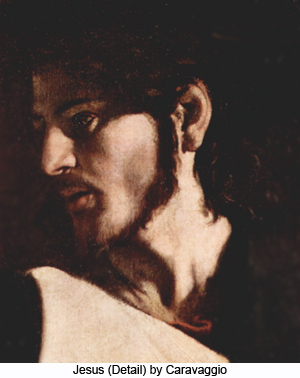
53Then each of them went home,81while Jesus went to the Mount of Olives.2Early in the morning he came again to the temple. All the people came to him and he sat down and began to teach them.3The scribes and the Pharisees brought a woman who had been caught in adultery; and making her stand before all of them,4they said to him, ‘Teacher, this woman was caught in the very act of committing adultery.5Now in the law Moses commanded us to stone such women. Now what do you say?’6They said this to test him, so that they might have some charge to bring against him. Jesus bent down and wrote with his finger on the ground.7When they kept on questioning him, he straightened up and said to them, ‘Let anyone among you who is without sin be the first to throw a stone at her.’8And once again he bent down and wrote on the ground.*9When they heard it, they went away, one by one, beginning with the elders; and Jesus was left alone with the woman standing before him.10Jesus straightened up and said to her, ‘Woman, where are they? Has no one condemned you?’11She said, ‘No one, sir.’* And Jesus said, ‘Neither do I condemn you. Go your way, and from now on do not sin again.’ 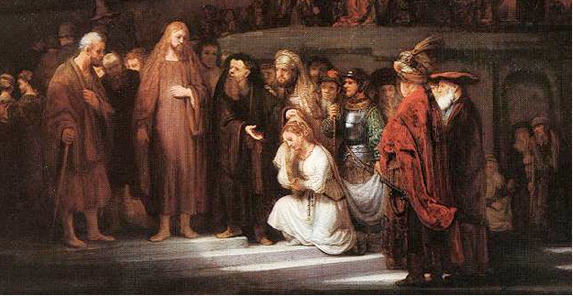
We know from the history of Gospel manuscripts that this story is what gelogists would call a “erratic”; it’s fetched up in this Gospel but it came from somewhere else, perhaps one of the other gospels, or maybe from a gospel we no longer have. It’s certainly not an authentic part of the gospel of John but nevertheless those who copied the gospel manuscripts were sure it was an authentic story about Jesus. The attitude of the religious police is frightening and unfortunately not unknown ioday. Some Islamic judgments on women, as well as some Christian judgments on homosexual partners, are from the same stable of condemnation. Why did Jesus write on the ground? It seems clear to me that what is written on the ground doesn’t last long but is quickly erased. Jesus is telling the pharsisees that their condemnation is written in dust because it is made by sinful people and will be erased by the love of God. If the only One who is without sin makes a merciful judgment, who can condemn? Notice that in this case Jesus was not disputing the sinfulness of the woman’s behaviour-although perhaps he wondered where the man had got to-but taking issue with their self-righteous, graceless treatment of someone who’d done wrong. This is how God treats us when we go wrong.
 Emmock's Blog