
This blog provides a meditation on the Episcopal daily readings along with a headline from world news:
SYRIAN OPPOSITION RESOLUTE IN FACE OF DEATH 

Genesis 27:1-29
Isaac Blesses Jacob
27When Isaac was old and his eyes were dim so that he could not see, he called his elder son Esau and said to him, ‘My son’; and he answered, ‘Here I am.’2He said, ‘See, I am old; I do not know the day of my death.3Now then, take your weapons, your quiver and your bow, and go out to the field, and hunt game for me.4Then prepare for me savoury food, such as I like, and bring it to me to eat, so that I may bless you before I die.’
5 Now Rebekah was listening when Isaac spoke to his son Esau. So when Esau went to the field to hunt for game and bring it,6Rebekah said to her son Jacob, ‘I heard your father say to your brother Esau,7“Bring me game, and prepare for me savoury food to eat, that I may bless you before the Lord before I die.”8Now therefore, my son, obey my word as I command you.9Go to the flock, and get me two choice kids, so that I may prepare from them savoury food for your father, such as he likes;10and you shall take it to your father to eat, so that he may bless you before he dies.’11But Jacob said to his mother Rebekah, ‘Look, my brother Esau is a hairy man, and I am a man of smooth skin.12Perhaps my father will feel me, and I shall seem to be mocking him, and bring a curse on myself and not a blessing.’13His mother said to him, ‘Let your curse be on me, my son; only obey my word, and go, get them for me.’14So he went and got them and brought them to his mother; and his mother prepared savoury food, such as his father loved.15Then Rebekah took the best garments of her elder son Esau, which were with her in the house, and put them on her younger son Jacob;16and she put the skins of the kids on his hands and on the smooth part of his neck.17Then she handed the savoury food, and the bread that she had prepared, to her son Jacob.
18 So he went in to his father, and said, ‘My father’; and he said, ‘Here I am; who are you, my son?’19Jacob said to his father, ‘I am Esau your firstborn. I have done as you told me; now sit up and eat of my game, so that you may bless me.’20But Isaac said to his son, ‘How is it that you have found it so quickly, my son?’ He answered, ‘Because the Lord your God granted me success.’21Then Isaac said to Jacob, ‘Come near, that I may feel you, my son, to know whether you are really my son Esau or not.’22So Jacob went up to his father Isaac, who felt him and said, ‘The voice is Jacob’s voice, but the hands are the hands of Esau.’23He did not recognize him, because his hands were hairy like his brother Esau’s hands; so he blessed him.24He said, ‘Are you really my son Esau?’ He answered, ‘I am.’25Then he said, ‘Bring it to me, that I may eat of my son’s game and bless you.’ So he brought it to him, and he ate; and he brought him wine, and he drank.26Then his father Isaac said to him, ‘Come near and kiss me, my son.’27So he came near and kissed him; and he smelled the smell of his garments, and blessed him, and said,
‘Ah, the smell of my son is like the smell of a field that the Lord has blessed.
28 May God give you of the dew of heaven, and of the fatness of the earth, and plenty of grain and wine.
29 Let peoples serve you, and nations bow down to you.
Be lord over your brothers, and may your mother’s sons bow down to you.
Cursed be everyone who curses you, and blessed be everyone who blesses you!’
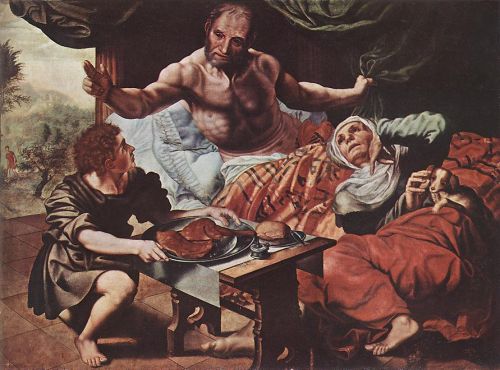 There are a number of folktale elements in this story: twins, the younger beats the older, the trickster beats the powerful, the wicked beats the pious, mother-and-younger-son plot against father-and-elder-son, disguises confuse the senses, a father’s blessing cannot be retracted. The Genesis author makes use of all these to tell us a shameful tale of how a blind old man is deceived on his death-bed and an obedient elder son deprived of his father’s blessing. However the reader already knows that Esau has been careless about the value of his birthright, while Jacob has coveted it. And as we read the story are we convinced that the old man is really deceived? Are the tricks good enough or are they pretexts which Isaac seizes to give the blessing to Jacob, whom in his heart of hearts he knows is more likely to make good use of it than Esau? Perhaps, we sense, Isaac can’t admit all this openly and the plot of Jacob and Rebecca gives him the excuse he needs. And as for the readers, don’t they, in spite of their disapproval of Jacob’s treachery, recognise him as the more lively, the more interesting of the twins, and want him to win?
All this is to prepare the rader for the truly scandalous discovery that God also prefers Jacob and has already begun to catch him in the net of his own trickery. God’s choices are often depicted as running counter to human wisdom and even His own morality. Why, for example, does He love David so much? God is more ruthless than we are when He wants to win over a person of wit, determination and liveliness to the cause of goodness. Remember, this “God” is a character in a human story-but the story may represent something profoundly characteristic of the presence which humans call “God”.
John 8:12-20
Jesus the Light of the World
12 Again Jesus spoke to them, saying, ‘I am the light of the world. Whoever follows me will never walk in darkness but will have the light of life.’13Then the Pharisees said to him, ‘You are testifying on your own behalf; your testimony is not valid.’14Jesus answered, ‘Even if I testify on my own behalf, my testimony is valid because I know where I have come from and where I am going, but you do not know where I come from or where I am going.15You judge by human standards;* I judge no one.16Yet even if I do judge, my judgement is valid; for it is not I alone who judge, but I and the Father* who sent me.17In your law it is written that the testimony of two witnesses is valid.18I testify on my own behalf, and the Father who sent me testifies on my behalf.’19Then they said to him, ‘Where is your Father?’ Jesus answered, ‘You know neither me nor my Father. If you knew me, you would know my Father also.’20He spoke these words while he was teaching in the treasury of the temple, but no one arrested him, because his hour had not yet come.
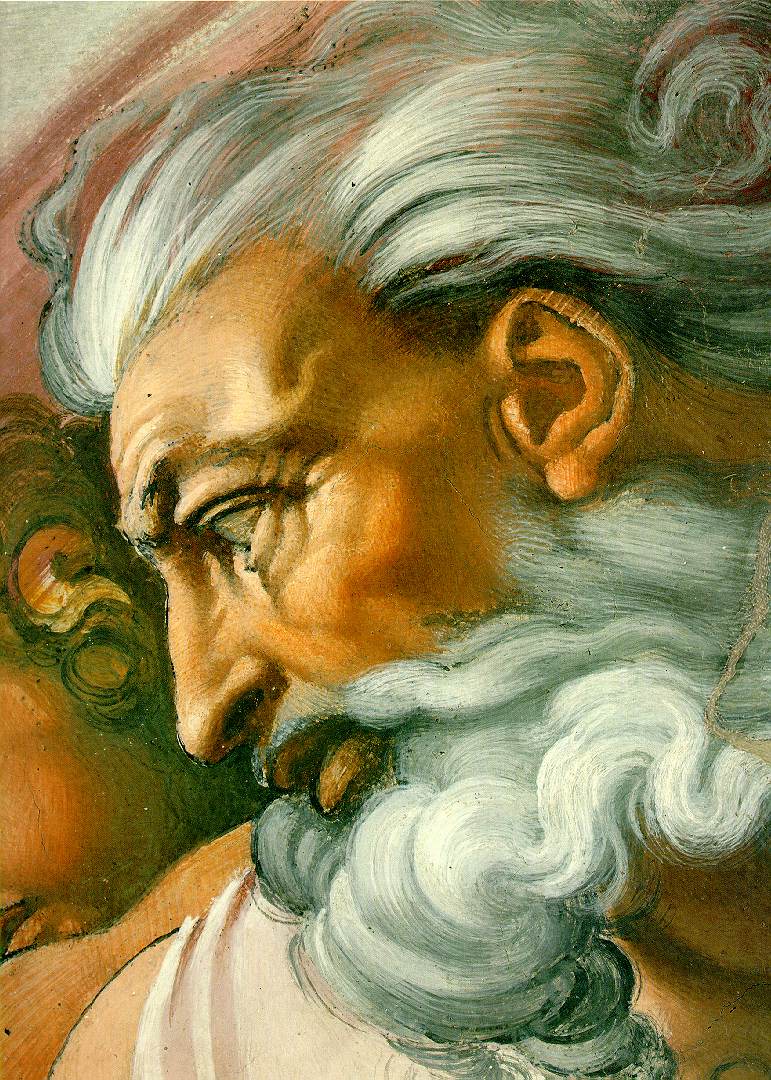
The ruthlessness of God's love
As John depicts Jesus, his contemporaries have some excuse in doubting him. He performs miracles, yes, but these may seem like mere tricks (like Jacob’s tricks?) and he announces himself in words which can only appear to be arrogant, claiming that the one he calls Father is his character witness. In this gospel, Jesus manifests the ruthless goodness of God which is utterly different to what even religious people (or is it especially religious people?) expect. The fierce love of Jesus wants the fullness of God’s life for human beings and is impatient with all substitutes. There are similarites between the God who is the “shield” of Jacob and the God who is the “father” of Jesus.
My ancestors worshipped a psychopathic God who needed to fry his human creatures in hell and was only deflected from this purpose by the blood sacrifice of his son. I’m glad to be rid of this tinpot dictator. But that travesty of God’s character was a misinterpretation of biblical evidence, such as the Jacob story, or John’s picture of Jesus, which reveals the inhumanity of God’s love, the voice that says “Let the dead bury the dead,” “Don’t cast your pearls in front of pigs,” “If you have not done it for the least of my brothers and sisters, you have not done it for me.” There’s something here that requires our attention.
 Emmock's Blog