
This blog provides a meditation on the Episcopal daily readings along with a headline from world news:
ALLEGED JESUIT KILLER IN COURT IN BOSTON FOR 1989 ATROCITY

In all six Jesuits were killed
Genesis 27:30-45
Esau’s Lost Blessing
30 As soon as Isaac had finished blessing Jacob, when Jacob had scarcely gone out from the presence of his father Isaac, his brother Esau came in from his hunting.31He also prepared savoury food, and brought it to his father. And he said to his father, ‘Let my father sit up and eat of his son’s game, so that you may bless me.’32His father Isaac said to him, ‘Who are you?’ He answered, ‘I am your firstborn son, Esau.’33Then Isaac trembled violently, and said, ‘Who was it then that hunted game and brought it to me, and I ate it all* before you came, and I have blessed him?—yes, and blessed he shall be!’34When Esau heard his father’s words, he cried out with an exceedingly great and bitter cry, and said to his father, ‘Bless me, me also, father!’35But he said, ‘Your brother came deceitfully, and he has taken away your blessing.’36Esau said, ‘Is he not rightly named Jacob?* For he has supplanted me these two times. He took away my birthright; and look, now he has taken away my blessing.’ Then he said, ‘Have you not reserved a blessing for me?’37Isaac answered Esau, ‘I have already made him your lord, and I have given him all his brothers as servants, and with grain and wine I have sustained him. What then can I do for you, my son?’38Esau said to his father, ‘Have you only one blessing, father? Bless me, me also, father!’ And Esau lifted up his voice and wept.
39 Then his father Isaac answered him:
‘See, away from* the fatness of the earth shall your home be, and away from* the dew of heaven on high.
40 By your sword you shall live, and you shall serve your brother;
but when you break loose,* you shall break his yoke from your neck.’<!– 41 –>
Jacob Escapes Esau’s Fury
41 Now Esau hated Jacob because of the blessing with which his father had blessed him, and Esau said to himself, ‘The days of mourning for my father are approaching; then I will kill my brother Jacob.’42But the words of her elder son Esau were told to Rebekah; so she sent and called her younger son Jacob and said to him, ‘Your brother Esau is consoling himself by planning to kill you.43Now therefore, my son, obey my voice; flee at once to my brother Laban in Haran,44and stay with him for a while, until your brother’s fury turns away—45until your brother’s anger against you turns away, and he forgets what you have done to him; then I will send, and bring you back from there. Why should I lose both of you in one day?’
John 8:21-32
Jesus Foretells His Death
21 Again he said to them, ‘I am going away, and you will search for me, but you will die in your sin. Where I am going, you cannot come.’22Then the Jews said, ‘Is he going to kill himself? Is that what he means by saying, “Where I am going, you cannot come”?’23He said to them, ‘You are from below, I am from above; you are of this world, I am not of this world.24I told you that you would die in your sins, for you will die in your sins unless you believe that I am he.’*25They said to him, ‘Who are you?’ Jesus said to them, ‘Why do I speak to you at all?*26I have much to say about you and much to condemn; but the one who sent me is true, and I declare to the world what I have heard from him.’27They did not understand that he was speaking to them about the Father.28So Jesus said, ‘When you have lifted up the Son of Man, then you will realize that I am he,* and that I do nothing on my own, but I speak these things as the Father instructed me.29And the one who sent me is with me; he has not left me alone, for I always do what is pleasing to him.’30As he was saying these things, many believed in him.<!– 31 –>
True Disciples
31 Then Jesus said to the Jews who had believed in him, ‘If you continue in my word, you are truly my disciples;32and you will know the truth, and the truth will make you free.’

- light of the world
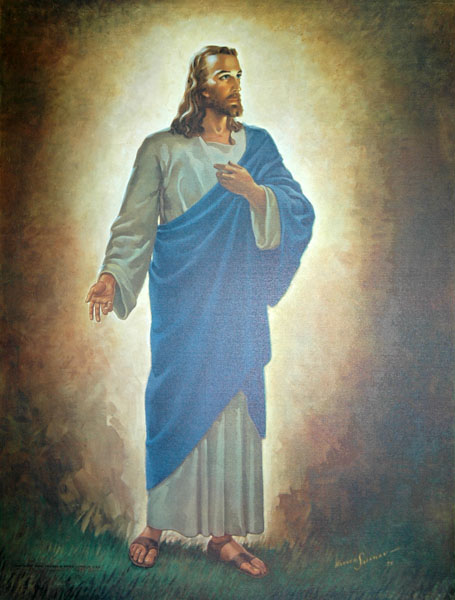
The lectionary places these two passages together and forces uncomfortable thoughts about their similarities. Jacob always acts in the confidence that he is really the chosen one in his family; Esau feels rejected but in fact collaborates with his own rejection by his lack of wisdom. There is an arrogance about Jacob which makes us dislike him even as we are drawn to him. In the passage from John’s gospel, Jesus plays the part of Jacob, the chosen one, blessed by the Father and the “Jews” are made to play the part of Esau, the rejected one. This theology of course stands historical reality on its head. As the other gospels show, Jesus is rejected by the religious leaders of his people who play the role of God’s chosen. John, the author of the gospel, knows this of course, and his upside down account is steeped in irony, which becomes evident in the mention of the son of man being lifted up, that is, put on a cross, but also through his death lifted up by God into divine life. John is saying to the reader that although it will seem that Jesus is the rejected one, his very rejection will reveal him as the beloved son of God. Yes, that’s powerful theology, but… but…I remain uncomfortable with a whole people (Jews) being thus depicted, and there is just a whiff of self-satisfaction in the character of Jesus as presented, just as there is in the character of Jacob.
My guess is that my reaction is triggered by John’s device of putting on the lips of Jesus the later Christian community’s beliefs about him. For believers to say, “Jesus is the light of the world” is one thing, for Jesus himself to say it is quite another. If some guy appears saying to me, “I am the light of the world,” I can imagine replying, “On your bike, sunshine,” or words to that effect. In the other gospels Jesus challenges people to become guileless like children, to forgive seventy times seven, to go the second mile, to love enemies, whereas in John’s gospel he mainly challenges people to believe in himself. All of which is to say that if John’s Gospel is historically accurate, it would be an obstacle rather than an encouragement to faith, for me at least. Fortunately I don’t think it is a depiction of Jesus as he was, but rather a profound portrait of him as the “word made flesh”: in this Gospel, he is made to speak what he is. The words he speaks in this passage are the truths about his nature which the Christian community has come to believe, with the help of the Holy Spirit over fifty or more years of development. I can see why John does this. He saying, “This is in truth WHO Jesus was on earth.” I’m saying, “Yes, but it’s not HOW he was on earth.”
I’d be particularly interested in my readers’ reaction to this issue.
 Emmock's Blog