
This blog provides a meditation on the Episcopal daily readings along with a headline from world news:
U.S SOFTLY SOFTLY POLICY OF FOOD AID BEARS FRUIT IN NORTH KOREA 

Genesis 39:1-23
Joseph and Potiphar’s Wife
39Now Joseph was taken down to Egypt, and Potiphar, an officer of Pharaoh, the captain of the guard, an Egyptian, bought him from the Ishmaelites who had brought him down there.2The Lord was with Joseph, and he became a successful man; he was in the house of his Egyptian master.3His master saw that the Lord was with him, and that the Lord caused all that he did to prosper in his hands.4So Joseph found favour in his sight and attended him; he made him overseer of his house and put him in charge of all that he had.5From the time that he made him overseer in his house and over all that he had, the Lord blessed the Egyptian’s house for Joseph’s sake; the blessing of the Lord was on all that he had, in house and field.6So he left all that he had in Joseph’s charge; and, with him there, he had no concern for anything but the food that he ate.
Now Joseph was handsome and good-looking.7And after a time his master’s wife cast her eyes on Joseph and said, ‘Lie with me.’8But he refused and said to his master’s wife, ‘Look, with me here, my master has no concern about anything in the house, and he has put everything that he has in my hand.9He is not greater in this house than I am, nor has he kept back anything from me except yourself, because you are his wife. How then could I do this great wickedness, and sin against God?’10And although she spoke to Joseph day after day, he would not consent to lie beside her or to be with her.11One day, however, when he went into the house to do his work, and while no one else was in the house,12she caught hold of his garment, saying, ‘Lie with me!’ But he left his garment in her hand, and fled and ran outside.13When she saw that he had left his garment in her hand and had fled outside,14she called out to the members of her household and said to them, ‘See, my husband* has brought among us a Hebrew to insult us! He came in to me to lie with me, and I cried out with a loud voice;15and when he heard me raise my voice and cry out, he left his garment beside me, and fled outside.’16Then she kept his garment by her until his master came home,17and she told him the same story, saying, ‘The Hebrew servant, whom you have brought among us, came in to me to insult me;18but as soon as I raised my voice and cried out, he left his garment beside me, and fled outside.’
19 When his master heard the words that his wife spoke to him, saying, ‘This is the way your servant treated me’, he became enraged.20And Joseph’s master took him and put him into the prison, the place where the king’s prisoners were confined; he remained there in prison.21But the Lord was with Joseph and showed him steadfast love; he gave him favour in the sight of the chief jailer.22The chief jailer committed to Joseph’s care all the prisoners who were in the prison, and whatever was done there, he was the one who did it.23The chief jailer paid no heed to anything that was in Joseph’s care, because the Lord was with him; and whatever he did, the Lord made it prosper.
-

Joseph and Potiphar's wife: Artemesia Gentileschi
Thomas Mann in his wonderful retelling of this story suggests that although sincere in his denial, Joseph was not entirely unflattered by his mistress’s attentions. Perhaps without going so far, the narrator wants us to think that Joseph is still a bit too full of himself and fails to act with wisdom. His fall from grace however is full of drama and the character of the spurned woman is psychologically convincing. Behind the stratagems of the human characters the readers sense the stratagem of God who teaches Joseph that blessings are not for personal consumption but for sharing with others. Joseph’s imprisonment puts him in the place where, as we will see, he is of use to his fellow prisoners and then to Pharaoh. This is not a simple story of “Jewish boy makes good in a foreign land”-although it plays with that theme-but a beautifully balanced novella about how the wisdom of God is fulfilled as much through the folly as through the wisdom of human beings.

Mark 2:1-12
Jesus Heals a Paralytic
- 2When he returned to Capernaum after some days, it was reported that he was at home.2So many gathered around that there was no longer room for them, not even in front of the door; and he was speaking the word to them.3Then some people* came, bringing to him a paralysed man, carried by four of them.4And when they could not bring him to Jesus because of the crowd, they removed the roof above him; and after having dug through it, they let down the mat on which the paralytic lay.5When Jesus saw their faith, he said to the paralytic, ‘Son, your sins are forgiven.’6Now some of the scribes were sitting there, questioning in their hearts,7‘Why does this fellow speak in this way? It is blasphemy! Who can forgive sins but God alone?’8At once Jesus perceived in his spirit that they were discussing these questions among themselves; and he said to them, ‘Why do you raise such questions in your hearts?9Which is easier, to say to the paralytic, “Your sins are forgiven”, or to say, “Stand up and take your mat and walk”?10But so that you may know that the Son of Man has authority on earth to forgive sins’—he said to the paralytic—11‘I say to you, stand up, take your mat and go to your home.’12And he stood up, and immediately took the mat and went out before all of them; so that they were all amazed and glorified God, saying, ‘We have never seen anything like this!’breaking into God’s house.
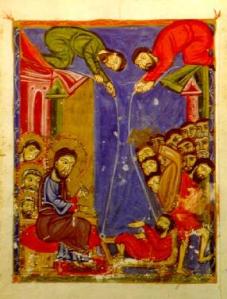
break- in at God's house
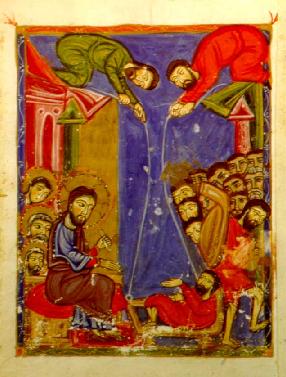
Mark is a master storyteller whose perceptions often confound our expectation. We expect Jesus to heal when the sick person has faith in him. Here Jesus notes the faith of the man’s friends through their physical assault on his house (it may be Jesus’ own property). Jesus creates a “house of God” and the paralysed man’s friends break into it, as if God’s goodnesss is physically located there. (Jesus describes his own healings as breaking into the devil’s house. This is the opposite: faithful people taking God’s house by storm) Faith is not simply a personal possession. It is a shared longing to “see the goodness of God in the land of the living.” The sick man has been taught to associate his illness with punishment for his sins so Jesus declares God’s forgiveness. Challenged about his right to do this, he shows that he has dared to ransack God’s house for his best gifts so that he can offer them to people, as he does when he commands the paralysed man to walk. The images of God’s house (Greek oikos) implicit in this story are unexpected, disturbing, and exciting.
 Emmock's Blog