
This blog proides a meditation on the Episcopal daily readings along with a headline from world news:
Cheetah becoming enfertile due to climate change 

Genesis 42:18-28
18 On the third day Joseph said to them, ‘Do this and you will live, for I fear God:19if you are honest men, let one of your brothers stay here where you are imprisoned. The rest of you shall go and carry grain for the famine of your households,20and bring your youngest brother to me. Thus your words will be verified, and you shall not die.’ And they agreed to do so.21They said to one another, ‘Alas, we are paying the penalty for what we did to our brother; we saw his anguish when he pleaded with us, but we would not listen. That is why this anguish has come upon us.’22Then Reuben answered them, ‘Did I not tell you not to wrong the boy? But you would not listen. So now there comes a reckoning for his blood.’23They did not know that Joseph understood them, since he spoke with them through an interpreter.24He turned away from them and wept; then he returned and spoke to them. And he picked out Simeon and had him bound before their eyes.25Joseph then gave orders to fill their bags with grain, to return every man’s money to his sack, and to give them provisions for their journey. This was done for them.<!– 26 –>
Joseph’s Brothers Return to Canaan
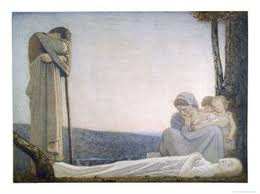
Rachel dies giving birth to Benjamin
26 They loaded their donkeys with their grain, and departed.27When one of them opened his sack to give his donkey fodder at the lodging-place, he saw his money at the top of the sack.28He said to his brothers, ‘My money has been put back; here it is in my sack!’ At this they lost heart and turned trembling to one another, saying, ‘What is this that God has done to us?”
Christian bible readers may care to note that by the time this story was written the convention that the third day was a day when things looked up, was already established. The painful comedy here is that the brothers link their present misfortune with their cruelty to Joseph; while Joseph himself hears what they are thinking. Joseph’s dream, conceived in youthful arrogance, was instrummental in bringing about his brothers’ rejection of him. Through bad and good fortune Jospeh has come to uhnderstand this, whereas his brothers only feel their own guilt. Now Joseph dreams that he may be able to renew his relationship with his family. His demand to see Benjamin expresses a dream which will force his distant father to surrender his youngest son into the kind of uncertainty that swallowed Joseph. By this time however, the reader judges that all will be well because of the overarching dream of God.
Mark 4:1-20
The Parable of the Sower
4Again he began to teach beside the lake. Such a very large crowd gathered around him that he got into a boat on the lake and sat there, while the whole crowd was beside the lake on the land.2He began to teach them many things in parables, and in his teaching he said to them:3‘Listen! A sower went out to sow.4And as he sowed, some seed fell on the path, and the birds came and ate it up.5Other seed fell on rocky ground, where it did not have much soil, and it sprang up quickly, since it had no depth of soil.6And when the sun rose, it was scorched; and since it had no root, it withered away.7Other seed fell among thorns, and the thorns grew up and choked it, and it yielded no grain.8Other seed fell into good soil and brought forth grain, growing up and increasing and yielding thirty and sixty and a hundredfold.’9And he said, ‘Let anyone with ears to hear listen!’
The Purpose of the Parables
10 When he was alone, those who were around him along with the twelve asked him about the parables.11And he said to them, ‘To you has been given the secret* of the kingdom of God, but for those outside, everything comes in parables;12in order that
“they may indeed look, but not perceive, and may indeed listen, but not understand;
so that they may not turn again and be forgiven.” ’
13 And he said to them, ‘Do you not understand this parable? Then how will you understand all the parables?14The sower sows the word.15These are the ones on the path where the word is sown: when they hear, Satan immediately comes and takes away the word that is sown in them.16And these are the ones sown on rocky ground: when they hear the word, they immediately receive it with joy.17But they have no root, and endure only for a while; then, when trouble or persecution arises on account of the word, immediately they fall away.*18And others are those sown among the thorns: these are the ones who hear the word,19but the cares of the world, and the lure of wealth, and the desire for other things come in and choke the word, and it yields nothing.20And these are the ones sown on the good soil: they hear the word and accept it and bear fruit, thirty and sixty and a hundredfold.’
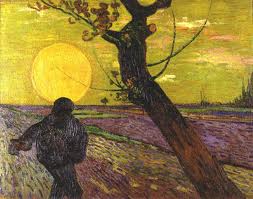
Van Gogh: Sower
This parable hs always troubled me, in that I think I understand it better than Mark! That’s ridiculous of course. But still, I can imagine Jesus telling this parable about a carefree sower who is not concerned with the waste, which he takes for granted, but looks to the growth which he trusts will come. This sower is God, I think, with whom it is always springtime, and who sows not merely a word, but men and women who are the bearers of his creative love. In this interpretation Jesus is characterising the spirit of his mission under God. But Mark has received in the materials he gathered for his gospel, an explanation of the parable which purports to come from Jesus. This explanation is more concerned with the nature of the soils than the nature of the sower. In context, it expresses Jesus’ shrewd estimate that only a very small proportion of the crowds that come to him will be fruitful soil. Human nature is weak and initial fruifulness is often deceptive. Nevertheless the teaching is worthwhile as some will reach good soil, take root and grow.The ripening of God’s purpose amiongst humanity may take a long time as in the story of Joseph.
The difference beteen these interpretations is between a divine optimism and generosity on the one hand, and a sober, committed realism on the other. As both are characteristic of Jesus, I can leave my readers to judge this issue for themselves.
 Emmock's Blog