This blog provides a meditation on the Episcopal daily readings along with a headline from world news:
KONY VIDEO SHOWS TRAUMA OF VIOLENCE

16 When Joseph saw Benjamin with them, he said to the steward of his house, ‘Bring the men into the house, and slaughter an animal and make ready, for the men are to dine with me at noon.’17The man did as Joseph said, and brought the men to Joseph’s house.18Now the men were afraid because they were brought to Joseph’s house, and they said, ‘It is because of the money, replaced in our sacks the first time, that we have been brought in, so that he may have an opportunity to fall upon us, to make slaves of us and take our donkeys.’19So they went up to the steward of Joseph’s house and spoke with him at the entrance to the house.20They said, ‘Oh, my lord, we came down the first time to buy food;21and when we came to the lodging-place we opened our sacks, and there was each one’s money in the top of his sack, our money in full weight. So we have brought it back with us.22Moreover, we have brought down with us additional money to buy food. We do not know who put our money in our sacks.’23He replied, ‘Rest assured, do not be afraid; your God and the God of your father must have put treasure in your sacks for you; I received your money.’ Then he brought Simeon out to them.24When the steward* had brought the men into Joseph’s house, and given them water, and they had washed their feet, and when he had given their donkeys fodder,25they made the present ready for Joseph’s coming at noon, for they had heard that they would dine there.
26 When Joseph came home, they brought him the present that they had carried into the house, and bowed to the ground before him.27He inquired about their welfare, and said, ‘Is your father well, the old man of whom you spoke? Is he still alive?’28They said, ‘Your servant our father is well; he is still alive.’ And they bowed their heads and did obeisance.29Then he looked up and saw his brother Benjamin, his mother’s son, and said, ‘Is this your youngest brother, of whom you spoke to me? God be gracious to you, my son!’30With that, Joseph hurried out, because he was overcome with affection for his brother, and he was about to weep. So he went into a private room and wept there.31Then he washed his face and came out; and controlling himself he said, ‘Serve the meal.’32They served him by himself, and them by themselves, and the Egyptians who ate with him by themselves, because the Egyptians could not eat with the Hebrews, for that is an abomination to the Egyptians.33When they were seated before him, the firstborn according to his birthright and the youngest according to his youth, the men looked at one another in amazement.34Portions were taken to them from Joseph’s table, but Benjamin’s portion was five times as much as any of theirs. So they drank and were merry with him.
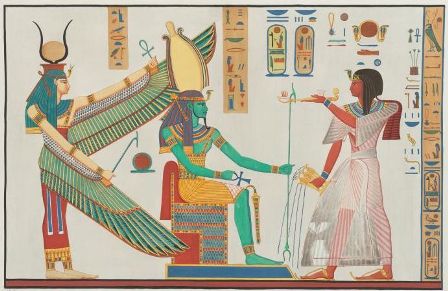
palace life in ancient Egypt
The author leads the readers towards the climax of his story. Why has Joseph demanded the presence of Benjamin? Old Jacob may be right in sensing something odd and threatening. As the story continues we realise that Joseph will use Benjamin as a sort of subsitute for himself, to test his other brothers’ capacity for care of a youngest brother who has been shown special favour, in this case, by Joseph himself. Although Joseph holds all the cards, he underestimates his own emotions and only barely controls himself. The author means us to see how much he too has learned: his own dream is now less important to him than his natural feelings of affection. The shrewd comedy of this story tells us that our follies and evils must be drummed out of us by the tests which life brings us.
Mark 5:1-20
Jesus Heals the Gerasene Demoniac
5They came to the other side of the lake, to the country of the Gerasenes.*2And when he had stepped out of the boat, immediately a man out of the tombs with an unclean spirit met him.3He lived among the tombs; and no one could restrain him any more, even with a chain;4for he had often been restrained with shackles and chains, but the chains he wrenched apart, and the shackles he broke in pieces; and no one had the strength to subdue him.5Night and day among the tombs and on the mountains he was always howling and bruising himself with stones.6When he saw Jesus from a distance, he ran and bowed down before him;7and he shouted at the top of his voice, ‘What have you to do with me, Jesus, Son of the Most High God? I adjure you by God, do not torment me.’8For he had said to him, ‘Come out of the man, you unclean spirit!’9Then Jesus* asked him, ‘What is your name?’ He replied, ‘My name is Legion; for we are many.’10He begged him earnestly not to send them out of the country.11Now there on the hillside a great herd of swine was feeding;12and the unclean spirits* begged him, ‘Send us into the swine; let us enter them.’13So he gave them permission. And the unclean spirits came out and entered the swine; and the herd, numbering about two thousand, rushed down the steep bank into the lake, and were drowned in the lake. 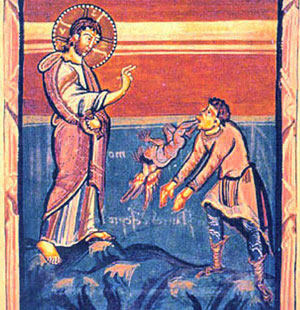
14 The swineherds ran off and told it in the city and in the country. Then people came to see what it was that had happened.15They came to Jesus and saw the demoniac sitting there, clothed and in his right mind, the very man who had had the legion; and they were afraid.16Those who had seen what had happened to the demoniac and to the swine reported it.17Then they began to beg Jesus* to leave their neighbourhood.18As he was getting into the boat, the man who had been possessed by demons begged him that he might be with him.19But Jesus* refused, and said to him, ‘Go home to your friends, and tell them how much the Lord has done for you, and what mercy he has shown you.’20And he went away and began to proclaim in the Decapolis how much Jesus had done for him; and everyone was amazed.
When we turn from the Joseph story to Mark’s Gospel we feel instantly how much darker the latter is. The key to this story is first of all in the area from which the man comes, “The Decapolis”, the ten towns established by the Greek successors of Alexander who ruled Israel for more than a century, viewed by the Jews as almost foreign territory. The area was subsequently taken over by the Romans. The second clue is the name of the man’s demons, “Legion”. When asked who he is, the man says, “I’m the Roman Army.” Evil spirits-perhaps we would call them, “destructive social determinants”- were thought to inhabit gentile territory. In this case, however. it’s the destructive power of the Roman Legions which has entered into the man’s soul. Like many people traumatised by conquest, he has internalised the violence and directed it against his own life. As a prison chaplain I saw many examples of men and women who harmed themselves, cutting their flesh terribly, in reaction to violence which had been done to them. Jesus has compassion on the man and confronts his demons, gaining power over them by forcing them to name themselves (naming the demons that torment you may still be a precondition of therapy). The modern reader will not like the destruction of the pigs but for the Jewish reader it would be black comedy: pigs were unclean anyway and a suitable residence for demons. The sight of the madman clothed and in his right mind frightens the bystanders as much as the fate of the pigs.Jesus leaves the cured man to be a witness to God’s goodness amongst his own people. The gospel doesn’t dwell on the evils of the Roman conquest but this fierce story is enough: the might of armies drives people mad. British politicians who think we can “defend our national security” in Afghanistan will ignore this madness when it occurrs amongst Afghanis and among our own soldiers. God feels compassion for these victims and wants his children to care and cure as well as opposing such casual violence, whoever does it, and wherever it is done.
 Emmock's Blog