
Genesis 44:18-34
US Soldier murders Afghan civilians and burns bodies 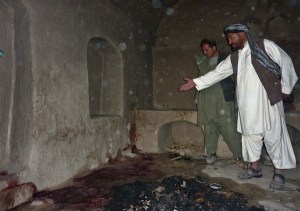
Judah Pleads for Benjamin’s Release
18 Then Judah stepped up to him and said, ‘O my lord, let your servant please speak a word in my lord’s ears, and do not be angry with your servant; for you are like Pharaoh himself.19My lord asked his servants, saying, “Have you a father or a brother?”20And we said to my lord, “We have a father, an old man, and a young brother, the child of his old age. His brother is dead; he alone is left of his mother’s children, and his father loves him.”21Then you said to your servants, “Bring him down to me, so that I may set my eyes on him.”22We said to my lord, “The boy cannot leave his father, for if he should leave his father, his father would die.”23Then you said to your servants, “Unless your youngest brother comes down with you, you shall see my face no more.”24When we went back to your servant my father we told him the words of my lord.25And when our father said, “Go again, buy us a little food”,26we said, “We cannot go down. Only if our youngest brother goes with us, will we go down; for we cannot see the man’s face unless our youngest brother is with us.”27Then your servant my father said to us, “You know that my wife bore me two sons;28one left me, and I said, Surely he has been torn to pieces; and I have never seen him since.29If you take this one also from me, and harm comes to him, you will bring down my grey hairs in sorrow to Sheol.”30Now therefore, when I come to your servant my father and the boy is not with us, then, as his life is bound up in the boy’s life,31when he sees that the boy is not with us, he will die; and your servants will bring down the grey hairs of your servant our father with sorrow to Sheol.32For your servant became surety for the boy to my father, saying, “If I do not bring him back to you, then I will bear the blame in the sight of my father all my life.”33Now therefore, please let your servant remain as a slave to my lord in place of the boy; and let the boy go back with his brothers.34For how can I go back to my father if the boy is not with me? I fear to see the suffering that would come upon my father.’
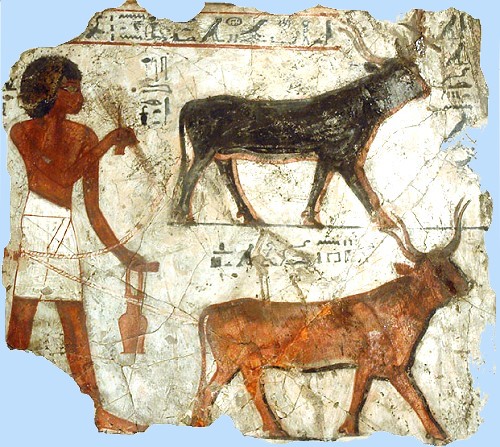
Egyptian farmer
This eloquent plea on behalf of his youngest brother out of loving care for his father, shows Joseph that Judah has come a long way from the man who sold him into slavery. He recognises and values the love that binds families together, and even respects the special love his father has for Benjamin. Joseph too has had to make his own journey from self-absorption to caring, in his case, for a whole people. The story constantly nudges the reader, through its sympathetic rendering of its characters feelings, towards recognising the nature of human kindness which begins with one’s own ” kind” and expands to include strangers. The revelation of this kindness is the purpose of God who dreams a future for all the characters he has created.
Mark 5:21-43
A Girl Restored to Life and a Woman Healed
21 When Jesus had crossed again in the boat* to the other side, a great crowd gathered round him; and he was by the lake.22Then one of the leaders of the synagogue named Jairus came and, when he saw him, fell at his feet23and begged him repeatedly, ‘My little daughter is at the point of death. Come and lay your hands on her, so that she may be made well, and live.’24So he went with him.
And a large crowd followed him and pressed in on him.25Now there was a woman who had been suffering from haemorrhages for twelve years.26She had endured much under many physicians, and had spent all that she had; and she was no better, but rather grew worse.27She had heard about Jesus, and came up behind him in the crowd and touched his cloak,28for she said, ‘If I but touch his clothes, I will be made well.’29Immediately her haemorrhage stopped; and she felt in her body that she was healed of her disease.30Immediately aware that power had gone forth from him, Jesus turned about in the crowd and said, ‘Who touched my clothes?’31And his disciples said to him, ‘You see the crowd pressing in on you; how can you say, “Who touched me?” ’32He looked all round to see who had done it.33But the woman, knowing what had happened to her, came in fear and trembling, fell down before him, and told him the whole truth.34He said to her, ‘Daughter, your faith has made you well; go in peace, and be healed of your disease.’
35 While he was still speaking, some people came from the leader’s house to say, ‘Your daughter is dead. Why trouble the teacher any further?’36But overhearing* what they said, Jesus said to the leader of the synagogue, ‘Do not fear, only believe.’37He allowed no one to follow him except Peter, James, and John, the brother of James.38When they came to the house of the leader of the synagogue, he saw a commotion, people weeping and wailing loudly.39When he had entered, he said to them, ‘Why do you make a commotion and weep? The child is not dead but sleeping.’40And they laughed at him. Then he put them all outside, and took the child’s father and mother and those who were with him, and went in where the child was.41He took her by the hand and said to her, ‘Talitha cum’, which means, ‘Little girl, get up!’42And immediately the girl got up and began to walk about (she was twelve years of age). At this all were overcome with amazement.43He strictly ordered them that no one should know this, and told them to give her something to eat.
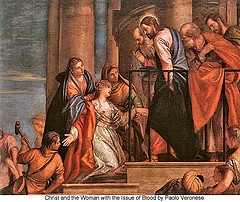
The woman who suffered from bleeding identifies herself to Jesus
This marvellous piece of gospel art depicts,by nesting the story of the sick woman within the story of a sick girl, the kindness of God towards women. This kindness is mediated by the physical presence of Jesus in situations which are forbidden by social taboo: the woman is unclean because of her bleeding and must not touch a man; and the girl in unclean because she is ” dead”. Jesus has to break these taboos in order to reveal God’s kindness. The woman’s own desperate trust in Jesus is shown by her initial breach of the taboo to which he gives specific approval by asking her to identify herself. Her willingness to do so is a public act of faith. In the case of the girl, Jesus goes into the very place of death and brings her out. His gentle command, “Time to get up, my wee dove” is a startling image of what the crucified and risen Lord will say to all humanity, amongst whom women will be equal sharers of God’s kindness. For Mark, the resurrection begins in the minstry of Jesus who by his bodily presence amongst evil and death, reveals God’s life. The Christian Church has the duty of continuing this ministry by its own bodily presence in places of destruction, saying to the world God loves, “Time to get up!”
 Emmock's Blog