This blog provides a meditation on the Episcopal daily readings along with a headline from world news:
Thomas Lubanga convicted for use of child soldiers in DR Congo

Lubanga (left)
Genesis 45:16-28
16 When the report was heard in Pharaoh’s house, ‘Joseph’s brothers have come’, Pharaoh and his servants were pleased.17Pharaoh said to Joseph, ‘Say to your brothers, “Do this: load your animals and go back to the land of Canaan.18Take your father and your households and come to me, so that I may give you the best of the land of Egypt, and you may enjoy the fat of the land.”19You are further charged to say, “Do this: take wagons from the land of Egypt for your little ones and for your wives, and bring your father, and come.20Give no thought to your possessions, for the best of all the land of Egypt is yours.” ’
21 The sons of Israel did so. Joseph gave them wagons according to the instruction of Pharaoh, and he gave them provisions for the journey.22To each one of them he gave a set of garments; but to Benjamin he gave three hundred pieces of silver and five sets of garments.23To his father he sent the following: ten donkeys loaded with the good things of Egypt, and ten female donkeys loaded with grain, bread, and provision for his father on the journey.24Then he sent his brothers on their way, and as they were leaving he said to them, ‘Do not quarrel* along the way.’
25 So they went up out of Egypt and came to their father Jacob in the land of Canaan.26And they told him, ‘Joseph is still alive! He is even ruler over all the land of Egypt.’ He was stunned; he could not believe them.27But when they told him all the words of Joseph that he had said to them, and when he saw the wagons that Joseph had sent to carry him, the spirit of their father Jacob revived.28Israel said, ‘Enough! My son Joseph is still alive. I must go and see him before I die.’
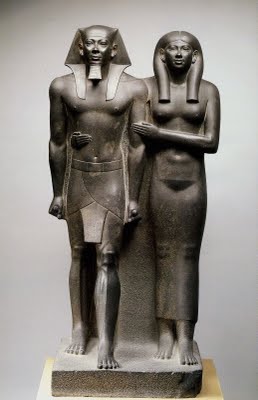
Pharaoh Menkaure and Consort
In this case the generosity of God to his special family is shown by Pharaoh! After the crisis of the story with its tangle of emotions, there is need for an expression of joy and satisfaction. The response of Pharaoh and his servants provides this. All will be well, the story tells us. Jacob will be reassured of his lost son’s survival and will receive all the honours of Egypt. Jacob’s own response is measured, reckoning that he’ll see Joseph before he dies. Readers who know the subsequent story realise that one day there will be a Pharaoh “who knows not Joseph” and that the purpose of God’s dream for his people will then be put to the test. For the moment however, an inclusive generosity holds sway. That may be, the story suggests, the best we can ask for in this life.
Mark 6:13-29
J.B. Phillips New Testament (PHILLIPS)
12-13So they went out and preached that men should change their whole outlook. They expelled many evil spirits and anointed many sick people with oil and healed them.
Herod’s guilty conscience
14-16“All this came to the ears of king Herod, for Jesus’ reputation was spreading, and people were saying that John the Baptist had risen from the dead, and that was why he was showing such miraculous powers. Others maintained that he was Elijah, and others that he was one of the prophets of the old days come back again. But when Herod heard of all this, he said, “It must be John whom I beheaded, risen from the dead!”
17-20For Herod himself had sent and arrested John and had him bound in prison, all on account of Herodias, wife of his brother Philip. He had married her, though John used to say to Herod, “It is not right for you to possess your own brother’s wife.” Herodias herself was furious with him for this and wanted to have him executed, but she could not do it, for Herod had a deep respect for John, knowing that he was a just and holy man, and protected him. He used to listen to him and be profoundly disturbed, and yet he enjoyed hearing him.21-23Then a good opportunity came, for Herod gave a birthday party for his courtiers and army commanders and for the leading people in Galilee. Herodias’ daughter came in and danced, to the great delight of Herod and his guests. The king said to the girl, “Ask me anything you like and I will give it to you!” And he swore to her, “I will give you whatever you ask me, up to half of my kingdom!”
24And she went and spoke to her mother, “What shall I ask for?” And she said, “The head of John the Baptist!”
25The girl rushed back to the king’s presence, and made her request. “I want you to give me, this minute, the head of John the Baptist on a dish!” she said.
26-29Herod was aghast, but because of his oath and the presence of his guests, he did not like to refuse her. So he sent one of the palace guardsman straightaway to bring him John’s head. He went off and beheaded him in the prison, brought back his head on the dish, and gave it to the girl who handed it to her mother. When his disciples heard what had happened, they came and took away the body and put it in a tomb.”

The ruler who consumes his people
This is the only story in Mark which doesn’t focus on Jesus. Why does he want to tell the reader all this about Herod? The answer is that he wants to make a great contrast between a ruler who consumes (almost literally) his people; and (in the next story) a ruler, Jesus, who feeds his people. Herod’s rule is for Mark an example of corrupt power: unearned personal wealth, used for self-glorification; dubious sexual shenanigans; persecution of the truth-telling prophet; ordering obscene murder rather than losing face-that’s the picture we get of Herod, and it’s the picture of unjust rule in all times and places. Not only rulers of states but rulers of multinational companies in our own day have behaved in this way. The history of oil companies in Nigeria is just such a saga of corruption, murder and contempt for anyone who opposes them. Mark’s realism contrasts well with the bland complicity of most sections of our mass media. Those who think faith should have nothing to do with politics should look at what Mark is doing in his gospel.
 Emmock's Blog