 This blog provides a meditation on the Episcopal daily readings along with a headline from world news:

Syrian tyrant enjoys “gilded life style”
Genesis 46:1-7, 28-34
Jacob Brings His Whole Family to Egypt
46When Israel set out on his journey with all that he had and came to Beer-sheba, he offered sacrifices to the God of his father Isaac.2God spoke to Israel in visions of the night, and said, ‘Jacob, Jacob.’ And he said, ‘Here I am.’3Then he said, ‘I am God,* the God of your father; do not be afraid to go down to Egypt, for I will make of you a great nation there.4I myself will go down with you to Egypt, and I will also bring you up again; and Joseph’s own hand shall close your eyes.’
5 Then Jacob set out from Beer-sheba; and the sons of Israel carried their father Jacob, their little ones, and their wives, in the wagons that Pharaoh had sent to carry him.6They also took their livestock and the goods that they had acquired in the land of Canaan, and they came into Egypt, Jacob and all his offspring with him,7his sons, and his sons’ sons with him, his daughters, and his sons’ daughters; all his offspring he brought with him into Egypt.
Jacob Settles in Goshen
28 Israel* sent Judah ahead to Joseph to lead the way before him into Goshen. When they came to the land of Goshen,29Joseph made ready his chariot and went up to meet his father Israel in Goshen. He presented himself to him, fell on his neck, and wept on his neck a good while.30Israel said to Joseph, ‘I can die now, having seen for myself that you are still alive.’31Joseph said to his brothers and to his father’s household, ‘I will go up and tell Pharaoh, and will say to him, “My brothers and my father’s household, who were in the land of Canaan, have come to me.32The men are shepherds, for they have been keepers of livestock; and they have brought their flocks, and their herds, and all that they have.”33When Pharaoh calls you, and says, “What is your occupation?”34you shall say, “Your servants have been keepers of livestock from our youth even until now, both we and our ancestors”—in order that you may settle in the land of Goshen, because all shepherds are abhorrent to the Egyptians.’
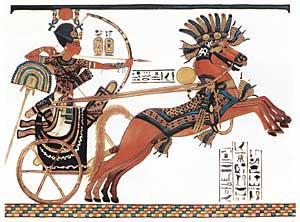
pharaoh in chariot
The most telling phrase in this story is “I myself shall go down with you and bring you up again” a divine promse which echoed for the Israelites not only in the exodus from Egypt but also in the return from Babylon. God shares the enforced exile of his people and brings them up again into the promised land. It also has an echo for Christian believers in the death and resurrection of Jesus-“I myself will go down with you…and bring you up..” Jacob knows that his own journeyings have been completed with this one, as it restores to him his lost son and leaves his whole family alive and provided for, which means more to him than any royal favours from Pharaoh. Joseph’s canny handling of God’s blessing reminds Jacob of his own carefulness in his younger years. His care bears fruit in Joseph.
Mark 6:30-46
Feeding the Five Thousand
30 The apostles gathered around Jesus, and told him all that they had done and taught.31He said to them, ‘Come away to a deserted place all by yourselves and rest a while.’ For many were coming and going, and they had no leisure even to eat.32And they went away in the boat to a deserted place by themselves.33Now many saw them going and recognized them, and they hurried there on foot from all the towns and arrived ahead of them.34As he went ashore, he saw a great crowd; and he had compassion for them, because they were like sheep without a shepherd; and he began to teach them many things.35When it grew late, his disciples came to him and said, ‘This is a deserted place, and the hour is now very late;36send them away so that they may go into the surrounding country and villages and buy something for themselves to eat.’37But he answered them, ‘You give them something to eat.’ They said to him, ‘Are we to go and buy two hundred denarii* worth of bread, and give it to them to eat?’38And he said to them, ‘How many loaves have you? Go and see.’ When they had found out, they said, ‘Five, and two fish.’39Then he ordered them to get all the people to sit down in groups on the green grass.40So they sat down in groups of hundreds and of fifties.41Taking the five loaves and the two fish, he looked up to heaven, and blessed and broke the loaves, and gave them to his disciples to set before the people; and he divided the two fish among them all.42And all ate and were filled;43and they took up twelve baskets full of broken pieces and of the fish.44Those who had eaten the loaves numbered five thousand men.
Jesus Walks on the Water
45 Immediately he made his disciples get into the boat and go on ahead to the other side, to Bethsaida, while he dismissed the crowd.46After saying farewell to them, he went up on the mountain to pray.

ancient Christian mosaic
See yesterday’s blog 684 for the picture of the corrupt ruler which Mark contrasts with this picture of the true ruler of God’s people. The key difference is that Jesus the true ruler feeds his people through his disciples using the meagre resources they have.
1. Tyrants like crowds and treat the people en masse. The true ruler orders them into groups where they can be human.
2. Tyrants take the people’s resources and consume them for their own pleasure; the true ruler uses what his disciples possess to nourish the people.
3. Tyrants abuse the rituals of state to take life; the true ruler “takes” “blesses” “breaks” and “gives” words which remind the Christian reader of the Last Supper and the sacrificial giving of life on the cross.
4. Tyrants will use spectacular events to gain popularity; the true ruler refuses to seek popularity but seeks the source of life in prayer.
There are many lessons here for what we can call “the politics of the kingdom”. Any political programme claiming the inspiration of Jesus should display the characteristics numbered above. They might be used for example to discern what validity if any we should give to claims of Christian inspiration amongst those contending for the nomination of the Republican Party in the USA; or of claims by conservative politicians in Britain that “we are a Christian nation.”
 Emmock's Blog