
This blog provides a meditation on the Episcopal daily readings along with a headline from world news:
PRIEST WHO REFUSED COMMUNUION TO LESBIAN SAYS HE FOLLOWED CATHOLIC PRACTICE
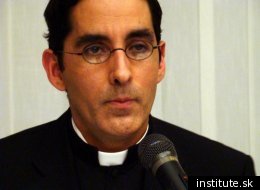
Fr. Marcel Guarnizo
GENESIS 47: 7-26
Then Joseph brought in his father Jacob, and presented him before Pharaoh, and Jacob blessed Pharaoh.8Pharaoh said to Jacob, ‘How many are the years of your life?’9Jacob said to Pharaoh, ‘The years of my earthly sojourn are one hundred and thirty; few and hard have been the years of my life. They do not compare with the years of the life of my ancestors during their long sojourn.’10Then Jacob blessed Pharaoh, and went out from the presence of Pharaoh.11Joseph settled his father and his brothers, and granted them a holding in the land of Egypt, in the best part of the land, in the land of Rameses, as Pharaoh had instructed.12And Joseph provided his father, his brothers, and all his father’s household with food, according to the number of their dependants.
<!– 13 –>
The Famine in Egypt
13 Now there was no food in all the land, for the famine was very severe. The land of Egypt and the land of Canaan languished because of the famine.14Joseph collected all the money to be found in the land of Egypt and in the land of Canaan, in exchange for the grain that they bought; and Joseph brought the money into Pharaoh’s house.15When the money from the land of Egypt and from the land of Canaan was spent, all the Egyptians came to Joseph, and said, ‘Give us food! Why should we die before your eyes? For our money is gone.’16And Joseph answered, ‘Give me your livestock, and I will give you food in exchange for your livestock, if your money is gone.’17So they brought their livestock to Joseph; and Joseph gave them food in exchange for the horses, the flocks, the herds, and the donkeys. That year he supplied them with food in exchange for all their livestock.18When that year was ended, they came to him the following year, and said to him, ‘We cannot hide from my lord that our money is all spent; and the herds of cattle are my lord’s. There is nothing left in the sight of my lord but our bodies and our lands.19Shall we die before your eyes, both we and our land? Buy us and our land in exchange for food. We with our land will become slaves to Pharaoh; just give us seed, so that we may live and not die, and that the land may not become desolate.’
20 So Joseph bought all the land of Egypt for Pharaoh. All the Egyptians sold their fields, because the famine was severe upon them; and the land became Pharaoh’s.21As for the people, he made slaves of them* from one end of Egypt to the other.22Only the land of the priests he did not buy; for the priests had a fixed allowance from Pharaoh, and lived on the allowance that Pharaoh gave them; therefore they did not sell their land.23Then Joseph said to the people, ‘Now that I have this day bought you and your land for Pharaoh, here is seed for you; sow the land.24And at the harvests you shall give one-fifth to Pharaoh, and four-fifths shall be your own, as seed for the field and as food for yourselves and your households, and as food for your little ones.’25They said, ‘You have saved our lives; may it please my lord, we will be slaves to Pharaoh.’26So Joseph made it a statute concerning the land of Egypt, and it stands to this day, that Pharaoh should have the fifth. The land of the priests alone did not become Pharaoh’s.

Egyptian slaves
The subtle contrast in the respective attitudes of Jacob and Joseph to Pharaoh is instructive: Jacob insists on his age and the great age of his ancestors, that is, he stands on his dignity before the mightiest man on earth and dares to take the initiative in blessing him, that is in having a superiority which can benefit the ruler. Jospeh on the other hand uses his intelligence so well for Pharaoh that he ends up turning a free population with lands of their own into Pharaoh’s serfs. We may say, as they did, that Joseph does it to save them from famine. He could however have given the seeds free of charge. Joseph’s excessive deference to Pharaoh’s interests is ironically mirrored in the later story of the Pharaoh who enslaves the Israelites. The narrator quietly prepares the reader for another stage of the story of God’s people.
Mark 6:47-56
47 When evening came, the boat was out on the lake, and he was alone on the land.48When he saw that they were straining at the oars against an adverse wind, he came towards them early in the morning, walking on the lake. He intended to pass them by.49But when they saw him walking on the lake, they thought it was a ghost and cried out;50for they all saw him and were terrified. But immediately he spoke to them and said, ‘Take heart, it is I; do not be afraid.’51Then he got into the boat with them and the wind ceased. And they were utterly astounded,52for they did not understand about the loaves, but their hearts were hardened.<!– 53 –>
Healing the Sick in Gennesaret
53 When they had crossed over, they came to land at Gennesaret and moored the boat.54When they got out of the boat, people at once recognized him,55and rushed about that whole region and began to bring the sick on mats to wherever they heard he was.56And wherever he went, into villages or cities or farms, they laid the sick in the market-places, and begged him that they might touch even the fringe of his cloak; and all who touched it were healed. 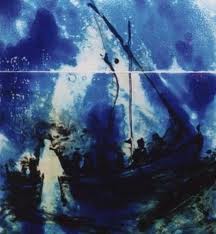
We have to unpick this narrative according to the imaginative world of the author. The disciples of Jesus are trying to cross the lake in a boat, that is, they are struggling with the powers of chaos and evil symbolised by the element of water. They are not making much headway. Jesus the (risen) son of God comes towards them intending to pass them by. He has a destination of his own. They are terrified by what they think is a ghost. (NB they are afraid of Him, not the storm!). Jesus identifies himself and joins them in the boat. The wind drops. The disciples don’t understand just as they haven’t understood the meaning of his Messianic feeding of the 5000. Soon they land and people are drawn to Jesus as by magnet. His physical presence brings healing.
For Mark the Jesus of his gospel is always already the crucified and risen Lord. The original version of Mark’s gospel has no resurrection story. That’s because for Mark the whole of Jesus ministry shows the power of the cross and resurrection breaking out into the everyday lives of people. Stories like this one reveal what is going on all the time in Jesus’ work: he goes into the place of chaos, death and evil to bring order, life and goodness where they are most needed. The readers are encouraged to see themselves in the unflattering portrait of the disciples: we like them long for more magic power than Jesus shows, and find it difficult to see the divine majesty in a man who feeds the hungry and tends the sick. One of the gifts of faith is an ability, in George McLeod’s great phrase, to see the “glory n the grey.”
 Emmock's Blog