
This blog provides a meditation on the Episcopal daily readings along with a headline from world news:
Aung San Suu Kyi wins in Burma

a people greets its true leader
SECOND CORINTHIANS 1
Salutation
1Paul, an apostle of Christ Jesus by the will of God, and Timothy our brother,
To the church of God that is in Corinth, including all the saints throughout Achaia:
2 Grace to you and peace from God our Father and the Lord Jesus Christ
Paul’s Thanksgiving after Affliction
3 Blessed be the God and Father of our Lord Jesus Christ, the Father of mercies and the God of all consolation,4who consoles us in all our affliction, so that we may be able to console those who are in any affliction with the consolation with which we ourselves are consoled by God.5For just as the sufferings of Christ are abundant for us, so also our consolation is abundant through Christ.6If we are being afflicted, it is for your consolation and salvation; if we are being consoled, it is for your consolation, which you experience when you patiently endure the same sufferings that we are also suffering.7Our hope for you is unshaken; for we know that as you share in our sufferings, so also you share in our consolation.

so daft and powerless...
My own study of Paul convinced me that 2 Corithians 1-9 is a slightly mixed up version of the last letter Paul wrote to Corinth and that the following chapters 10-13 are in fact the preceding “angry” letter in which he expressed his frustration at the attitude of the Corinthian church. (Those who would enjoy a narrative of these matters can find it in my “Paul: an Unauthorised Autobiography” available on Kindle) If I’m right, today’s passage is the beginning of Paul’s reconciliation with his converts in Corinth. In any case it strikes a note of consolation-a paradoxical sort of consolation that includes pain. In the shared life of those who follow Messiah Jesus, no suffering is wasted. If one suffers, it is for the benefit of another, because all suffering is a share in the redemptive suffering of Jesus which is the vehicle of God’s love and consolation. Like other Jewish people of his time, Paul expected a Messiah who would establish justice by acts of wisdom and power. Perhaps at first the fate of Jesus was for him the derisory end of a false teacher. So when he came to put his faith in Jesus he had to see his death on the cross as the world turned upside down: here in this Roman atrocity was a declaration of divine love so astonishingly daft and powerless as to disarm all the arrogance and violence of the world. We must be very careful not to turn Paul’s amazement at the cross of Messiah Jesus into something formulaic and matter of course. It’s this “abundant suffering” which overflows into the lives of believers and offers consolation.
At the start of another Holy Week there’s nothing better, especially for ministers of the Church, than recapturing our own wonder at the cross of Christ.
Mark 11:12-25
Jesus Curses the Fig Tree
12 On the following day, when they came from Bethany, he was hungry.13Seeing in the distance a fig tree in leaf, he went to see whether perhaps he would find anything on it. When he came to it, he found nothing but leaves, for it was not the season for figs.14He said to it, ‘May no one ever eat fruit from you again.’ And his disciples heard it.
Jesus Cleanses the Temple
15 Then they came to Jerusalem. And he entered the temple and began to drive out those who were selling and those who were buying in the temple, and he overturned the tables of the money-changers and the seats of those who sold doves;16and he would not allow anyone to carry anything through the temple.17He was teaching and saying, ‘Is it not written,
“My house shall be called a house of prayer for all the nations”? But you have made it a den of robbers.’
18And when the chief priests and the scribes heard it, they kept looking for a way to kill him; for they were afraid of him, because the whole crowd was spellbound by his teaching.19And when evening came, Jesus and his disciples* went out of the city.
The Lesson from the Withered Fig Tree
20 In the morning as they passed by, they saw the fig tree withered away to its roots.21Then Peter remembered and said to him, ‘Rabbi, look! The fig tree that you cursed has withered.’22Jesus answered them, ‘Have* faith in God.23Truly I tell you, if you say to this mountain, “Be taken up and thrown into the sea”, and if you do not doubt in your heart, but believe that what you say will come to pass, it will be done for you.24So I tell you, whatever you ask for in prayer, believe that you have received* it, and it will be yours. 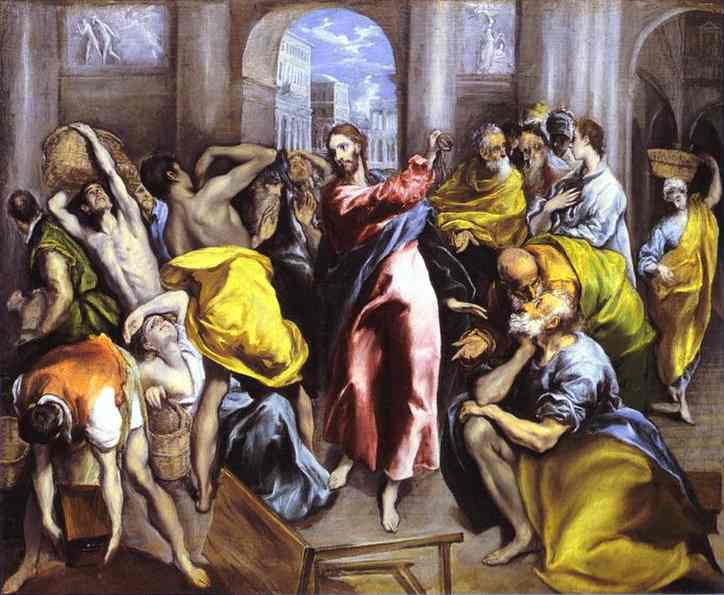
25 ‘Whenever you stand praying, forgive, if you have anything against anyone; so that your Father in heaven may also forgive you your trespasses.’*
Mark saw the cursing of the fig tree as a prophetic action, like those acted parables of Jeremeiah and Ezekiel. In this case the meaning is clear: God has expected the temple worship of his people to bear fruit, but it has not done so. For that reason, the temple is doomed. Jesus denounced the temple trading, not as a distraction from worship but as a brutal denial of the pupose of the “court of the gentiles” where it took place. Although Gentiles were excluded from the “court of Israel” (on pain of death) they were allowed into the public area of the temple for their own prayers. In the time of the Messiah it was expected that the Gentiles would flow up to the “house of God”. Jesus’ words “house of prayer for all nations” may refer to this expectation, and may indeed suggest that the prophecy was being fulfilled in his actions.
The story challenges religious people to ask if our own holy places are cluttered with “customs of exclusion” which assert our rightness by keeping others out. Everything from perfect liturgical propriety to charismatic ecstasy can express exclusivity, as can both orthodox theology (did Jesus ever ask if people believed the doctrine of the Trinity) and semi-agnostic carelessness (it doesn’t matter what you believe.) Often the exclusivity is not unconnected with the commercial interests of a religion. The true messiah enters the holy place and declares it open, but the means by which the holy of holies is actually torn open is nothing less than his death on the cross. (Mark 15:38).
In just these ways also he comes into the temple of my heart.
 Emmock's Blog