This blog provides a meditation on the Episcopal daily readings along with a headline from world news:
Bosnia still bears the scars of genocide
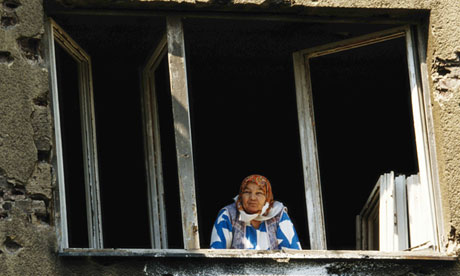
Bosnian woman looks from bullet-scarred building
Corinthians 10:14-17, 11:27-32
14 Therefore, my dear friends,* flee from the worship of idols.15I speak as to sensible people; judge for yourselves what I say.16The cup of blessing that we bless, is it not a sharing in the blood of Christ? The bread that we break, is it not a sharing in the body of Christ?17Because there is one bread, we who are many are one body, for we all partake of the one bread.<!– 27 –>
Partaking of the Supper Unworthily
27 Whoever, therefore, eats the bread or drinks the cup of the Lord in an unworthy manner will be answerable for the body and blood of the Lord.28Examine yourselves, and only then eat of the bread and drink of the cup.29For all who eat and drink* without discerning the body,* eat and drink judgement against themselves.30For this reason many of you are weak and ill, and some have died.*31But if we judged ourselves, we would not be judged.32But when we are judged by the Lord, we are disciplined* so that we may not be condemned along with the world
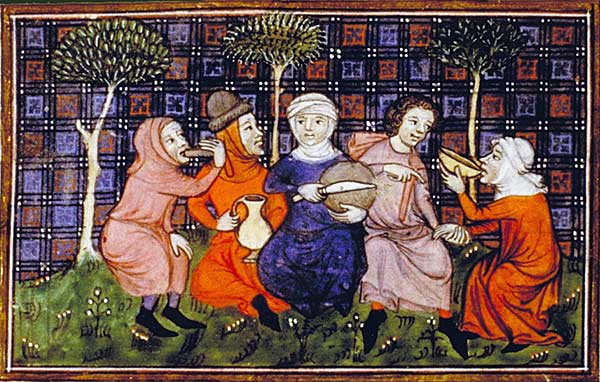
peasants breaking bread-medieval
Both sacramentalists and anti-sacramentalists have made a meal (!) of these passages where clearly Paul is talking about far more than a ritual:
1. When he speaks of the body and blood of Jesus, he means the life of Jesus poured out for, shared with, others- supremely in his death on the cross.
2. When he speaks of the “body” without qualification, he means a life which believers share with each other and with Jesus their Lord.
3. The Lord’s supper is only a channel of God’s goodness if those who share it are committed to this shared life.
4. Before sharing the supper we should examine our lives to see if we have neglected or refused to share our lives with each other and our Lord. Our own judgment and that of Christ will bring us to the table in a contrite and disciplined frame of mind. There is no suggestion that if we have sinned we should not be there at all.
5. Paul believes that the refusal of shared life is weakening and destructive. It is contrary to the all -inclusive, multi-ethnic nature of the “assembly” of God’s people and devalues the poured- out life of the One whose cross is “offensive to Jews and daft to Gentiles”. It can cause genocide.
Mark 14:12-25
<!– 12 –>
The Passover with the Disciples
12 On the first day of Unleavened Bread, when the Passover lamb is sacrificed, his disciples said to him, ‘Where do you want us to go and make the preparations for you to eat the Passover?’13So he sent two of his disciples, saying to them, ‘Go into the city, and a man carrying a jar of water will meet you; follow him,14and wherever he enters, say to the owner of the house, “The Teacher asks, Where is my guest room where I may eat the Passover with my disciples?”15He will show you a large room upstairs, furnished and ready. Make preparations for us there.’16So the disciples set out and went to the city, and found everything as he had told them; and they prepared the Passover meal.
17 When it was evening, he came with the twelve.18And when they had taken their places and were eating, Jesus said, ‘Truly I tell you, one of you will betray me, one who is eating with me.’19They began to be distressed and to say to him one after another, ‘Surely, not I?’20He said to them, ‘It is one of the twelve, one who is dipping bread* into the bowl* with me.21For the Son of Man goes as it is written of him, but woe to that one by whom the Son of Man is betrayed! It would have been better for that one not to have been born.’<!– 22 –>
The Institution of the Lord’s Supper
22 While they were eating, he took a loaf of bread, and after blessing it he broke it, gave it to them, and said, ‘Take; this is my body.’23Then he took a cup, and after giving thanks he gave it to them, and all of them drank from it.24He said to them, ‘This is my blood of the* covenant, which is poured out for many.25Truly I tell you, I will never again drink of the fruit of the vine until that day when I drink it new in the kingdom of God.’

shared life
This passage is part of the oldest strand of the material that the gospel writers inherited from their communities. That means it may reflect the most closely the evidence of original witnesses; but at the same time, it’s the most worked-over and the most likely to say what the communities wanted it to say. We should certainly not assume it’s a blow-by-blow account of what happened. This pasage says that Jesus, knowing that the religious authorities might arrest him, had arranged a safe house where he could celebrate passover with the twelve. We should be suspicious of this. Who cooked the last supper? Where were the female disciples? (The only ones who didn’t run away!) The tradition that one of the twelve “handed Jesus over” is very old and presumably historical as it asks questions of Jesus’ original choice and of the nature of the “twelve”. We know very little about Judas Iscariot, which has given scope for much fairly banal speculation. Mark means the reader to see that Jesus was recasting the passover meal to point to the significance of his own death. Bread which has already been used by Jesus in the 5000 feeding as a sign of shared life and would be used as such within the passover meal, is here recast as a sign of violent death. Even if Jesus didn’t say, “broken for you” the breaking of the bread with the words “this is my body” is a clear statement: Jesus bodily self will be broken to sustain his followers. The cup of wine, used for a blessing in the passover is also recast: it is first of all, “blood of the covenant”. Any covenant could be sealed with the sign of blood but Jews did not see the Mosaic covenant as sealed in that way. Someone has taken the fact of the passover lambs, whose blood protected the Israelites from the angel of death, and made it into blood of the “covenant” by which the Israelites went out from slavery into freedom. Jesus’ blood is a sign of a new covenant of deliverance from slavery but this time it is “for many”-a code phrase by which Jesus means, “all nations”. Jesus’ life poured out, Mark tells the reader, is the foundational sacrifice of a new divine deliverance for all humanity. Did Jesus want his death to be seen this way? I think so, because it’s consonant with what we know about his ministry and teaching. For Mark, however, these material signs of Jesus’ presence would have seemed especially apropriate as throughout his whole gospel, Jesus’ bodily presence has been presented as a channel of deliverance and new life.
I never share in holy communion without asking, as his first disciples did, “Surely it’s not I?” but all too often, it is.
 Emmock's Blog