
This blog provides a meditation on the Episcopal daily readings along with a headline from world news:
 Gunter Grass barred from Israel for proposing nuclear inspection of Iran and Israel

Exodus 12:21-27
21 Then Moses called all the elders of Israel and said to them, ‘Go, select lambs for your families, and slaughter the passover lamb.22Take a bunch of hyssop, dip it in the blood that is in the basin, and touch the lintel and the two doorposts with the blood in the basin. None of you shall go outside the door of your house until morning.23For the Lord will pass through to strike down the Egyptians; when he sees the blood on the lintel and on the two doorposts, the Lord will pass over that door and will not allow the destroyer to enter your houses to strike you down.24You shall observe this rite as a perpetual ordinance for you and your children.25When you come to the land that the Lord will give you, as he has promised, you shall keep this observance.26And when your children ask you, “What do you mean by this observance?”27you shall say, “It is the passover sacrifice to the Lord, for he passed over the houses of the Israelites in Egypt, when he struck down the Egyptians but spared our houses.” ’ And the people bowed down and worshipped.
It’s hard to look at the rules for this festival without questions: what kind of people build the murder of another nation’s first-born into their own holiest celebration? Yes, of course the story tells us of the obduracy of the Egyptian ruler who has enslaved the Israeltes, but unless we are very naive we have to ask, “Who’s telling this story?” While there may be some small historical evidence for the presence of Hebrews in Egypt there is no evidence at all for the story told in Exodus, which in any case was put in its final form 1000 years or so after the supposed events it recounts. Whatever traditions of ancient times there may have been in some Israeli clans, they would not have contained many facts. What we’re dealing with is the establishment and editing of the religious traditions of Israel between the 6th and 3rd centuries before Christ, under the guidance of leaders who wanted to keep the people together through faith in one God and his Torah. So the answer to the question about the Passover cannot be “because those are historical facts” and has to be “because that’s the story the religious leaders wanted to tell and celebrate.” God’s faithfulness to Israel is expressed in the murder of Egyptians.
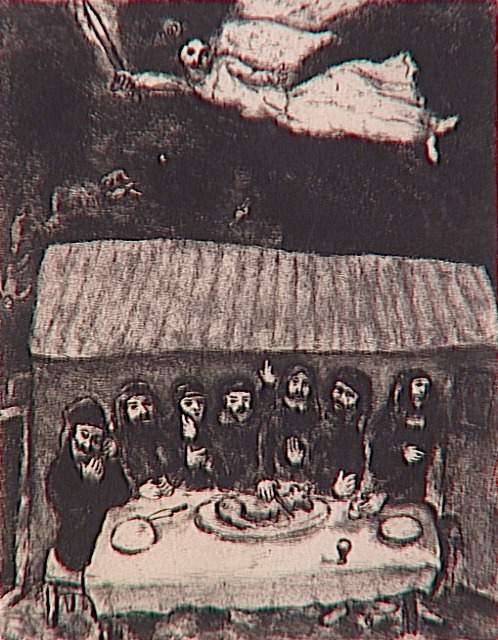
the angel of death passes over
I know this negative questioning is not to the taste of many bible scholars, especially not to those who take an uncritical view of “God’s people Israel”, both those who come from what is called the “evangelical” wing of the church and those who who call themsleves “liberation” theologians. But those of us who value our Jewish heritage of faith and want to transmit it to our grandchildren have to be honest: if God’s favour to one people involves the murder of another, who needs this God? We can only hold onto the heritage if we allow it to come into collision with the story of the crucified and risen Jesus whom the angel did not pass over, and of the 6 million 20th century Jewish men women and children whom the angel did not pass over.
Mark 16:1-8
The Resurrection of Jesus
16When the sabbath was over, Mary Magdalene, and Mary the mother of James, and Salome bought spices, so that they might go and anoint him.2And very early on the first day of the week, when the sun had risen, they went to the tomb.3They had been saying to one another, ‘Who will roll away the stone for us from the entrance to the tomb?’4When they looked up, they saw that the stone, which was very large, had already been rolled back.5As they entered the tomb, they saw a young man, dressed in a white robe, sitting on the right side; and they were alarmed.6But he said to them, ‘Do not be alarmed; you are looking for Jesus of Nazareth, who was crucified. He has been raised; he is not here. Look, there is the place they laid him.7But go, tell his disciples and Peter that he is going ahead of you to Galilee; there you will see him, just as he told you.’8So they went out and fled from the tomb, for terror and amazement had seized them; and they said nothing to anyone, for they were afraid.*
Here Mark tells the story of the “Great Exodus” that is, the deliverance of Jesus and his disciples from evil and death. In think that vereses 1-8 are roughly what Mark wanted to give his readers (all the other verses are added by editors who didn’t see what Mark was doing.) Why doesn’t Mark tell the stories of the appearances of risen Lord? One answer is that Mark never presents anyone other than the crucified and risen Lord Jesus. Throughout his whole gospel Jesus acts as the one who bears the evil of the world and conquers it. When Mark has the disciples ask, “Who is this, whom even the waves and winds obey?” the answer is, “the crucified and risen Lord.”

he is not here...
The other answer is that Mark knows the stories of the appearances of Jesus to his disciples and knows that they cannot be the substance of faith: at best they can point the seeker in the right direction. In his story the disciples are reminded that Jesus will go before them to Galilee, where he will meet them. That is, those who return to the workaday world holding to Jesus’ promise will meet Him there. That’s Mark’s message to his readers also: as they hold to Jesus’ promise in their own Galilees, they will be companioned by the risen Lord and come to know him in a way that is not dependent on the testimony of others. In effect the end of Mark’s Gospel leads the reader back to its first words, “The beginning of the gospel of Jesus Messiah, the Son Of God.” The day of the resurrection was not the Jewish Sabbath but rather the first day of the working week. Jesus comes back to get on with the job along with those who follow him. By making resurrection day a weekly holiday we’ve lost this realism and made the resurrection an end in itself.
 Emmock's Blog