This blog provides a meditation on the Episcopal daily readings along with a headline from wold news:
SYRIAN CEASEFIRE BEGINS WITH FIFTY DEATHS

Syrian victims in Lebanon
Exodus 12:40-51
40 The time that the Israelites had lived in Egypt was four hundred and thirty years.41At the end of four hundred and thirty years, on that very day, all the companies of the Lord went out from the land of Egypt.42That was for the Lord a night of vigil, to bring them out of the land of Egypt. That same night is a vigil to be kept for the Lord by all the Israelites throughout their generations.<!– 43 –>
Directions for the Passover
43 The Lord said to Moses and Aaron: This is the ordinance for the passover: no foreigner shall eat of it,44but any slave who has been purchased may eat of it after he has been circumcised;45no bound or hired servant may eat of it.46It shall be eaten in one house; you shall not take any of the animal outside the house, and you shall not break any of its bones.47The whole congregation of Israel shall celebrate it.48If an alien who resides with you wants to celebrate the passover to the Lord, all his males shall be circumcised; then he may draw near to celebrate it; he shall be regarded as a native of the land. But no uncircumcised person shall eat of it;49there shall be one law for the native and for the alien who resides among you.
50 All the Israelites did just as the Lord had commanded Moses and Aaron.51That very day the Lord brought the Israelites out of the land of Egypt, company by company.

Seder(Passover) in families
I don’t understand Passover but I know that Jesus celebrated it and understood it. I can imagine what he would have believed about it:
1. That it celebrated the foundation of God’s covenant with Israel. That is, the covenant which seems a balanced partnership -God commands, Israel obeys- is founded on the gracious choice of Israel by God and his delieverance of his people from Egypt. As Hosea makes God say, “I called my son out of Egypt.”
2. That although it celebrated God’s choice of Israel, it was open to slaves and foreigners. It was not a “racial” possession.
3. That it returned Israel to its condition on the night of deliverance-not a proud nation but a gathering of refugees guided by God.
4. That it was not bound to the authority of the priesthood but shared in families and amongst friends.
Matthew Mark and Luke (but not John!) depict Jesus’ last supper as a passover meal in which he uses the unleavened bread, the bread of the escape from slavery, as a symbol of his own life: He is their road to freedom. He also uses the cup of blessing as a symbol of his lfe-blood poured out: the generous, sacrificial outpouring of his life establishes a new partnership with God into which all people (“Many”) may enter.
I have always benefitted from Maundy Thursday communions which use the passover liturgy in a more recognisable form than in our usual communion liturgy, bringing me closer to the faith of Israel while closer still to the Israelite who changed it forever.
Matthew 28:1-16
<!– 28 –>28After the sabbath, as the first day of the week was dawning, Mary Magdalene and the other Mary went to see the tomb.2And suddenly there was a great earthquake; for an angel of the Lord, descending from heaven, came and rolled back the stone and sat on it.3His appearance was like lightning, and his clothing white as snow.4For fear of him the guards shook and became like dead men.5But the angel said to the women, ‘Do not be afraid; I know that you are looking for Jesus who was crucified.6He is not here; for he has been raised, as he said. Come, see the place where he* lay.7Then go quickly and tell his disciples, “He has been raised from the dead,* and indeed he is going ahead of you to Galilee; there you will see him.” This is my message for you.’8So they left the tomb quickly with fear and great joy, and ran to tell his disciples.9Suddenly Jesus met them and said, ‘Greetings!’ And they came to him, took hold of his feet, and worshipped him.10Then Jesus said to them, ‘Do not be afraid; go and tell my brothers to go to Galilee; there they will see me.’<!– 11 –>
The Report of the Guard
11 While they were going, some of the guard went into the city and told the chief priests everything that had happened.12After the priests* had assembled with the elders, they devised a plan to give a large sum of money to the soldiers,13telling them, ‘You must say, “His disciples came by night and stole him away while we were asleep.”14If this comes to the governor’s ears, we will satisfy him and keep you out of trouble.’15So they took the money and did as they were directed. And this story is still told among the Jews to this day.
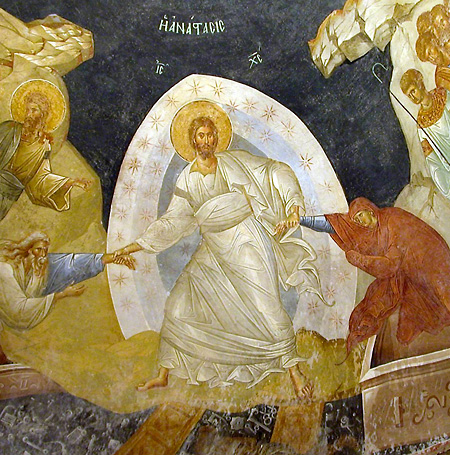
Through Jesus God rescues humanity from death
<!– 16 –>Only Matthew gives anything like a description of Jesus’ resurrection, and even he limits himself to a dramatic narrative of the stone being rolled away. I love the detail of God’s angel perched on the stone which has been placed as a end point to Jesus’ life, but I don’t think that the angel would have appeared in a news photo taken at the time. The stories in the gospels are not eye-witness historical acounts but the carefully crafted, sacred narratives of communities who believed in Jesus Messiah: they say what believers believed and wanted to tell each other and the world. As such they tell us more than any so-called factual account could possible do, as they present in the one story a record of events and of years of meditation on the meaning of these events. The angel is not there because there was a definitive spotting of an angel at the time, but because believers experienced the presence of Jesus Messiah as God’s triumph over evil and death. So was there really an angel? There would have been no angel in a photograph but there was really an angel. We can note that Matthew goes beyond Mark (who has no appearances of Jesus at all) in mentioning a brief encounter of the risen Lord with the women near the tomb in Jerusalem and a meeting with all his followers in Galilee. When we deal with the gospel stories of resurrection we are allowed entry into the community life of people who had experienced the utter transformation of their own lives by the life of Jesus of Nazareth as a personal and a communal presence amonst them, and whose mixture of remembrance of Jesus and celebration of his presence, created the gospel stories. It’s important to recognise that those who want to make the stories into mere historical accounts are demeaning them and failing to respond to their power.
 Emmock's Blog