This blog provides a meditation on the Episcopal daily readings along with a headline from world news:
North Korean missile falls into the sea

oops
13The Lord said to Moses:2Consecrate to me all the firstborn; whatever is the first to open the womb among the Israelites, of human beings and animals, is mine.<!– 11 –>
The Consecration of the Firstborn
11 ‘When the Lord has brought you into the land of the Canaanites, as he swore to you and your ancestors, and has given it to you,12you shall set apart to the Lord all that first opens the womb. All the firstborn of your livestock that are males shall be the Lord’s.13But every firstborn donkey you shall redeem with a sheep; if you do not redeem it, you must break its neck. Every firstborn male among your children you shall redeem.14When in the future your child asks you, “What does this mean?” you shall answer, “By strength of hand the Lord brought us out of Egypt, from the house of slavery.15When Pharaoh stubbornly refused to let us go, the Lord killed all the firstborn in the land of Egypt, from human firstborn to the firstborn of animals. Therefore I sacrifice to the Lord every male that first opens the womb, but every firstborn of my sons I redeem.”16It shall serve as a sign on your hand and as an emblem* on your forehead that by strength of hand the Lord brought us out of Egypt.’
This is another example (see blog 709) of how God’s deliverance of the people from Egypt becomes an “eternal event” which doesn’t slip into the past but is actualised over and over again in the custom of the people-in this case, the sacrifice of the first-born animal, and, by proxy of animal substitution, first-born human children. Such sacrifices existed in the customs of other peoples at the time, so we may guess that the Israelites reintepreted existing custom for the new purpose of celebrating God’s “mighty deeds.” I have a slightly uneasy feeling nevertheless about this custom. It’s almost as if they knew God could be a killer and proper sacrifices would make sure he didn’t kill their first-born. The status of the first-born male child as belonging to God has profound echoes in Judaism-think of Isaac or Samuel-and even within Christianity-think of Jesus.
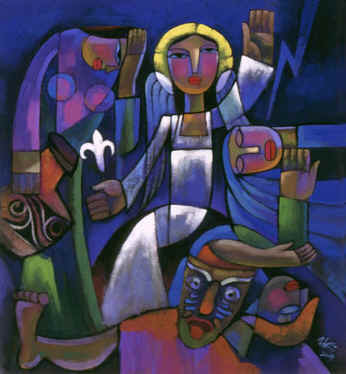
He Qi
Luke 24:1-12
The Resurrection of Jesus
24But on the first day of the week, at early dawn, they came to the tomb, taking the spices that they had prepared.2They found the stone rolled away from the tomb,3but when they went in, they did not find the body.*4While they were perplexed about this, suddenly two men in dazzling clothes stood beside them.5The women* were terrified and bowed their faces to the ground, but the men* said to them, ‘Why do you look for the living among the dead? He is not here, but has risen.*6Remember how he told you, while he was still in Galilee,7that the Son of Man must be handed over to sinners, and be crucified, and on the third day rise again.’8Then they remembered his words,9and returning from the tomb, they told all this to the eleven and to all the rest.10Now it was Mary Magdalene, Joanna, Mary the mother of James, and the other women with them who told this to the apostles.11But these words seemed to them an idle tale, and they did not believe them.12But Peter got up and ran to the tomb; stooping and looking in, he saw the linen cloths by themselves; then he went home, amazed at what had happened.*

The resurrection: Zacek
If God does sometimes intervene, why the hell doesn’t He intervene more often?
My answer is that God has given total freedom to the universe to be itself. If human beings are to have free will, that freedom has to be given to every atom in the universe. God works amongst his creatures by persuasion and inspiration but not by inteference. There are no exceptions, he has no favourites. That’s the nature of God’s love. So I can’t believe that God stooped to any hocus-pocus with a dead body in the case of his son Jesus. But if we are “with God”, and I believe the dead are with God, we are no longer part of this universe and no longer subject to its rules.
Wise readers will be able to spot all sorts of problems with his view, some of which I’ve noticed myself. Still, it’s all part of my struggle to make sense of my Christian faith and my commitment to scientific truth, and may therefore be some help others engaged in the same struggle.
 Emmock's Blog