
This blog provides a meditation on the Episcopal daily readings along with a headline from world news:
Breivik raises an arm 
Exodus 14:21-31
21 Then Moses stretched out his hand over the sea. The Lord drove the sea back by a strong east wind all night, and turned the sea into dry land; and the waters were divided.22The Israelites went into the sea on dry ground, the waters forming a wall for them on their right and on their left.23The Egyptians pursued, and went into the sea after them, all of Pharaoh’s horses, chariots, and chariot drivers.24At the morning watch the Lord in the pillar of fire and cloud looked down upon the Egyptian army, and threw the Egyptian army into panic.25He clogged* their chariot wheels so that they turned with difficulty. The Egyptians said, ‘Let us flee from the Israelites, for the Lord is fighting for them against Egypt.’
The Pursuers Drowned
26 Then the Lord said to Moses, ‘Stretch out your hand over the sea, so that the water may come back upon the Egyptians, upon their chariots and chariot drivers.’27So Moses stretched out his hand over the sea, and at dawn the sea returned to its normal depth. As the Egyptians fled before it, the Lord tossed the Egyptians into the sea.28The waters returned and covered the chariots and the chariot drivers, the entire army of Pharaoh that had followed them into the sea; not one of them remained.29But the Israelites walked on dry ground through the sea, the waters forming a wall for them on their right and on their left.
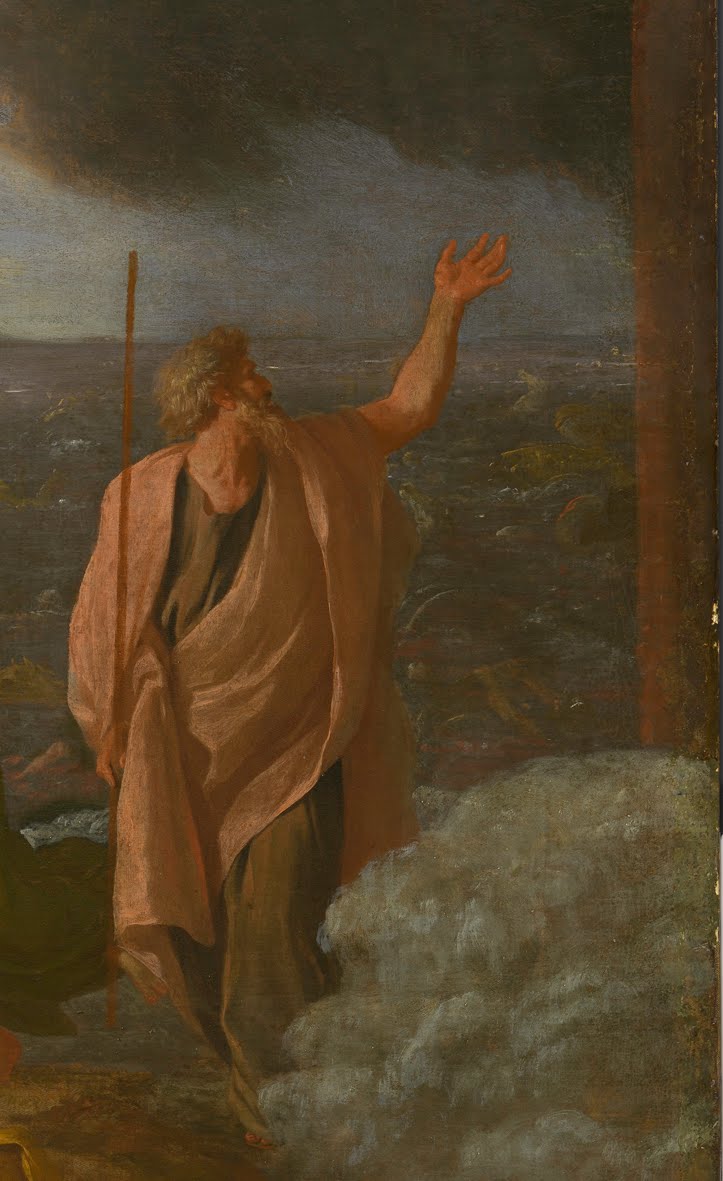
Moses' raised arm
30 Thus the Lord saved Israel that day from the Egyptians; and Israel saw the Egyptians dead on the seashore.31Israel saw the great work that the Lord did against the Egyptians. So the people feared the Lord and believed in the Lord and in his servant Moses.
The oldest evidence for the Red Sea battle is an ancient Israeli victory song quoted in the Bible:
“Sing to the Lord for he has triumphed gloriously/ Horse and rider he has thrown into the sea.”
One thing that the legends of the Exodus tell us is that Israel’s God is not to be messed with. the Egyptians are deliberately trapped and drowned. I don’t personally believe in a God who does things like this-indeed if such a God existed I’d prefer being drowned to worshipping him. But it’s one of the great cartoon stories. Children can see the approaching mighty army of Egyptians chasing the tiny group of Israelites who are surely doomed? But no, God opens a way for them through the terrible waters, entices the Egyptian army into the same track, then let’s them have it. Wow! Zap! Israelites 10, Egyptians 0. It’s a story that gives heart to all small people menaced by great powers. My Cuban friend Pablo applies it to the relationship of his country to the USA over his lifetime. So many ways the great power has planned to destroy his country, so many tmes they’ve been defeated. He puts it down to God rarther than Fidel.
Actually the story is carefully constructed to provide a precise image of God’s help to faithful people. When they’re faced with an obstacle which like the Red Sea seems insuperable, people who trust in God often find that there is, after all, a way through. People who trust arrogantly in their own strength, on the other hand, often come to grief. But it’s good to remember that Israel and Egypt are roles to be played out in life rather than fixed identities. In some instances today for example, Israel plays the role of Egypt the great power, and leaves the role of Israel to the Palestinians. The Exodus story tells any people that wants to be God’s people to trust in God and not their own might or armaments. It’s unlikely to be a popular message.
John 14:1-17
Jesus the Way to the Father
14‘Do not let your hearts be troubled. Believe* in God, believe also in me.2In my Father’s house there are many dwelling-places. If it were not so, would I have told you that I go to prepare a place for you?*3And if I go and prepare a place for you, I will come again and will take you to myself, so that where I am, there you may be also.4And you know the way to the place where I am going.’*5Thomas said to him, ‘Lord, we do not know where you are going. How can we know the way?’6Jesus said to him, ‘I am the way, and the truth, and the life. No one comes to the Father except through me.7If you know me, you will know* my Father also. From now on you do know him and have seen him.’
8 Philip said to him, ‘Lord, show us the Father, and we will be satisfied.’9Jesus said to him, ‘Have I been with you all this time, Philip, and you still do not know me? Whoever has seen me has seen the Father. How can you say, “Show us the Father”?10Do you not believe that I am in the Father and the Father is in me? The words that I say to you I do not speak on my own; but the Father who dwells in me does his works.11Believe me that I am in the Father and the Father is in me; but if you do not, then believe me because of the works themselves.12Very truly, I tell you, the one who believes in me will also do the works that I do and, in fact, will do greater works than these, because I am going to the Father.13I will do whatever you ask in my name, so that the Father may be glorified in the Son.14If in my name you ask me* for anything, I will do it.
The Promise of the Holy Spirit
15 ‘If you love me, you will keep* my commandments.16And I will ask the Father, and he will give you another Advocate,* to be with you for ever.17This is the Spirit of truth, whom the world cannot receive, because it neither sees him nor knows him. You know him, because he abides with you, and he will be in*you.
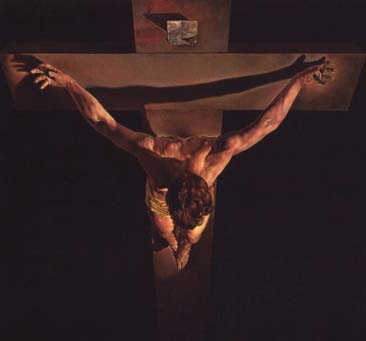
Jesus' raised arms
In Bible Blog Oikos March 6th 2012 I posted a long essay on the use of the Greek “oikos” (house) in the gospel. Those who want to explore this topic might find it helpful. The “house of God” is used in scripture to refer to the ark of the covenant, the temple in Jerusalem, the people of Israel, the kingdomof God and heaven as God’s dwelling. In the Gospels it is also used of Jesus Messiah himself, as the one in whom God dwells. In the case of this beautiful passage from John we have perhaps become used to interpreting “house” as meaning God’s heaven. We often use the passage in the burial service. My own judgment is that it’s bigger than that. God’s household is for Jesus his kingdom on earth and in heaven, which is the one community of love on both sides of death. As the disciples face Jesus’ death and the danger to their own lives, it appears that an insuperable obstacle barrs the way to into God’s household. But Jesus says, no, there is a way, not round the danger, but through the midst of its waves. He is himself that way, the dry track through the killing waters. But Jesus doesn’t use any of this Exodus imagery. Instead he imagines himself as the woman of the household who goes ahead when the family is moving to a new house, a flitting, as we call it in Scotland. She goes ahead to make the house ready-to “redd it up” as we say-then shows her family into its new quarters. In this homely image he is talking about his death on the cross and his resurrection. I am always astonished by the beauty and meaningfulness of this image, which I invite readers to consider and explore for themselves. It’s not that the cross is the road and the resurrection is the house of God. No, both cross and resurrection, both weakness and strength, both death and life, are the one house of God’s love.
 Emmock's Blog