
This blog provides a meditation on the Episcopal daily readings along with a headline from world news:
Black hole swallows a star, pictures in real time

- nasa image

Exodus 34:1-17
Moses Makes New Tablets
34The Lord said to Moses, ‘Cut two tablets of stone like the former ones, and I will write on the tablets the words that were on the former tablets, which you broke.2Be ready in the morning, and come up in the morning to Mount Sinai and present yourself there to me, on the top of the mountain.3No one shall come up with you, and do not let anyone be seen throughout all the mountain; and do not let flocks or herds graze in front of that mountain.’4So Moses cut two tablets of stone like the former ones; and he rose early in the morning and went up on Mount Sinai, as the Lord had commanded him, and took in his hand the two tablets of stone.5The Lord descended in the cloud and stood with him there, and proclaimed the name, ‘The Lord.’*6The Lord passed before him, and proclaimed,
‘The Lord, the Lord,
a God merciful and gracious,
slow to anger,
and abounding in steadfast love and faithfulness,
7 keeping steadfast love for the thousandth generation,*
forgiving iniquity and transgression and sin,
yet by no means clearing the guilty,
but visiting the iniquity of the parents
upon the children
and the children’s children,
to the third and the fourth generation.’
8And Moses quickly bowed his head towards the earth, and worshipped.9He said, ‘If now I have found favour in your sight, O Lord, I pray, let the Lord go with us. Although this is a stiff-necked people, pardon our iniquity and our sin, and take us for your inheritance.’<!– 10 –>
The Covenant Renewed
10 He said: I hereby make a covenant. Before all your people I will perform marvels, such as have not been performed in all the earth or in any nation; and all the people among whom you live shall see the work of the Lord; for it is an awesome thing that I will do with you.11 Observe what I command you today. See, I will drive out before you the Amorites, the Canaanites, the Hittites, the Perizzites, the Hivites, and the Jebusites.12Take care not to make a covenant with the inhabitants of the land to which you are going, or it will become a snare among you.13You shall tear down their altars, break their pillars, and cut down their sacred poles*14(for you shall worship no other god, because the Lord, whose name is Jealous, is a jealous God).15You shall not make a covenant with the inhabitants of the land, for when they prostitute themselves to their gods and sacrifice to their gods, someone among them will invite you, and you will eat of the sacrifice.16And you will take wives from among their daughters for your sons, and their daughters who prostitute themselves to their gods will make your sons also prostitute themselves to their gods.17 You shall not make cast idols.
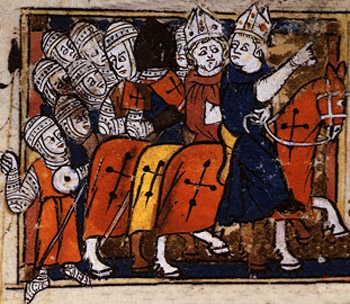
The One God’s killers
I suppose the question to be asked about this version of the covenant of God with his people is: would the average Amorite think that God was merciful and gracious in sending into their territory a bunch of savages intent on ethnic cleansing? The theology of this kind of story probably came about like this:
1. The tribes of Israel gradually settled the land of Canaan, and found space for themslves, probably without much fighting.
2. They began to attribute their setlement of this good land to their ancestral God.
3. Legends of Moses and Joshua became part of a great story of escape from slavery in Egypt.
4. Prophets denounced the people for sharing their neighbours “Gods of fertility” who were said to be helpful to farmers.
5. Stories of the settlement of the land were altered to include a divine command to wipe out or drive out the original inhabitants and to have nothing to do with their Gods.
6. These stories have been used in modern times to justify Israel’s seizure of Palestine and its treatment of Arabs.
In effcct a radical strand of the faith of Israel, its insistence on ONE God, was the motive for a factually inaccurate history of conquest and ethnic intolerance. The modern reader may be dismayed by this analysis: we expect history to be reasonably factual. But that’s a very modern idea, imperfectly practiced even now. In the ancient world, histories were always vehicles for for national or religious propaganda. The story exists to bolster a conviction. The problem of how belief in the one God can be other than exclusive ( we have the true God, so stay away from us) or crusading ( we have the true God so we’re taking you over) is one that neither Judaism, Christianity or Islam has completely solved. At times all three religions have found ways of being vibrant without persecuting others and peaceful without being merely defensive; but their best practice has often been forgotten.
Matthew 5:21-26
Concerning Anger
21 ‘You have heard that it was said to those of ancient times, “You shall not murder”; and “whoever murders shall be liable to judgement.”22But I say to you that if you are angry with a brother or sister,* you will be liable to judgement; and if you insult* a brother or sister,* you will be liable to the council; and if you say, “You fool”, you will be liable to the hell* of fire.23So when you are offering your gift at the altar, if you remember that your brother or sister* has something against you,24leave your gift there before the altar and go; first be reconciled to your brother or sister,* and then come and offer your gift.25Come to terms quickly with your accuser while you are on the way to court* with him, or your accuser may hand you over to the judge, and the judge to the guard, and you will be thrown into prison.26Truly I tell you, you will never get out until you have paid the last penny.

wisdom for human community
Here Jesus begins to set our the terms of the”better righteousness” he has demanded from his disciples. It doesn’t set aside the old command, “You shall not kill,” but it spells out the intention of God in giving it, that people should live in peace. Jesus therefore forbids the behaviour which puts community peace at risk: anger, insult and abuse. He adds that you can’t have a right relationship to God while having a wrong relationship with a brother or sister. This is in line with what the prophets of Israel had preached: Jesus makes it a specific instruction. The bit about settling matters out of court is an aspect of Jesus’ rough and ready wisdom: if you’re in the wrong, better settle up before the court imposes its penalty, he says. His contemporaries probably knew that as worldly widom. Here by implication, Jesus applies it to our earthly journey to a heavenly court: better settle up in this life with a brother you’ve wronged before you stand before the judge! Jesus “law” is majestic in form -“they said….but I say”, while being surprisingly practical and everday in content. His loving interest in people and their communities is evident.
 Emmock's Blog