
This blog provides a meditation on the Episcopal daily readings along with a headline from world news:
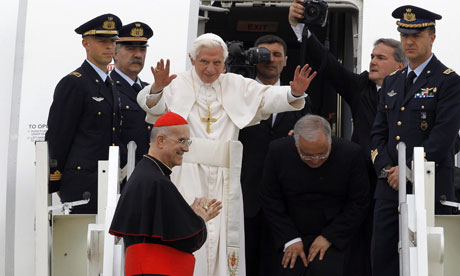
Allegations of corruption and nepotism in Vatican 
Galatians 1:1-17
THE LETTER OF PAUL TO THE
Galatians
Salutation
1Paul an apostle—sent neither by human commission nor from human authorities, but through Jesus Christ and God the Father, who raised him from the dead—2and all the members of God’s family* who are with me,
To the churches of Galatia:
3 Grace to you and peace from God our Father and the Lord Jesus Christ,4who gave himself for our sins to set us free from the present evil age, according to the will of our God and Father,5to whom be the glory for ever and ever. Amen.
There Is No Other Gospel
6 I am astonished that you are so quickly deserting the one who called you in the grace of Christ and are turning to a different gospel—7not that there is another gospel, but there are some who are confusing you and want to pervert the gospel of Christ.8But even if we or an angel* from heaven should proclaim to you a gospel contrary to what we proclaimed to you, let that one be accursed!9As we have said before, so now I repeat, if anyone proclaims to you a gospel contrary to what you received, let that one be accursed!
10 Am I now seeking human approval, or God’s approval? Or am I trying to please people? If I were still pleasing people, I would not be a servant* of Christ.<!– 11 –>
Paul’s Vindication of His Apostleship
11 For I want you to know, brothers and sisters,* that the gospel that was proclaimed by me is not of human origin;12for I did not receive it from a human source, nor was I taught it, but I received it through a revelation of Jesus Christ.
13 You have heard, no doubt, of my earlier life in Judaism. I was violently persecuting the church of God and was trying to destroy it.14I advanced in Judaism beyond many among my people of the same age, for I was far more zealous for the traditions of my ancestors.15But when God, who had set me apart before I was born and called me through his grace, was pleased16to reveal his Son to me,* so that I might proclaim him among the Gentiles, I did not confer with any human being,17nor did I go up to Jerusalem to those who were already apostles before me, but I went away at once into Arabia, and afterwards I returned to Damascus.

Paul was a tentmaker not a priest or minister
Paul is difficult to read, often because we underrate his radicalism and interpret it as arrogance. This business of “being apppointed by God” for example, is easy to see as one-upmanship, whereas it is truly a refusal to think of his Christian faith as a religion. He is not part of an organised cult with appointed priests and officials: he is carrying good news: a way of relating to God and other people which rejects all religious baggage and is based on the conviction that the God who is beyond the universe has come to the world in Jesus Messiah, showing his love for his creatures in his self-sacrifice on a Roman cross. He has come, so we do no need to find a way to him or of pleasing him. That’s what religion does. Paul’s good news is that we can dispense with all that and simply trust God’s love here and now in the shared life of the open community of God’s children. Anyone who seeks to re-introduce the trappngs of religion-Jewish religion as in this case, Greek religion as in Corinth- is accursed because he/she is allied with those who in the name of religion, crucified Jesus Messiah. That’s why Paul wants to emphasise that he’s not part of a hierarchy but a human being to whom God has come in Jesus.
More than fifty years ago I was reading Dietrich Bonhoeffer’s “Letters and Papers from Prison” in which, as he awaited execution by the Nazis, he set out his view of “religionless Christianity”.This has often since been misunderstood as a familiar process of making Christianity acceptable to a scientific culture. Bonhoeffer himself said that he was not seeking to dispense with the traditional faith in the incarnation, crucifixion, resurrection and ascension of Jesus, far less with faith in the Creator, but to interpret all of these without the trappings of religion. For Paul, Jewish religion means trying to win God’s approval by obedience to ritual and moral law; Greek religion means trying to find a way to the Godhead. In both cases those who are “good” at the religion have to mediate the means of salvation to others. God has come and revealed himself, Paul says. Away with all this hocus-pocus and self-justfying regulation. If God has hidden nothing, there’s no room for those who claim to know God’s will or mystery better than others. Old religious boundaries and hierarchies are blown away by this faith.
Matthew 13:44-52
 Three Parables

44 ‘The kingdom of heaven is like treasure hidden in a field, which someone found and hid; then in his joy he goes and sells all that he has and buys that field.
45 ‘Again, the kingdom of heaven is like a merchant in search of fine pearls;46on finding one pearl of great value, he went and sold all that he had and bought it.
47 ‘Again, the kingdom of heaven is like a net that was thrown into the sea and caught fish of every kind;48when it was full, they drew it ashore, sat down, and put the good into baskets but threw out the bad.49So it will be at the end of the age. The angels will come out and separate the evil from the righteous50and throw them into the furnace of fire, where there will be weeping and gnashing of teeth.<!– 51 –>
Treasures New and Old
51 ‘Have you understood all this?’ They answered, ‘Yes.’52And he said to them, ‘Therefore every scribe who has been trained for the kingdom of heaven is like the master of a household who brings out of his treasure what is new and what is old.’
We can see Jesus’ parables of the kingdom or rule of God as comunicating the same good news as Paul: God has come (in Jesus’ ministry!) to rule his world by love; therefore his kingdom will consist of those who are persuaded to live in his way. It cannot start large and it will not spread by force. But where it is “seen” and “received” it is recognised with as immeasurably precious, so that complete comitment to it is no longer sacrifice, but common sense. Yes, there may be those who think they can take advantage of God’s goodness to advance their own selfish ends. There will come a time when they are sorted out; meantime those who truly respond to God’s loving rule should not worry about them.
Matthew adds a note for “scribes of the kingdom”, perhaps writers like himself, who can bring out his store the riches of theTorah as well as of the Gospel, knowing that the new fulfils the old.
The joy that Jesus images in these stories is a challenge to those whose job it is to communicate the Christian faith. If it is not winsome it is not true. That does not mean it’s wishy-washy. Jesus’ notes of denunciation and warning are quite clear, but the note of joy, that God has come to those whose reputationns are not built on showing others how to fnd him, is paramount.
 Emmock's Blog
Love This!! Christianity is not about religion but about a relationship! Beautifully said! 🙂