
This blog provides a meditation on the Episcopal daily readings along with a headline from world news:
Hawaii Observatory “sees” Galaxy 12.9 billion light years away 

Matthew 15:29-39
Jesus Cures Many People
29 After Jesus had left that place, he passed along the Sea of Galilee, and he went up the mountain, where he sat down.30Great crowds came to him, bringing with them the lame, the maimed, the blind, the mute, and many others. They put them at his feet, and he cured them,31so that the crowd was amazed when they saw the mute speaking, the maimed whole, the lame walking, and the blind seeing. And they praised the God of Israel.
Feeding the Four Thousand
32 Then Jesus called his disciples to him and said, ‘I have compassion for the crowd, because they have been with me now for three days and have nothing to eat; and I do not want to send them away hungry, for they might faint on the way.’33The disciples said to him, ‘Where are we to get enough bread in the desert to feed so great a crowd?’34Jesus asked them, ‘How many loaves have you?’ They said, ‘Seven, and a few small fish.’35Then ordering the crowd to sit down on the ground,36he took the seven loaves and the fish; and after giving thanks he broke them and gave them to the disciples, and the disciples gave them to the crowds.37And all of them ate and were filled; and they took up the broken pieces left over, seven baskets full.38Those who had eaten were four thousand men, besides women and children.39After sending away the crowds, he got into the boat and went to the region of Magadan.*
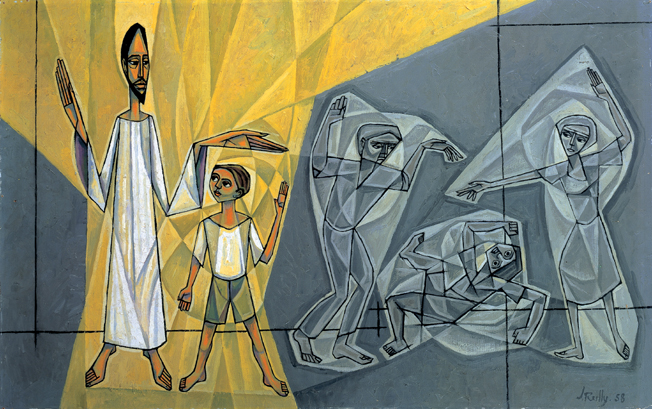
Jesus heals a disturbed child
Many readers will, as I did, look at the lectionary passage above and say, “Oh, it’s the story of the feeding of the five thousand!” But that’s to overlook the very clear narative that Matthew gives us. First Jesus “takes his seat”on a mountain, that is, in bible language, he takes the place of Moses. But then, rather than giving laws to those who are “at his feet” in the traditional posture of disciples, he heals them of all their diseases. In another place Matthew attributes Jesus’ power to heal to his sacrificial compassion, quoting Isaiah, “He himself carried our diseases.” Jesus’ “Healing on the Mount” is for Matthew as important as his “Sermon on the Mount”: it reveals a new covenant between God and his people which begins with the healing action of God, through his servant Jesus.
The story of the feeding which then follows is used by Matthew as a dramatic symbol of the healing which has already taken place. Doubtless the miraculous feeding stories in all four gospels go back to actual desert meals of Jesus and his followers, but each gospel writer interprets the feedings differently. For Matthew the feeding of a huge crowd with the apparently tiny resources of Jesus and his disciples is an image of Jesus’ ministry of healing: through him, the true Messiah and his followers, God heals the people. Of course Matthew knew that with the gentle use of “Moses imagery” his readers would pick up the relationship between this miraculous feeding and the manna which God sent to Israel in the desert. John’s gospel uses this relationship to call Jesus, “the bread of life”. For Matthew the bread of life is the healing ministry of Jesus. Indeed, it may be the case that with his two scenes of Jesus on a mountain (this one and the mountain of the sermon) he means his readers to see that the inner truth of Jesus’ teaching is its healing power.
Healing, for Matthew, is what frees people from the oppressive and distorting power of evil, and of the human beings who are in league with evil, so they can live as children of the father in heaven. I think that one of the reasons why religious healers have such a bad name is that the mainstream churches have abandoned healing as part of their normal ministry, leaving the field free for exploitative fakes as well as sincere individuals. A great surgeon I know says, “I don’t heal. God heals, nature heals, I only assist.”
 Emmock's Blog