This blog provides a meditation on the Episcopal daily readings along with a headline from world news:
SSU KYI RISKS HEALTH FOR DUTY 
GALATIANS 6
Brothers, even if people are caught out in some wrong-doing, those of you who have an understanding should restore them with a gentle attitude, keeping an eye on yourselves, in case you also are tempted. Lift one another’s loads, and so fulfill the law of Messiah. For if you think you’re quite something when you’re nothing, you’re fooling yourself, but each of you should put his own work to the test. Then you can be happy with yourself, as you are, and not in comparison with someone else. For “everyone must shift his own weight.”
Students of the message are to share their resources with their teachers. Make no mistake: God is not mocked, for “you will reap whatever you’ve sown.” So the one who sows in the field of flesh and blood, will from flesh and blood reap decay; but the one who sows in the field of the Spirit, will reap the life of the age to come. Let’s not grow “weary in well-doing”, for we shall reap, if we don’t weaken. So then, while it is the right season, let’s do good to all people, and especially to those in the household of the faith.
See with what huge letters I’m writing to you, in my own hand!
Those who are pressing you to be snipped, want to make a good show in flesh and blood, with the one aim of not being bothered by the cross of Christ. In fact, those who have been snipped, do not fully observe the Jewish law themselves, but want to have you snipped, so that they can boast about your flesh and blood.
God forbid that I should boast about anything!-except the cross of our Lord Jesus Messiah, by which the world has been killed off for me, and I for the world. For neither snipping nor foreskins are the issue, but new creation.
Those who will march to this command, peace and mercy be upon them, and upon God’s Israel.
From now on, let nobody give me grief, for I bear on my body the brand-marks of Jesus.
May the kindness of the Lord Jesus Messiah be with your spirit, brothers. Amen.

bear one another’s burdens:nun provides care for an elderly lady
This is my own translation of the passage for today. I’ve kept Paul’s address to his readers as “brothers” rather than changing it to “brothers and sisters” ( as I usually would) because the issue of circumcision is a male issue. I’ve put quotation marks around phrases in Paul’s Greek which I judge to be common currency within the church. Is Paul thinking of a particular law of Messiah Jesus? If so, it might be his words, “The one who wants to be greatest must be the servant of all.” Here again we see that although for Paul people cannot be made right by laws, they can,as they are being made right by God’s love, be kept right by laws and commands, especially those of Jesus.
Paul emphasises both communal resonsibility -believers are responsible for each other’s welfare-and individual responsibility-believers are responsible for their own way of life. The distinction between what Paul calls “the field of flesh and blood (Greek “sarx”) and the “field of the Spirit (Greek “pneuma”) is shown with regard to to the issue of providing for the bodily needs of teachers in the Christian community: it is a spiritual action to attend to their flesh and blood needs!
The one line of Paul’s own handwriting reminds us the he normally dictated his letters to a scribe.
I’ve translated the Greek peritome (circumcision) as “snipping” to get the flavour of this neutral word for something his Jewish friends would have called it “sign of the covenant”. Again Paul emphasises that insisting on such “religious requirements” nullifies the gospel which calls believers to die, with Messiah, to their old selves and to be recreated by God’s spirit. Paul reminds his readers that he carries on his body the scars of Roman whippings and other beatings for his work as a messenger of Messiah. These are the real “brand-marks” of Jesus.
These comments hould be read along with yesterday’s blog 759. I’ve tried to show that this fierce and sometimes obscure letter contains some of Paul’s most radical teachings, especially his desire to distinguish the Christian gospel from the best religion he knows. Even the best religion, he says, can become a way of using God and our neighbour for our own purposes. The gospel opens us to both.
Matthew 16:21-28<!– 21 –>
Jesus Foretells His Death and Resurrection
21 From that time on, Jesus began to show his disciples that he must go to Jerusalem and undergo great suffering at the hands of the elders and chief priests and scribes, and be killed, and on the third day be raised.22And Peter took him aside and began to rebuke him, saying, ‘God forbid it, Lord! This must never happen to you.’23But he turned and said to Peter, ‘Get behind me, Satan! You are a stumbling-block to me; for you are setting your mind not on divine things but on human things.’<!– 24 –>
The Cross and Self-Denial
24 Then Jesus told his disciples, ‘If any want to become my followers, let them deny themselves and take up their cross and follow me.25For those who want to save their life will lose it, and those who lose their life for my sake will find it.26For what will it profit them if they gain the whole world but forfeit their life? Or what will they give in return for their life?
27 ‘For the Son of Man is to come with his angels in the glory of his Father, and then he will repay everyone for what has been done.28Truly I tell you, there are some standing here who will not taste death before they see the Son of Man coming in his kingdom.’
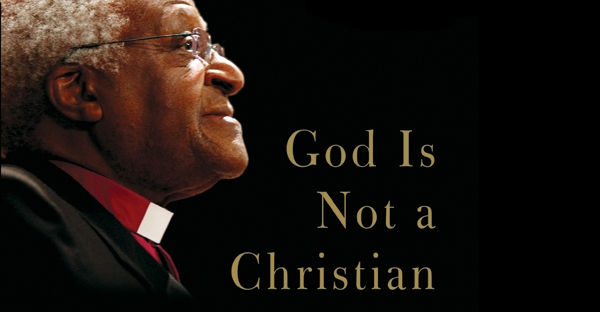
Desmond Tutu: even Christianity is a religion!
Matthew shows Jesus dealing with the problem of religion. Surely, Peter says to Jesus, the Messiah must be supernaturally successsful and enjoy the obedience of his people. This earns him the sternest rebuke Jesus ever gave a disiciple. He calls him Satan, the enemy of God and humanity, and accuses him of thinking in a human rather than a God-like way. This “human” is Jesus’ equivalent of Paul’s “flesh and blood”. Jesus’ way is not an add-on to traditional religion but a radical subversion of it, denying its central tenet that God will give earthly blessings to those who do what he commands. The cross represents the risk that believers take in opposing the powers that be, in Jesus’ case, the Roman administration and the Jewish religious establishment. The cost of discipleship is made starkly clear. Jesus does promise that those who are careless with their lives for his sake will find true life both here and in the world to come, but no-one should imagine that Christian faith will improve their marriage or their career prospects. I’ve often wished that Jesus was not like this but I’ve never been able to change him.
 Emmock's Blog