
This blog provids a meditation on the Episcopal daily readings along with a headline from world news:
Michigan Rep Lisa Brown banned for saying “vagina”

Rep. Lisa Brown
in aborton debate
Matthew 17:1-13
The Transfiguration
17Six days later, Jesus took with him Peter and James and his brother John and led them up a high mountain, by themselves.2And he was transfigured before them, and his face shone like the sun, and his clothes became dazzling white.3Suddenly there appeared to them Moses and Elijah, talking with him.4Then Peter said to Jesus, ‘Lord, it is good for us to be here; if you wish, I* will make three dwellings* here, one for you, one for Moses, and one for Elijah.’5While he was still speaking, suddenly a bright cloud overshadowed them, and from the cloud a voice said, ‘This is my Son, the Beloved;* with him I am well pleased; listen to him!’6When the disciples heard this, they fell to the ground and were overcome by fear.7But Jesus came and touched them, saying, ‘Get up and do not be afraid.’8And when they looked up, they saw no one except Jesus himself alone.
9 As they were coming down the mountain, Jesus ordered them, ‘Tell no one about the vision until after the Son of Man has been raised from the dead.’10And the disciples asked him, ‘Why, then, do the scribes say that Elijah must come first?’11He replied, ‘Elijah is indeed coming and will restore all things;12but I tell you that Elijah has already come, and they did not recognize him, but they did to him whatever they pleased. So also the Son of Man is about to suffer at their hands.’13Then the disciples understood that he was speaking to them about John the Baptist.
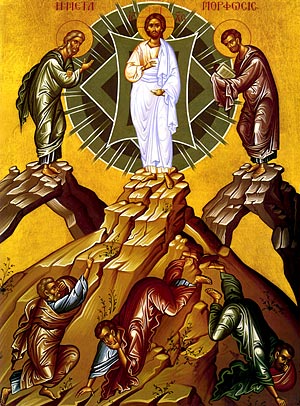
Greek Orthodox Icon
The first thing to say about this passage is that of course it is not recounting a historical happening. It is clearly a”theological construction” in which the details of the event are intended to reveal the beliefs of the storyteller: in this case, the conviction that Jesus is the “beloved son” of God, for whose coming the Jewish Torah (Moses) and the prophets (Elijah) have prepared the way. A true disciple however, listens and obeys Jesus rather than contemplating his glory.
There was a current Jewish belief that Elijah would return as a forerunner of the Messiah. The Christian tradition interpreted John the Baptist as a returned Elijah who preceded Jesus Messiah.
Theses are the beliefs which this story was meant to convey. But if it didn’t really happen, where did it come from? Well. it exists in Mark’s gospel which was used by Matthew as a source for his own gospel. That’s where Matthew found this story and used it without substantial alteration. In Mark, the story, along with Peter’s confession of Jesus as Messih forms a hinge which joins the first part of his story to the second. In the first Jesus carries on a successful battte aganst Satan by means of teaching and healing. But it’s a game of two halves, for in the second, Satan, working through the Jewsih religious establishment, succeeds in putting Jesus on a Roman cross and kills him. The “transfiguration” story tells the reader how to interpret the second half: Jesus, the true son of God, willingly descends into the evil of the world and risks his own life so that evil may be defeated in God’s way, by sacrificial love rather than by power. The story reminds the reader where God’s son has come from and why.

Transfiguration: Salvador Dali
Matthew’ gospel is longer and tells the story of Jesus from a different perspctive. In it, the mountain of transfiguration is one of a series of mountains-of the sermon, of the feedings, of the transfiguration, of the crucifixion, and of the resurrection, all of which characterise vital aspects of Jesus’ life. The case of the transfiguration is unique in that Jesus neither acts nor suffers but is simply illuminated by a light which shines backwards and forwards on the other high points: the one who teaches, heals and feeds, suffers and dies and is raised from death is the beloved child of God, to whom alone disciples should listen. My readers will see how clumsy my explanation is in comparison with the wonderful concise and beautiful story told by the evangelists. That’s why the story was invented and passed on: it says something about Jesus which is inadequately represented by any other means. The ancient reader was immensely more sophisticated than the modern in knowing how understand such stories. He or she would advise us to hold the story in our hearts, so that, as we act and suffer from day to day as ordinary disciples of Jesus, we may ever and again, find ourselves on the mountain top where the beloved son shines in the goodness of God, who calls us to listen to him.
 Emmock's Blog