
This blog provides a meditation on the Episcopal daily readings along with a headline from world news:
Russia’s aid to the world: sell it more arms 
Romans 7:1-12
<!– 7 –>
An Analogy from Marriage
7Do you not know, brothers and sisters*—for I am speaking to those who know the law—that the law is binding on a person only during that person’s lifetime?2Thus a married woman is bound by the law to her husband as long as he lives; but if her husband dies, she is discharged from the law concerning the husband.3Accordingly, she will be called an adulteress if she lives with another man while her husband is alive. But if her husband dies, she is free from that law, and if she marries another man, she is not an adulteress.
4 In the same way, my friends,* you have died to the law through the body of Christ, so that you may belong to another, to him who has been raised from the dead in order that we may bear fruit for God.5While we were living in the flesh, our sinful passions, aroused by the law, were at work in our members to bear fruit for death.6But now we are discharged from the law, dead to that which held us captive, so that we are slaves not under the old written code but in the new life of the Spirit.<!– 7 –>
The Law and Sin
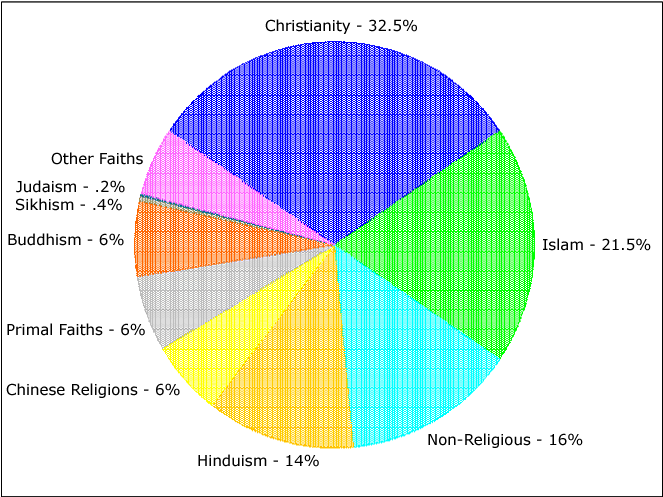
in a world of competeing beliefs, explanation is desirable
7 What then should we say? That the law is sin? By no means! Yet, if it had not been for the law, I would not have known sin. I would not have known what it is to covet if the law had not said, ‘You shall not covet.’8But sin, seizing an opportunity in the commandment, produced in me all kinds of covetousness. Apart from the law sin lies dead.9I was once alive apart from the law, but when the commandment came, sin revived10and I died, and the very commandment that promised life proved to be death to me.11For sin, seizing an opportunity in the commandment, deceived me and through it killed me.12So the law is holy, and the commandment is holy and just and good.
Paul is saying something straightforward here although his manner of saying it seems a little complex. A person who is marked by the “inheritance of Adam”, that is, a person fundamentally rebellious towards God, will not be conscious of his rebellion, until faced with a specifc prohibition, as for example “You shall not covet”. But as soon as the command is issued the disobedience will kick in, and the person will acknowledge his enmity towards God. Such a person feels that he was innocent until the Law revealed his true sinful nature. “Apart from the Law, sin lies dead.” We can understand this argument. But then Paul switches the argument in a way that is startling: “once I was alive apart from the Law, but when the commandment came, sin revived and I died,” He’s just argued that apart from the Law, sin lies dead. Now the Law with its commandment revives sin and kills the sinner, that is, puts the sinner under God’s sentence of death: “those who obey the Law will live; those who disobey will die.”
This close argument has been interpreted as a personal confession by Paul of how the Torah worked on his own psyche but I think that he’s stretching his knowledge of his ancestral religion to criticise all religious legalism: in commanding what is holy, it reveals and gives power to all the unholiness of human beings. It seems that sin and death have got humanity boxed in but there is a last twist to Paul’s argument of life and death: if we’re dead the law no longer applies to us, he says. And we are “dead” because by uniting ourselves with Jesus, our old selves “die” with him on the cross. We no longer want to grab the fruit for ourselves in opposition to God (as Adam & Eve did) but are pleased to receive the friutfulness that God offers us. Wow! It’s a very packed piece of writing but its main purpose is to show that legalistic religion traps the sinful person, whereas trust in Jesus liberates her.
Is this kind of scripture helpful to us? I suspect that many people, irritated by Paul’s strange logic and alienated by his 1st century presuppositions, will answer, “no.” I on the contrary think that the effort of Paul to make good sense of “trust in Jesus” is salutary. Just taking refuge in Jesus is not quite good enough. Why for example is trust in Jesus better than trust in Mohammed (peace upon him!)? Paul would say that Islam is just another Law whereas Jesus brings freedom from sin and law. Making sense of faith in the face of competing beliefs and allegiances is Paul’s gift to the church.
 Emmock's Blog