
This blog provides a meditation on the Episcopal daily readings along witb a headline from world news:
Italian highest Court rules it illegal to say “You don’t have the balls” (Non hai le cogliones)

non hai le cogliones
PSALM 69But as for me, my prayer is to you, O Lord. At an acceptable time, O God, in the abundance of your steadfast love, answer me.
With your faithful help14rescue me from sinking in the mire;
let me be delivered from my enemies and from the deep waters.
15 Do not let the flood sweep over me, or the deep swallow me up, or the Pit close its mouth over me.
16 Answer me, O Lord, for your steadfast love is good; according to your abundant mercy, turn to me.
17 Do not hide your face from your servant, for I am in distress—make haste to answer me.
18 Draw near to me, redeem me, set me free because of my enemies.
19 You know the insults I receive, and my shame and dishonour; my foes are all known to you.
20 Insults have broken my heart, so that I am in despair.
I looked for pity, but there was none; and for comforters, but I found none.
21 They gave me poison for food, and for my thirst they gave me vinegar to drink.
22 Let their table be a trap for them, a snare for their allies.
23 Let their eyes be darkened so that they cannot see, and make their loins tremble continually.
24 Pour out your indignation upon them, and let your burning anger overtake them.
25 May their camp be a desolation; let no one live in their tents.
26 For they persecute those whom you have struck down, and those whom you have wounded, they attack still more.*
27 Add guilt to their guilt; may they have no acquittal from you.
28 Let them be blotted out of the book of the living; let them not be enrolled among the righteous.

pour out your indignation upon them…Bosch
This psalm is placed by the Lectionary beside the story of Jesus’ crucifixion because the first believers saw the connection between them, not only in the detail about vinegar, but also in the persecution against which the psalmist complains. It is of course near to Jesus in the agony it reflects but not in its demand for God to bring evil on those who have caused it. We believe that Jesus died forgiving his enemies. But only Luke tells us that he did so. Matthew says nothing of the sort. We may decide to accept Luke’s account as it is in tune with Jesus’ demand that we should love our enemies and pray for them. It’s good nevertheless to be reminded by the Pslam that the agony of a just man unjustly treated is partly his anger that evil people are getting away with this outrage. If Jesus managed to forgive it’s not because he didn’t have this anger. Of course he did. The crucifixion is a terrible crime which must never be made comfortable, especially in the presence of those who are likely to suffer such evil at the hands of oppressors. Forgiveness is more than anger at injustice but it is never less.
Matthew 28:1-10
The Resurrection of Jesus
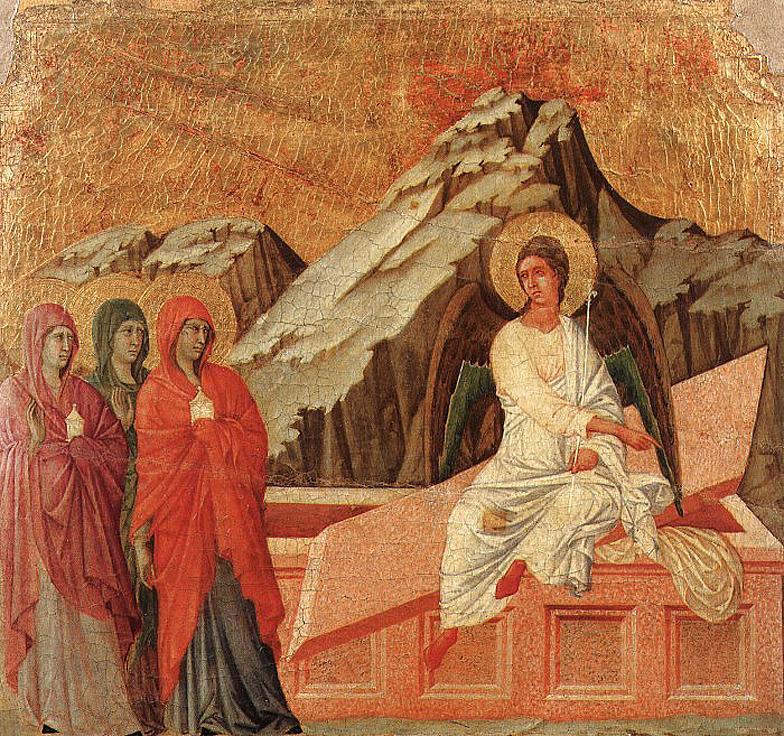
28After the sabbath, as the first day of the week was dawning, Mary Magdalene and the other Mary went to see the tomb.2And suddenly there was a great earthquake; for an angel of the Lord, descending from heaven, came and rolled back the stone and sat on it.3His appearance was like lightning, and his clothing white as snow.4For fear of him the guards shook and became like dead men.5But the angel said to the women, ‘Do not be afraid; I know that you are looking for Jesus who was crucified.6He is not here; for he has been raised, as he said. Come, see the place where he* lay.7Then go quickly and tell his disciples, “He has been raised from the dead,* and indeed he is going ahead of you to Galilee; there you will see him.” This is my message for you.’8So they left the tomb quickly with fear and great joy, and ran to tell his disciples.9Suddenly Jesus met them and said, ‘Greetings!’ And they came to him, took hold of his feet, and worshipped him.10Then Jesus said to them, ‘Do not be afraid; go and tell my brothers to go to Galilee; there they will see me.’
a signal of God’s action
Matthew tells the story of the resurrection almost as if it was an everyday matter. Almost, but not quite. He gives the reader a signal that this is no ordinary event but rather something which is not “of” this world, although it happens in this world. The signal is the athletic angel who comes and perches on the rolled-away stone, delivering the message of resurrection. But the account of this event is as sober as that of the crucifixion. Matthew wants to say two things:
1. The resurrection of Jesus is an act of God: it would not be recorded on Roman security cameras.
2. But it is a fact in this world’s history through those who experienced God’s action and trusted in it.
When the women obey the angel, they meet with Jesus. To this I can only add my own testimony that when I have trusted the messenger of God who surmounts evil and death to deliver good news of resurrection and tells me to share it, I also have met with Jesus. I have experienced no miracles, raptures, transcendental enlightenments or spiritual ecstasies, but the crucified and risen Lord has been with me in the life I share daily with other human beings and all the living creatures of the world. These, I repeat are not ecstatic experiences but involve the sober recognition that the one who is with me, or has just left me, is Jesus; and that I shouldn’t attempt to look him in the eye, but only perhaps, as the women did, take hold of his feet and worship-before he cuffs my ear and tells me to get on with loving God and my neighbour.
 Emmock's Blog