
This blog provides a meditation on the Epilscopal daily readings along with a headline from world news. Older blogs can be accessed by inserting bible blog +number, or date, or topic in a search engine
Sectarian violence starts again in Lebanon
PSALM 105 from verse 23

Shia gunmen in revenge kidnap
3 Then Israel came to Egypt; Jacob lived as an alien in the land of Ham.
24 And the Lord made his people very fruitful, and made them stronger than their foes,
25 whose hearts he then turned to hate his people, to deal craftily with his servants.
26 He sent his servant Moses, and Aaron whom he had chosen.
27 They performed his signs among them, and miracles in the land of Ham.
28 He sent darkness, and made the land dark; they rebelled* against his words.
29 He turned their waters into blood, and caused their fish to die.
30 Their land swarmed with frogs, even in the chambers of their kings.
31 He spoke, and there came swarms of flies, and gnats throughout their country.
32 He gave them hail for rain, and lightning that flashed through their land.
33 He struck their vines and fig trees, and shattered the trees of their country.
34 He spoke, and the locusts came, and young locusts without number;
35 they devoured all the vegetation in their land, and ate up the fruit of their ground.
36 He struck down all the firstborn in their land, the first issue of all their strength.
37 Then he brought Israel* out with silver and gold, and there was no one among their tribes who stumbled.
38 Egypt was glad when they departed, for dread of them had fallen upon it.
39 He spread a cloud for a covering, and fire to give light by night.
40 They asked, and he brought quails, and gave them food from heaven in abundance.
41 He opened the rock, and water gushed out; it flowed through the desert like a river.
42 For he remembered his holy promise, and Abraham, his servant.
43 So he brought his people out with joy, his chosen ones with singing.
44 He gave them the lands of the nations, and they took possession of the wealth of the peoples,
45 that they might keep his statutes and observe his laws.
Praise the Lord!

Jewish settlement in West Bank
Modern theologians often interpret the story of the exodus as revealing God’s justice for the oppressed people of Israel. And yes, it does that, as long as we remember that the justice celebrated is ONLY for Israel. In the bible narrative God has already chosen his people through their ancestors Abraham, Isaac and Jacob. He hears the cry of HIS people and by signs and wonders delivers them from slavery, SO THAT they can live by his law in LAND STOLEN from other peoples, whom they are subsequently commanded to exterminate. Does all this reveal a God of universal justice or a tyrant arranging things for his favourite?
Of course, this is not Israel’s last word about God, but this first word has been so decisive for both modern Israel and the Chrstian Church that it’s important to note how dangerous it is. If one of my neighbours expressed a conviction that God loved him more than anyone else; had saved him from wicked people; and instructed him to take possession of my property and to kill me and my family if I resisted; would I accept his theology or sit on his head till the men in white coats arrived? The power and beauty of many bible passages which assert this creed should not concal from us its pathological blindness.
But it’s part of the Bible! Yes, and the Christian doctrine of scriptural authority is that all scripture must be read in the light of Christ, in the fellowship of the church, with the help of the Holy Spirit. That involves clear denunciation of everything unchristlike. Believers cannot hide behind commands to accept it all as God’s Word. They are responsible for their own beliefs, as are Israelis who believe God instructed the conquest of Palestine and Moselms who believe Allah has instructed the destruction of Israel. One of my college teachers, the late Professor Ian Henderson, used to point out how much evil could be caused by what he called the “nuttiness coefficient” in religious people.
John 4:27-42
27 Just then his disciples came. They were astonished that he was speaking with a woman, but no one said, ‘What do you want?’ or, ‘Why are you speaking with her?’28Then the woman left her water-jar and went back to the city. She said to the people,29‘Come and see a man who told me everything I have ever done! He cannot be the Messiah,* can he?’30They left the city and were on their way to him.
31 Meanwhile the disciples were urging him, ‘Rabbi, eat something.’32But he said to them, ‘I have food to eat that you do not know about.’33So the disciples said to one another, ‘Surely no one has brought him something to eat?’34Jesus said to them, ‘My food is to do the will of him who sent me and to complete his work.35Do you not say, “Four months more, then comes the harvest”? But I tell you, look around you, and see how the fields are ripe for harvesting.36The reaper is already receiving* wages and is gathering fruit for eternal life, so that sower and reaper may rejoice together.37For here the saying holds true, “One sows and another reaps.”38I sent you to reap that for which you did not labour. Others have laboured, and you have entered into their labour.’
39 Many Samaritans from that city believed in him because of the woman’s testimony, ‘He told me everything I have ever done.’40So when the Samaritans came to him, they asked him to stay with them; and he stayed there for two days.41And many more believed because of his word.42They said to the woman, ‘It is no longer because of what you said that we believe, for we have heard for ourselves, and we know that this is truly the Saviour of the world.’ 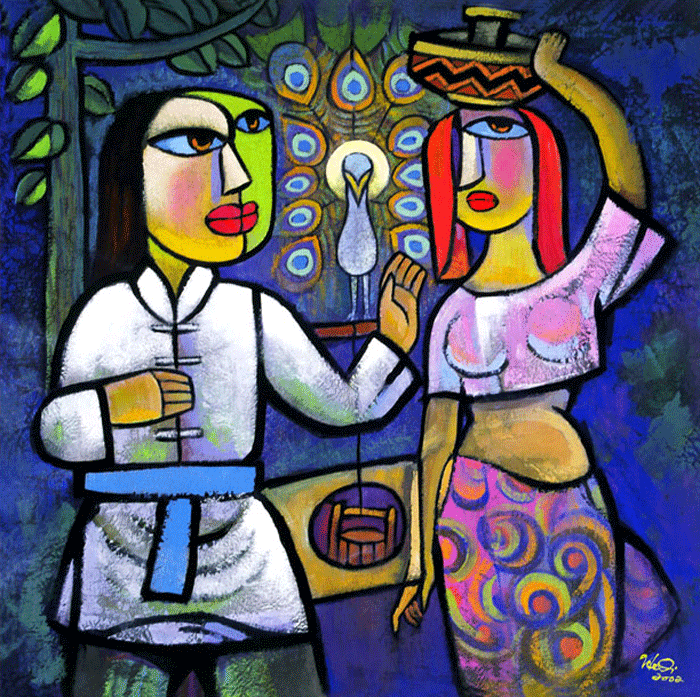
Given the woman’s history, the miracle is not so much that Jesus knew it, but that she was glad he knew it! He has relieved her of the burden of concealment -in John’s Gospel the usual word for truth is the Greek aletheia=non-concealment- and she has is able both to accept her past and to begin a new way of life. By implication this is also true of the Samaritans as a community. If they accept Jesus, they accept also a sinful past, a present forgivness and a new future.
Jesus’ words to his disciples celebrate the encounter with the samaritan woman as “doing the will of the one who sent me” which is nourishment for his own life. He adds that there’s no need to wait for the harvest of God’s kingdom: it’s here already, as the despised Samaritans ask Jesus to “abide” amongst them.
The Samaritans had been separated from Israel because of the sectarian nature of official Judaism in its formative period under Ezra and Nehemiah. They were seen as unorthodox and contaminated by marriage with the “people of the land.” Jesus, the true bridegroom has gone seeking his people and they have responded. This is the only indication in the gospels of a missionary outreach to non-Jews, although Samaritans are portrayed positively in the gospel tradition. John depicts Jesus’ impatience with the orthodox Jewish view that “at harvest time” all people will come to their God. Harvest is now, he says; let go of your prejudice and share the life God offers to all.
In a world of religious and ethnic prejudice, this story is helpful.
 Emmock's Blog