
This blog provides a meditation on the Episcopal readings for today along with a headline from world news:
Climate change brings fires to Northern Canada:

Psalm 33
The Greatness and Goodness of God
1 Rejoice in the Lord, O you righteous. Praise befits the upright.
2 Praise the Lord with the lyre; make melody to him with the harp of ten strings.
3 Sing to him a new song; play skilfully on the strings, with loud shouts.
4 For the word of the Lord is upright, and all his work is done in faithfulness.
5 He loves righteousness and justice; the earth is full of the steadfast love of the Lord.
6 By the word of the Lord the heavens were made, and all their host by the breath of his mouth.
7 He gathered the waters of the sea as in a bottle; he put the deeps in storehouses.
8 Let all the earth fear the Lord; let all the inhabitants of the world stand in awe of him.
9 For he spoke, and it came to be; he commanded, and it stood firm.
10 The Lord brings the counsel of the nations to nothing; he frustrates the plans of the peoples.
11 The counsel of the Lord stands for ever, the thoughts of his heart to all generations.
12 Happy is the nation whose God is the Lord, the people whom he has chosen as his heritage.
13 The Lord looks down from heaven; he sees all humankind.
14 From where he sits enthroned he watches all the inhabitants of the earth—
15 he who fashions the hearts of them all, and observes all their deeds.
16 A king is not saved by his great army; a warrior is not delivered by his great strength.
17 The war horse is a vain hope for victory, and by its great might it cannot save.
18 Truly the eye of the Lord is on those who fear him, on those who hope in his steadfast love,
19 to deliver their soul from death, and to keep them alive in famine.
20 Our soul waits for the Lord; he is our help and shield.
21 Our heart is glad in him, because we trust in his holy name.
22 Let your steadfast love, O Lord, be upon us, even as we hope in you.
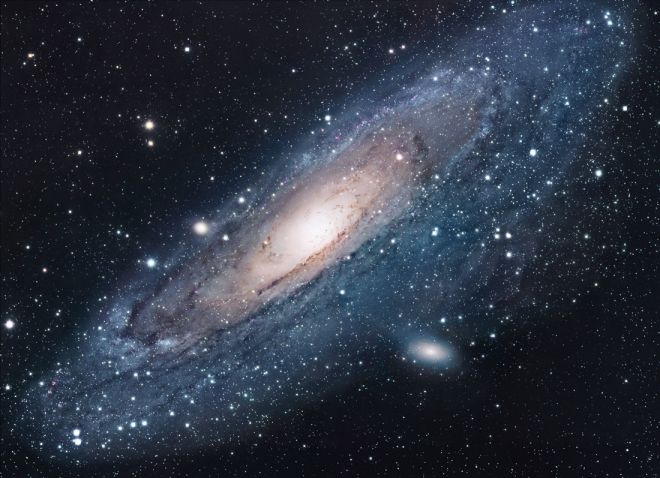
Andromeda galaxy
Belief in God as creator came relatively late in the history of Israel’s religion. For long enough, they honoured God as their God, one among others, but with a special care for Israel, his people. Even some of the earlier prophets, who saw their God as a God of justice did not thinkof him as creator. It may be that the experience of exile in Babylon, a sophisticated civilization with an understanding of the universe, led them to extend their faith in God to include his ordering of the forces of the universe by his wise word. This is the faith which we can find in the later prophets like the second Isaiah, in the psalms and in the first chapter of the book of Genesis. It is a faith which was inherited by the Christian Church, defended vociferously by opponents of the theory of evolution, travestied by theologies of so-called “intelligent design”, and mindlessly attacked by atheists like Richard Dawkins.
Its important to emphasise that faith in the creator God is not a theory about how the universe began or how life of earth developed. Those theories are the province of various sciences whose practictioners constantly test them against available facts and revise them as necessary. This means that scientifc theories, even the most modern, are always provisional as the history of science shows. For Richard Dawkins to suggest that these theories are “reality” as he does in his latest book for schoolchildren, is ridiculously naive and disrespectful to the history of his own discipline. Of course in 2000 years scientists will look back on the utterly inadequate theories of R Dawkins.

two of my brothers greeting each other
Sometimes indeed, as with the intelligent design theologians, believers have misunderstood the nature of their own belief as if it gave them privileged knowledge about the development of the universe and of life. Faith in the creator God is the conviction that there is love which is not of this or any universe, in which all universes and all life exists; which is responsible for all that has been, is now, and shall be. In a sense this belief is also provisional for it depends for its precise content, on human knowledge of the universe and living creatures. Discoveries about, for example, the “big bang” and DNA have significantly altered the content of creation faith. Sometimes these discoveries, as with the theory of evolution, are disturbing to this faith and demand changes in its expression. It remains, nevertheless a conviction that all things, even the most terrifying, are within the compass of a love which is not of any universe but is manifested in the fact of existence. This hand, this mind, this leaf, this bird, that larval parasite eating the body of its host, that South African policeman shooting miners, those uncountable galaxies, are all manifestations of divine love. The key to understanding this love, Christians say, is the life, death and resurrection of Jesus called Messiah. Now this faith may seem wrong-headed to many people, but it is neither ridiculous nor un-scientific.
For example, belief in a creator God has often included the notion of free will, seen in the human capacity of choice. Modern theological reflection on paticle physics has suggested that this freedom can be tracked into the smallest bits of matter; while reflection on the development of life on earth suggests that it includes the freedom for many species to become extinct. Scientific discovery offers to creation faith both facts and theories which challenge it and and give it scope for expansion.
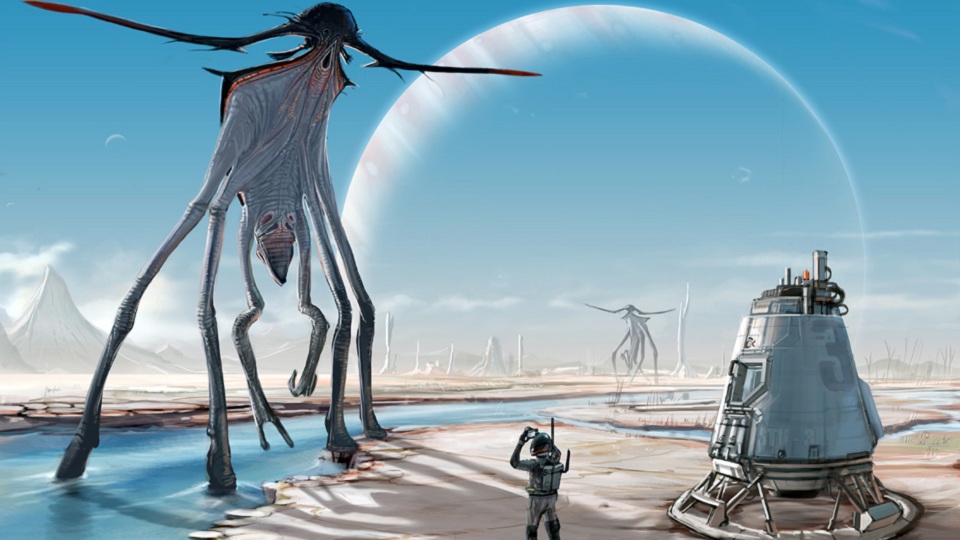
what would discovery of extra- terrestrial life mean for Christianity?
For most believers this faith remains a trust in God, in “whom we live and move and have our being”; whose love is responsible for us, and to whom we are responsible for our use of the gift of life. It saves people from human arrogance, “Let all the earth fear the Lord,” and gives a profound humour to their estimation of human power, “the war-horse is a vain hope for victory” (for ‘war-horse’ substitute ‘nuclear missile’). In expressing this faith alongside the discoveries of science there is opportunity for exploration, imagination and rigorous thinking.
 Emmock's Blog