
This blog provides a meditation on the Episcopal daily readings along with a headline from world news
VATICAN BACKS BALD BARBIE FOR CHEMOTHERAPY KIDS

“bald barbies” made for children undergoing chemotherapy
PSALM 106: 32-end
32 Israel angered the Lord * at the waters of Meribah, and it went ill with Moses on their account;
33 for they made his spirit bitter, and he spoke words that were rash.
34 They did not destroy the peoples as the Lord commanded them,
35 but they mingled with the nations and learned to do as they did.
36 They served their idols, which became a snare to them.
37 They sacrificed their sons and their daughters to the demons;
38 they poured out innocent blood, the blood of their sons and daughters,
whom they sacrificed to the idols of Canaan; and the land was polluted with blood.
39 Thus they became unclean by their acts, and prostituted themselves in their doings.
40 Then the anger of the Lord was kindled against his people, and he abhorred his heritage;
41 he gave them into the hand of the nations, so that those who hated them ruled over them.
42 Their enemies oppressed them, and they were brought into subjection under their power.
43 Many times he delivered them, but they were rebellious in their purposes, and were brought low through their iniquity.
44 Nevertheless, he regarded their distress when he heard their cry.
45 For their sake he remembered his covenant, and showed compassion according to the abundance of his steadfast love.
46 He caused them to be pitied by all who held them captive.
47 Save us, O Lord our God, and gather us from among the nations,
that we may give thanks to your holy name and glory in your praise.
48 Blessed be the Lord, the God of Israel, from everlasting to everlasting.
And let all the people say, ‘Amen.’ Praise the Lord!
disposable peoples?
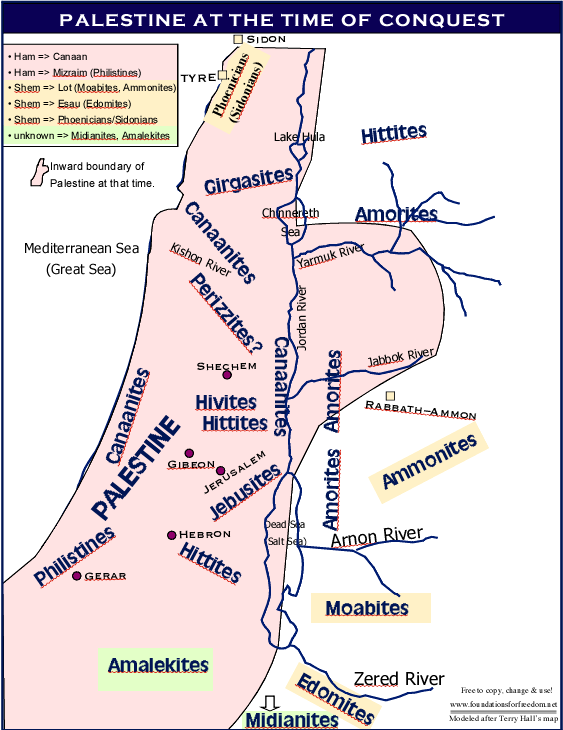
Psalm 106 is a long catalogue of Israel’s sins against their covenant with their God: that they should worship him only and obey his commandments; and that he would love and protect them as a nation. The whole of the Old Testament has been edited with this covenant in mind in a effort to make this theology shine from its pages. In all probability the theology itself belongs to a relatively late period in the whole sweep of biblical history, proabably to the era ” after the exile” say from the 5th-3rd centuries BCE. This means that when the editors were revising stories of the Exodus (13th century BCE) or settlement of Canaan (12th century BCE) they were applying this theology to times in which nobody would have had a clue what covenant they were talking about. It’s probable for example that the settlement of Canaan by the tribes which later called themselves Israel was relatively peaceful-there would have been some battles, sieges and skirkishes- but nothing like the one organised invasion depicted in the bible. There would almost certainly have been co-existence with the other inhabitants of the land, including worship of their Gods and inter-marriage with their young people. All of this of course cannot be admitted by the bible editors. According to them, the Lord kept his side of the bargain by giving Israel the land and they failed to keep their side by not cleansing the land of its inhabitants, which according to the editors, led to all kinds of temptations down the years. I’ve spelt this out in some detail (most of it is agreed by most bible scholars) in order to make sense when I state that the command to wipe out the inhabitants of Canaan was “given” perhaps a thousand years after the tribes settled in Canaan. It is a fabrication by those who edited the bible history. Of course the editors had good reason to write the story this way: they believed that they had understood the history of their people and that their equation <obedience to God’s covenant =national success; disobedience=disaster> was the key to this understanding. Their reasons seemed good but the results were bad, such as a very mechanical understanding of God’s justice in the world, and the view that the lives of other nationalities in Palestine were regarded as utterly disposable by the God of Israel. This theology of the Covenant is articuated especially in the book of Deuteronomy but is present throughout the Old Testament and is expressed in many of the Psalms, as above. Let’s be clear what it says, namely that only when Israel is prepared to exterminate the non-Jewish inhabitants of its land, can it enjoy the full favour of God. One can imagine the sort of people who would approve that theology.
However beautiful this psalm, therefore, it is vital for Christian people to untangle its expression of faith, so that we can be clear that “this is not the word of the Lord.” How can I say that of a bit of the Christian bible? Because the written word is to be read in the light of the incarnate Word Jesus Christ and with the help of the holy spirit. It would be an offense against Jesus to think that faith in him makes no difference to the interpretation of the scriptures. It’s also a matter of justice that we have an answer ready for any nutter who wants to kill Palestinians “because God commands it in the bible.”
John 5:19-29
The Authority of the Son
19 Jesus said to them, ‘Very truly, I tell you, the Son can do nothing on his own, but only what he sees the Father doing; for whatever the Father* does, the Son does likewise.20The Father loves the Son and shows him all that he himself is doing; and he will show him greater works than these, so that you will be astonished.21Indeed, just as the Father raises the dead and gives them life, so also the Son gives life to whomsoever he wishes.22The Father judges no one but has given all judgement to the Son,23so that all may honour the Son just as they honour the Father. Anyone who does not honour the Son does not honour the Father who sent him.24Very truly, I tell you, anyone who hears my word and believes him who sent me has eternal life, and does not come under judgement, but has passed from death to life.
25 ‘Very truly, I tell you, the hour is coming, and is now here, when the dead will hear the voice of the Son of God, and those who hear will live.26For just as the Father has life in himself, so he has granted the Son also to have life in himself;27and he has given him authority to execute judgement, because he is the Son of Man.28Do not be astonished at this; for the hour is coming when all who are in their graves will hear his voice29and will come out—those who have done good, to the resurrection of life, and those who have done evil, to the resurrection of condemnation.

“If Christians would concentrate on representing Christ, they’d be a damn site more use than they often are.” Mark Twain
In this passage, John depicts Jesus as leaving no room for doubt: he, not Israel, is God’s beloved son; his words and actions faithfully mirror those of God; He is both God’s judgement and God’s salvation, since those who honour him already have eternal life and those who don’t already have already condemned themselves. For John it is the flesh-and-blood Son of God, that is, the life and death and resurrection of Jesus, which is the full revelation of the Father’s character. If we ask how a time-bound event can be eternal truth, John has Jesus say that the Holy Spirit will bring to mind the story of Jesus and lead his disciples into all truth. The flesh-and-blood Jesus, now with the Father, is not inaccessible but leaves a reminder of himself in the Christian community and its writings. As the community faithfully reflects on these, the Holy Spirit deepens its understanding in every generation. Churches become truly missionary and at the same time truly ecumenical towards other faiths, when they hold to the inclusive Christ rather than their own divisive traditions.
 Emmock's Blog