
This blog provides a meditation on the Episcopal daily readings along with a headline from world news:
Libyans kill ambassador because of film critical of Islam

Chris Stevens murdered
Job 29:1,30:1-2,16-31
Job Finishes His Defence
29Job again took up his discourse and said:
30‘But now they make sport of me,
those who are younger than I,
whose fathers I would have disdained
to set with the dogs of my flock.
2 What could I gain from the strength of their hands?
All their vigour is gone.
16 ‘And now my soul is poured out within me;
days of affliction have taken hold of me.
17 The night racks my bones,
and the pain that gnaws me takes no rest.
18 With violence he seizes my garment;*
he grasps me by* the collar of my tunic.
19 He has cast me into the mire,
and I have become like dust and ashes.
20 I cry to you and you do not answer me;
I stand, and you merely look at me.
21 You have turned cruel to me;
with the might of your hand you persecute me.
22 You lift me up on the wind, you make me ride on it,
and you toss me about in the roar of the storm.
23 I know that you will bring me to death,
and to the house appointed for all living.
24 ‘Surely one does not turn against the needy,*
when in disaster they cry for help.*
25 Did I not weep for those whose day was hard?
Was not my soul grieved for the poor?
26 But when I looked for good, evil came;
and when I waited for light, darkness came.
27 My inward parts are in turmoil, and are never still;
days of affliction come to meet me.
28 I go about in sunless gloom;
I stand up in the assembly and cry for help.
29 I am a brother of jackals,
and a companion of ostriches.
30 My skin turns black and falls from me,
and my bones burn with heat.
31 My lyre is turned to mourning,
and my pipe to the voice of those who weep.
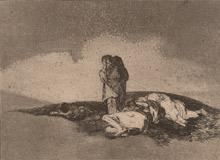 Job has lost all his wealth, his family and his health, because in this drama God has allowed Satan to remove all his good fortune in order to see if Job will then abandon his faith in God. We may object to this as slanderous to God, but of course all misfortune is permitted by God. It has become clear by this time in the drama that Job has not abandoned his faith but rather kept it in an awkward form: he refuses to abandon his faith in a just God and therefore insists that he must receive an answer to his anguished question: why has this happened to me?
It is not Job who abandons faith but his pious comforters who are ready to excuse the terrible misfortunes which have fallen on this good man and his family. Human beings, they think, should not have the impertinence to complain to their maker. Job insists that only a just God can rightly be honoured. Job even contrasts God’s behaviour with his own: he would never have added to a wretched man’s burdens but God has done so. So let God explain!
The drama is good therapy for timid Christians who peddle unsustainable pieties when unbelievers ask whether this world could have been created by a kindly God. “Job” suggests they should respect the rough questions of those who suffer so that they can examine their own experience. Do they simply believe in God because they are comfortable?
John 11:1-16
The Death of Lazarus
11Now a certain man was ill, Lazarus of Bethany, the village of Mary and her sister Martha. 2Mary was the one who anointed the Lord with perfume and wiped his feet with her hair; her brother Lazarus was ill. 3So the sisters sent a message to Jesus,* ‘Lord, he whom you love is ill.’ 4But when Jesus heard it, he said, ‘This illness does not lead to death; rather it is for God’s glory, so that the Son of God may be glorified through it.’ 5Accordingly, though Jesus loved Martha and her sister and Lazarus, 6after having heard that Lazarus* was ill, he stayed two days longer in the place where he was.
7 Then after this he said to the disciples, ‘Let us go to Judea again.’ 8The disciples said to him, ‘Rabbi, the Jews were just now trying to stone you, and are you going there again?’ 9Jesus answered, ‘Are there not twelve hours of daylight? Those who walk during the day do not stumble, because they see the light of this world. 10But those who walk at night stumble, because the light is not in them.’ 11After saying this, he told them, ‘Our friend Lazarus has fallen asleep, but I am going there to awaken him.’ 12The disciples said to him, ‘Lord, if he has fallen asleep, he will be all right.’ 13Jesus, however, had been speaking about his death, but they thought that he was referring merely to sleep. 14Then Jesus told them plainly, ‘Lazarus is dead. 15For your sake I am glad I was not there, so that you may believe. But let us go to him.’ 16Thomas, who was called the Twin,*said to his fellow-disciples, ‘Let us also go, that we may die with him.’

resurrection and life
I do not think this story is historical. Why? a) No-one can restore the truly dead to life; b) None of the other gospels has this episode, which presumably would have demanded inclusion if it had been known.
If it’s not history, what is it? I think it’s a narrative fantasia on the whole of Jesus’ life and death. Out of love for humanity he comes into a place of danger; there he declares himself as the giver of eternal life; and there he enters the place of death on behalf of humanity, so that he may summon it from death to life.
It’s part of John’s way of preaching the gospel, telling this story, which provides in context, an immediate reason for Jesus’ opponents to seek his death. Jesus suffers death because he liberates people from death.
A modern theologian would make his point about Jesus in discursive prose. Indeed John often does this by putting the required description in the mouth of Jesus himself; but his invented stories allow him scope to present profound truths about Jesus the Christ in a way that goes beyond theological concepts: he tells the reader that Jesus is resurrection and life but his story reveals this truth in action. Creative storytelling is still an important if often neglected means of communicating religious truth.
 Emmock's Blog