
This blog provides a meditation on the Episcopal daily readings along with a headline from world news:
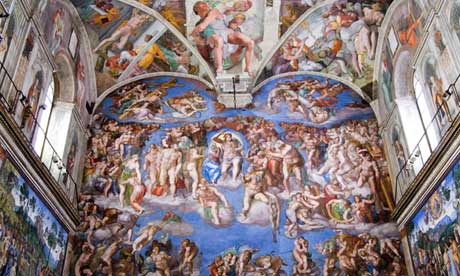
Sistine Chapel visitors a drunken herd, critic claims 
Acts 20:17-38
Paul Speaks to the Ephesian Elders
17 From Miletus he sent a message to Ephesus, asking the elders of the church to meet him.18When they came to him, he said to them:
‘You yourselves know how I lived among you the entire time from the first day that I set foot in Asia,19serving the Lord with all humility and with tears, enduring the trials that came to me through the plots of the Jews.20I did not shrink from doing anything helpful, proclaiming the message to you and teaching you publicly and from house to house,21as I testified to both Jews and Greeks about repentance towards God and faith towards our Lord Jesus.22And now, as a captive to the Spirit,* I am on my way to Jerusalem, not knowing what will happen to me there,23except that the Holy Spirit testifies to me in every city that imprisonment and persecutions are waiting for me.24But I do not count my life of any value to myself, if only I may finish my course and the ministry that I received from the Lord Jesus, to testify to the good news of God’s grace.
25 ‘And now I know that none of you, among whom I have gone about proclaiming the kingdom, will ever see my face again.26Therefore I declare to you this day that I am not responsible for the blood of any of you,27for I did not shrink from declaring to you the whole purpose of God.28Keep watch over yourselves and over all the flock, of which the Holy Spirit has made you overseers, to shepherd the church of God* that he obtained with the blood of his own Son.*29I know that after I have gone, savage wolves will come in among you, not sparing the flock.30Some even from your own group will come distorting the truth in order to entice the disciples to follow them.31Therefore be alert, remembering that for three years I did not cease night or day to warn everyone with tears.32And now I commend you to God and to the message of his grace, a message that is able to build you up and to give you the inheritance among all who are sanctified.33I coveted no one’s silver or gold or clothing.34You know for yourselves that I worked with my own hands to support myself and my companions.35In all this I have given you an example that by such work we must support the weak, remembering the words of the Lord Jesus, for he himself said, “It is more blessed to give than to receive.” ’
36 When he had finished speaking, he knelt down with them all and prayed.37There was much weeping among them all; they embraced Paul and kissed him,38grieving especially because of what he had said, that they would not see him again. Then they brought him to the ship.

The theatre at Ephesus nearby which Paul lectured
The Ephesian memory of Paul, who had lived amongst them for several years, and in my estimation been imprisoned in the Roman HQ in that city, is here used by Luke to give a warm picture of the relationship between the great apostle and the people of the church. The speech that Luke puts in Paul’s mouth has these elements:
1. He has preached the good news, the “evangelion”. This word had been taken early in Christian development from the prophecies of Isaiah where it refers to the message of God’s justice as being like the message of the herald who after battle brings good news of victory. This message or announcement of God’s victory in Jesus has been preached by Paul both publicly and privately.
2. He has been led by the Spirit which has assured hm that his calling as an apostle will lead to suffering.
3. The message and the community formed around it have been open to Jews and Gentiles.
4. The true gospel will be subject to attack and distortion. Believers should use his memory to defend the truth.
5. The gospel and the Christian life built upon it are founded in a generosity which begins with God: “it is more blesssed to give than to receive.”
Luke at all points reminds his readers that Christian faith is spread through contact between people, a contact unlimited by religious or racial barriers. Those who bear the good news are part of the generosity of Jesus Christ whose life is poured out for the world, encouraging trust in God, and practical goodness amonst people.
This is Luke’s theology and Luke’s vision of the Christian Church. There are other visions, not least Paul’s own, but churches modelled on the work of Luke will always maintain the connection between the ministry of the church and the ministry of Jesus.
Luke 5:1-11
Jesus Calls the First Disciples
5Once while Jesus* was standing beside the lake of Gennesaret, and the crowd was pressing in on him to hear the word of God,2he saw two boats there at the shore of the lake; the fishermen had gone out of them and were washing their nets.3He got into one of the boats, the one belonging to Simon, and asked him to put out a little way from the shore. Then he sat down and taught the crowds from the boat.4When he had finished speaking, he said to Simon, ‘Put out into the deep water and let down your nets for a catch.’5Simon answered, ‘Master, we have worked all night long but have caught nothing. Yet if you say so, I will let down the nets.’6When they had done this, they caught so many fish that their nets were beginning to break.7So they signalled to their partners in the other boat to come and help them. And they came and filled both boats, so that they began to sink.8But when Simon Peter saw it, he fell down at Jesus’ knees, saying, ‘Go away from me, Lord, for I am a sinful man!’9For he and all who were with him were amazed at the catch of fish that they had taken;10and so also were James and John, sons of Zebedee, who were partners with Simon. Then Jesus said to Simon, ‘Do not be afraid; from now on you will be catching people.’11When they had brought their boats to shore, they left everything and followed him. 
The story Luke tells, while including phrases from Mark’s version, also has elements which it shares with the post-resurrection story in John 21: namely the fact that the men have fished all night and caught nothing, but now in Jesus’ presence they make a huge catch; and also Peter’s words,”Depart from me for I am a sinful man,” seem more appropriate to a situation where he has gone wrong. Wherever Luke got these elements he would have understood the significance of the profitless night-fishing as an image of powerlessness in the face of evil and indifference. It is the presence of Jesus that makes the difference: NOW they will prosper as they catch people for the kingdom.
Luke’s assumption is that God rules the world by persuasion, catching people in the net of goodness, so that his will may be done on earth. Although miracles may happen, these are just signs of God’ goodness. For Luke God’s preferred method of salvation involves the long haul. Believers are a necessary part of God’s plan for which reason it might even fail, as witness Jesus’ question, “When the Son of Man comes, will he find faith on the earth? (Luke 18:8)
 Emmock's Blog