This blog provides a meditation on the Episcopal daily readings along with a headline from world news:
Great Barrier Reef loses more than half coral cover 

Acts 21:1-14
Paul’s Journey to Jerusalem
21When we had parted from them and set sail, we came by a straight course to Cos, and the next day to Rhodes, and from there to Patara.*2When we found a ship bound for Phoenicia, we went on board and set sail.3We came in sight of Cyprus; and leaving it on our left, we sailed to Syria and landed at Tyre, because the ship was to unload its cargo there.4We looked up the disciples and stayed there for seven days. Through the Spirit they told Paul not to go on to Jerusalem.5When our days there were ended, we left and proceeded on our journey; and all of them, with wives and children, escorted us outside the city. There we knelt down on the beach and prayed6and said farewell to one another. Then we went on board the ship, and they returned home.
7 When we had finished* the voyage from Tyre, we arrived at Ptolemais; and we greeted the believers* and stayed with them for one day.8The next day we left and came to Caesarea; and we went into the house of Philip the evangelist, one of the seven, and stayed with him.9He had four unmarried daughters* who had the gift of prophecy.10While we were staying there for several days, a prophet named Agabus came down from Judea.11He came to us and took Paul’s belt, bound his own feet and hands with it, and said, ‘Thus says the Holy Spirit, “This is the way the Jews in Jerusalem will bind the man who owns this belt and will hand him over to the Gentiles.” ’12When we heard this, we and the people there urged him not to go up to Jerusalem.13Then Paul answered, ‘What are you doing, weeping and breaking my heart? For I am ready not only to be bound but even to die in Jerusalem for the name of the Lord Jesus.’14Since he would not be persuaded, we remained silent except to say, ‘The Lord’s will be done.’
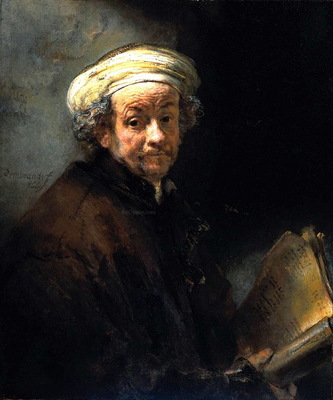
Rembrandt: self-portrait as St. Paul
Again Luke, the author, uses the convention of a diary narrative which doesn’t really claim the author’s personal presence at these events. My own chronology of Paul’s life deduced from his letters suggests that this final visit to Jerusalem was to deliver the “collection for the poor” to the church there. It was Paul’s proof that “his churches” were truly part of the Christian community, sharing their goods with their brothers and sisters. Luke doesn’t mention this purpose at this point. As the story stands his main aim is to highlight the obvious danger to Paul, the apostate pharsisee, in visiting Jerusalem and his own refusal to allow this to hinder his mission. “Binding and handing over to Gentiles” are of course what happened to Jesus but the words are used ironically as the whole of Paul’s mission has “bound him and handed him over to Gentiles.” In all things he is ready to share the life and death of Jesus. The author knows what the reader as yet doesn’t, namely, that Paul’s arrest in Jerusalem (the holy city of Judaism) will send him to Rome (the capital and holy city of the Empire). Alongside the wills of human beings another will is working. Luke intends his story of Paul’s identification with Jesus to be an example to his readers.
Luke 5:12-26
Jesus Cleanses a Leper
12 Once, when he was in one of the cities, there was a man covered with leprosy.* When he saw Jesus, he bowed with his face to the ground and begged him, ‘Lord, if you choose, you can make me clean.’13Then Jesus* stretched out his hand, touched him, and said, ‘I do choose. Be made clean.’ Immediately the leprosy* left him.14And he ordered him to tell no one. ‘Go’, he said, ‘and show yourself to the priest, and, as Moses commanded, make an offering for your cleansing, for a testimony to them.’15But now more than ever the word about Jesus* spread abroad; many crowds would gather to hear him and to be cured of their diseases.16But he would withdraw to deserted places and pray.
Jesus Heals a Paralytic
17 One day, while he was teaching, Pharisees and teachers of the law were sitting nearby (they had come from every village of Galilee and Judea and from Jerusalem); and the power of the Lord was with him to heal.*18Just then some men came, carrying a paralysed man on a bed. They were trying to bring him in and lay him before Jesus;*19but finding no way to bring him in because of the crowd, they went up on the roof and let him down with his bed through the tiles into the middle of the crowd* in front of Jesus.20When he saw their faith, he said, ‘Friend,* your sins are forgiven you.’21Then the scribes and the Pharisees began to question, ‘Who is this who is speaking blasphemies? Who can forgive sins but God alone?’22When Jesus perceived their questionings, he answered them, ‘Why do you raise such questions in your hearts?23Which is easier, to say, “Your sins are forgiven you”, or to say, “Stand up and walk”?24But so that you may know that the Son of Man has authority on earth to forgive sins’—he said to the one who was paralysed—‘I say to you, stand up and take your bed and go to your home.’25Immediately he stood up before them, took what he had been lying on, and went to his home, glorifying God.26Amazement seized all of them, and they glorified God and were filled with awe, saying, ‘We have seen strange things today.’
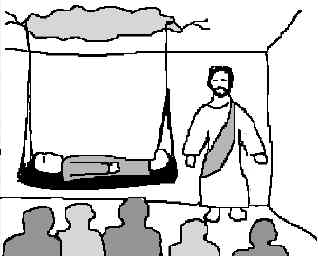
Child’s cartoon gets the humour in the story
Luke is following the gospel of Mark at this point. Mark depicts Jesus at war with evil spirits who cause disease and animate an ethic of exclusion through the pharisees. Luke wants the reader to feel that the goodness of God is available to heal the bodies and souls of human beings, but there’s a gap between its availability and its use, which must be crossed. The leper crosses it by ignoring the law against approaching healthy people and by declaring his trust in Jesus. Jesus crosses it by the movement of his hand, touching the leper. In the case of the paralysed man, his friends cross it by breaking into the house where Jesus is and Jesus crosses it both by his declaration of forgiveness and his command to walk. The pharisees are shown to protect and reinforce the gap: indeed their religious power rests on the fact that they are keepers of the gap between God and the people and can prescribe who, if any, shall be allowed to cross it. For the pharisees the proper observance of the Law gives access to the God who is hidden behind it; for Luke’s Jesus, God, the holy and compassionate one, is present in the law, challenging fixed interpretations of it, so that it conveys his true character. Faith means reaching out towards this challenging God.
 Emmock's Blog