
This blog provides a meditation on the Episcopal daily readings along with a headline from world news:
Ikea airbrushes women from Catalogue to please Saudis

now you see her, now you don’t…
Acts 21:15-26
15 After these days we got ready and started to go up to Jerusalem.16Some of the disciples from Caesarea also came along and brought us to the house of Mnason of Cyprus, an early disciple, with whom we were to stay.
Paul Visits James at Jerusalem
17 When we arrived in Jerusalem, the brothers welcomed us warmly.18The next day Paul went with us to visit James; and all the elders were present.19After greeting them, he related one by one the things that God had done among the Gentiles through his ministry.20When they heard it, they praised God. Then they said to him, ‘You see, brother, how many thousands of believers there are among the Jews, and they are all zealous for the law.21They have been told about you that you teach all the Jews living among the Gentiles to forsake Moses, and that you tell them not to circumcise their children or observe the customs.22What then is to be done? They will certainly hear that you have come.23So do what we tell you. We have four men who are under a vow.24Join these men, go through the rite of purification with them, and pay for the shaving of their heads. Thus all will know that there is nothing in what they have been told about you, but that you yourself observe and guard the law.25But as for the Gentiles who have become believers, we have sent a letter with our judgement that they should abstain from what has been sacrificed to idols and from blood and from what is strangled* and from fornication.’26Then Paul took the men, and the next day, having purified himself, he entered the temple with them, making public the completion of the days of purification when the sacrifice would be made for each of them.
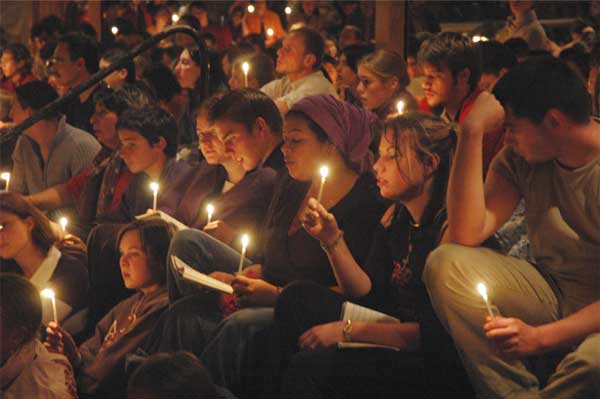
Taize ecumenical gathering of young people
Paul does write that for the sake of the gospel he has become all things to all people, a Jew amongst Jews, a gentile amongst Gentiles, so Luke’s account is possible. Throughout the book of Acts hoswever, Luke has underestimated the gulf expressed by Paul between his own view of the Torah, as something superseded by the Gospel, even indeed, as the instrument by which Messiah Jesus was brought to the cross; and the views of the Jerusalem believers. By the time Luke was writing, say 85-90 AD the specifics of Paul’s distinctive theology had been forgotten, or watered down, and a new multinational consensus, represented perhaps by the first three gospels , was emerging.
Luke 5:27-39
Jesus Calls Levi
27 After this he went out and saw a tax-collector named Levi, sitting at the tax booth; and he said to him, ‘Follow me.’28And he got up, left everything, and followed him.
29 Then Levi gave a great banquet for him in his house; and there was a large crowd of tax-collectors and others sitting at the table* with them.30The Pharisees and their scribes were complaining to his disciples, saying, ‘Why do you eat and drink with tax-collectors and sinners?’31Jesus answered, ‘Those who are well have no need of a physician, but those who are sick;32I have come to call not the righteous but sinners to repentance.’
The Question about Fasting
33 Then they said to him, ‘John’s disciples, like the disciples of the Pharisees, frequently fast and pray, but your disciples eat and drink.’34Jesus said to them, ‘You cannot make wedding-guests fast while the bridegroom is with them, can you?35The days will come when the bridegroom will be taken away from them, and then they will fast in those days.’36He also told them a parable: ‘No one tears a piece from a new garment and sews it on an old garment; otherwise the new will be torn, and the piece from the new will not match the old.37And no one puts new wine into old wineskins; otherwise the new wine will burst the skins and will be spilled, and the skins will be destroyed.38But new wine must be put into fresh wineskins.39And no one after drinking old wine desires new wine, but says, “The old is good.” ’
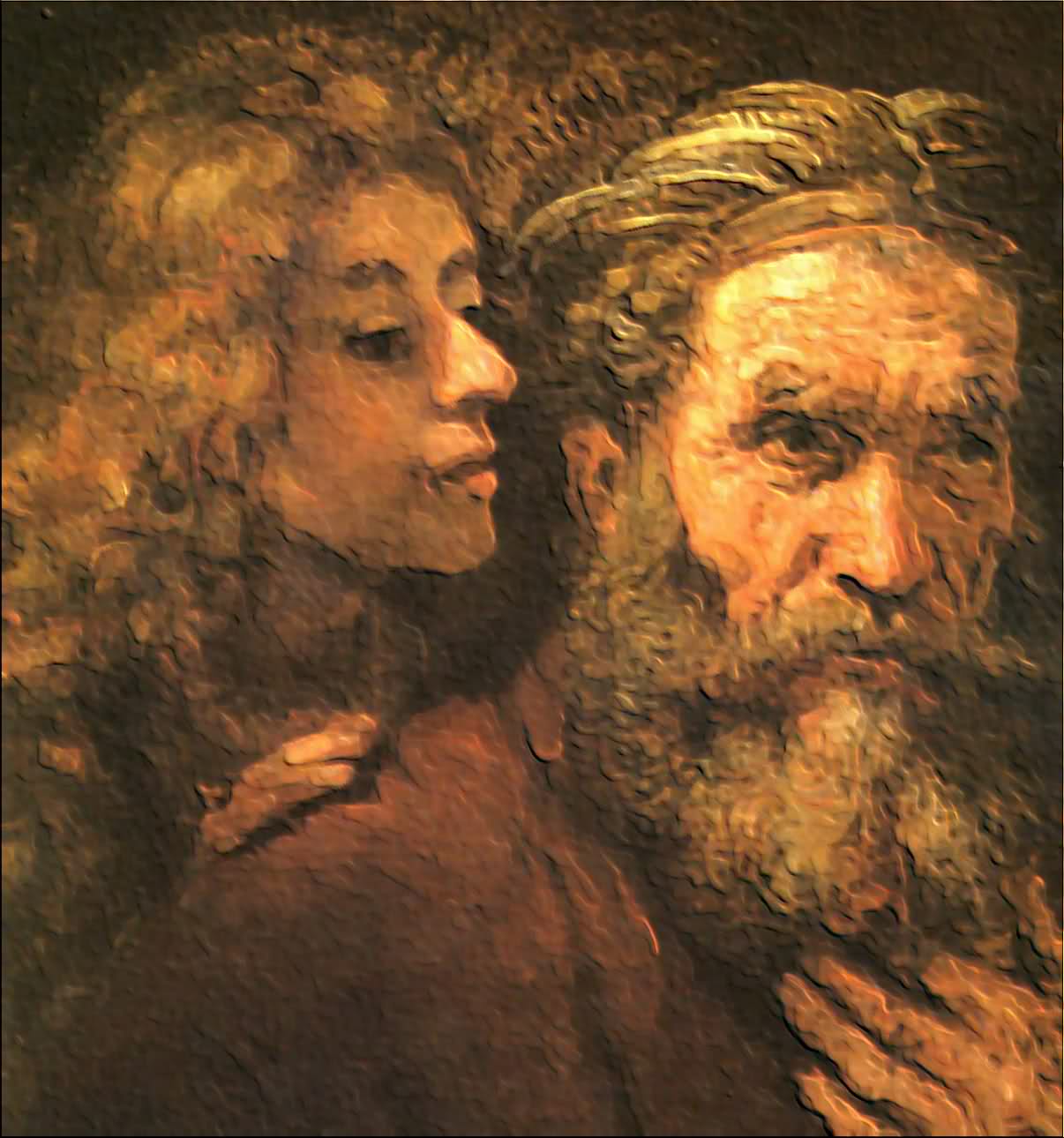
the Gospel writer composes but the angel whispers in his ear (Rembrandt: St. Matthew)
Luke is following the gospel of Mark here and his changes are instructive. Mark has Jesus say, “I have not come to call the righteous but sinners.” -which is a blunt, ironical and disturbing utterance. Luke edits this and adds the words “to repentance” which makes the whole thing more respectable: Jesus calls sinners-to repentance! What could be wrong or disturbing about that? The possibility that the Son of God was more readily loved by social outcasts, like Levi the collaborator, than by decent people; and that he didn’t immediately protect himself by demanding their repentance, is rejected, at least in this part of his gospel, by Luke. Jesus is a divine doctor, tending the sick.
Mark gives Jesus parable clearly enough: the old garment (the Torah) can’t be patched by new material (Jesus’ teaching); the new wine (Jesus’ teaching) can’t be put in old wineskins (Torah customs) or it will blow them to bits. There must be new communities and new customs (new wine skins) for the new wine. I invite the reader to look at what Luke has made of this and see if s/he can make any sense of it. Obviously there was something in the original that Luke didn’t like, but his meaning escapes me. Why would anyone ever patch an old cloak with a piece of a new one? See Mark’s version at Mark 2: 18-20. It seems to me that at this point Luke’s normally very skilled editing of Mark’s gospel breaks down and shows his hand at work. This is important because it lets us see the freedom with which the Gospel authors treated what we regard as holy scripture.
 Emmock's Blog