
This blog provides a meditation on the Episcopal daily readings along with a headline from world news:
Elderly Kenyans win right to bring case against British Government for torture 
The Acts 21: 37-22-13
37 Just as Paul was about to be brought into the barracks, he said to the tribune, ‘May I say something to you?’ The tribune* replied, ‘Do you know Greek?38Then you are not the Egyptian who recently stirred up a revolt and led the four thousand assassins out into the wilderness?’39Paul replied, ‘I am a Jew, from Tarsus in Cilicia, a citizen of an important city; I beg you, let me speak to the people.’40When he had given him permission, Paul stood on the steps and motioned to the people for silence; and when there was a great hush, he addressed them in the Hebrew* language, saying:
22‘Brothers and fathers, listen to the defence that I now make before you.’
2 When they heard him addressing them in Hebrew,* they became even more quiet. Then he said:
3 ‘I am a Jew, born in Tarsus in Cilicia, but brought up in this city at the feet of Gamaliel, educated strictly according to our ancestral law, being zealous for God, just as all of you are today.4I persecuted this Way up to the point of death by binding both men and women and putting them in prison,5as the high priest and the whole council of elders can testify about me. From them I also received letters to the brothers in Damascus, and I went there in order to bind those who were there and to bring them back to Jerusalem for punishment.
Paul Tells of His Conversion
6 ‘While I was on my way and approaching Damascus, about noon a great light from heaven suddenly shone about me.7I fell to the ground and heard a voice saying to me, “Saul, Saul, why are you persecuting me?”8I answered, “Who are you, Lord?” Then he said to me, “I am Jesus of Nazareth* whom you are persecuting.”9Now those who were with me saw the light but did not hear the voice of the one who was speaking to me.10I asked, “What am I to do, Lord?” The Lord said to me, “Get up and go to Damascus; there you will be told everything that has been assigned to you to do.”11Since I could not see because of the brightness of that light, those who were with me took my hand and led me to Damascus.
12 ‘A certain Ananias, who was a devout man according to the law and well spoken of by all the Jews living there,13came to me; and standing beside me, he said, “Brother Saul, regain your sight!” In that very hour I regained my sight and saw him.14Then he said, “The God of our ancestors has chosen you to know his will, to see the Righteous One and to hear his own voice;15for you will be his witness to all the world of what you have seen and heard.16And now why do you delay? Get up, be baptized, and have your sins washed away, calling on his name.”
 Paul defends himself before his own people in the only way he knows, by telling the story of his calling. The readers of The Acts have of course read it before, but Luke wants them to see that the Great Apostle remains always the one who persecuted the disciples and was turned from his violence by a vision of Jesus, calling him to let the Gentiles hear the Gospel.
 Luke 6:12-26
Jesus Chooses the Twelve Apostles
12 Now during those days he went out to the mountain to pray; and he spent the night in prayer to God.13And when day came, he called his disciples and chose twelve of them, whom he also named apostles:14Simon, whom he named Peter, and his brother Andrew, and James, and John, and Philip, and Bartholomew,15and Matthew, and Thomas, and James son of Alphaeus, and Simon, who was called the Zealot,16and Judas son of James, and Judas Iscariot, who became a traitor.
Jesus Teaches and Heals
17 He came down with them and stood on a level place, with a great crowd of his disciples and a great multitude of people from all Judea, Jerusalem, and the coast of Tyre and Sidon.18They had come to hear him and to be healed of their diseases; and those who were troubled with unclean spirits were cured.19And all in the crowd were trying to touch him, for power came out from him and healed all of them.
Blessings and Woes
20 Then he looked up at his disciples and said:
‘Blessed are you who are poor, for yours is the kingdom of God.
21 ‘Blessed are you who are hungry now, for you will be filled.
‘Blessed are you who weep now, for you will laugh.
22 ‘Blessed are you when people hate you, and when they exclude you, revile you, and defame you* on account of the Son of Man.23Rejoice on that day and leap for joy, for surely your reward is great in heaven; for that is what their ancestors did to the prophets.
24 ‘But woe to you who are rich, for you have received your consolation.
25 ‘Woe to you who are full now, for you will be hungry.
‘Woe to you who are laughing now, for you will mourn and weep.
26 ‘Woe to you when all speak well of you, for that is what their ancestors did to the false prophets. 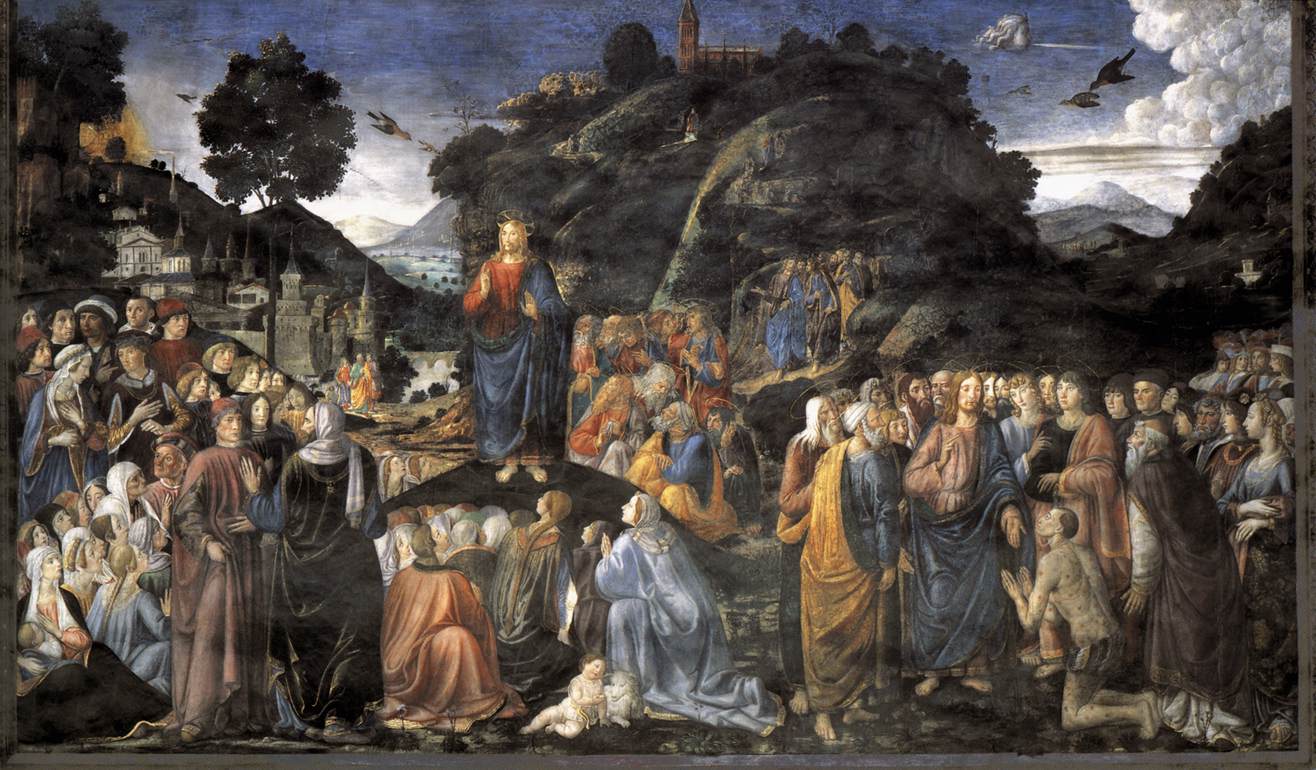
Matthew has Jesus go up a mountain like Moses to address his sermon to the people: he gives a new Torah. Luke has Jesus stand on the level plain and address his disciples whom after prayer he has called to be the Twelve who represent the new people of God. Like Matthew’s version (Matthew 5) Luke’s begins with blessings, but these are no general blessings. They are the Lord’s blessings on his own followers: the poor, the hungry and the sorrowful. The enemies of the gospel are rich, well-fed and happy. The blessings promise that in God’s time these conditions shall be reversed. In the time and place of God’s rule, the poor shall share the Lord’s rule, the hungry shall be fed, the sorrowful given joy, whereas the rich, well-fed and happy will be rejected. Luke sees the promise being fulfiulled in the life of the Christian community, ( Acts 2 ) whose shared life sees to it that hunger and poverty are abolished. Matthew’s gospel has a vertical dimension by which God’s rule breaks into the world from above, through the divine Son, Jesus. Luke’s gospel does not ignore the vertical dimension but supplements it with a horizontal dimension in which God’s rule spreads throughout the world by the ministry of Jesus continued in the community of disciples.
Could Jesus address many of his present day disciples as “poor”?
 Emmock's Blog